Product Reviews · 6 min read · 4 July 2026
The Best Portable Generator for UK Homes (2026): Petrol, Battery and Renter-Safe Picks
Nine out of ten UK households want backup power for the same four hours: fridge, boiler, router, phones. That job rarely needs petrol — and here is what it does need.
By the Nims Casa editorial team — written from professional cleaning experience and checked against our editorial standards.
Affiliate disclosure: if you buy through links in this article we may earn a small commission at no extra cost to you. Our recommendations come from professional cleaning experience and are never influenced by retailers or brands.
Ask ten UK households what they want backup power for and nine describe the same evening. The lights go, the router dies, the combi stops firing, and somebody starts hunting through drawers for candles. That job — four hours, a fridge-freezer, a boiler, a few phones — is a different problem from powering a site saw, and the kit that solves it looks nothing like the roaring open-frame machine most people picture.
Britain's grid is also unusually reliable: the typical customer loses supply for well under an hour across a whole year, and most cuts are restored inside 120 minutes. The honest starting point, then, is that most UK homes never financially recoup a petrol machine. What has changed since about 2022 is the battery power station — silent, safe indoors, and cheap enough now to earn its shelf space even if the power never goes off.
Our top picks at a glance
EcoFlow Delta 2 Portable Power Station
~£600–£750A 1,024Wh LiFePO4 battery with 1,800W of pure sine wave output and genuine UK 13A sockets, which covers a fridge-freezer, a combi boiler, lighting and devices for roughly six to nine hours. One of our contributors ran hers through a four-hour Cumbrian cut without touching the reserve.
Pros
- ✓ Silent and safe to use indoors, no fumes or fuel
- ✓ Recharges to 80% in about 50 minutes from a wall socket
- ✓ Expandable with a second battery if your needs grow
Cons
- ✗ Will not run a kettle, immersion heater or electric shower
- ✗ At 12kg it is portable but not casually so
Honda EU22i Inverter Generator
~£1,200–£1,500The unit our trade contributors keep buying after cheaper ones die, producing 1,800W continuous of clean inverter power at around 57dB. It is the one small generator we would trust with a boiler PCB without hesitation.
Pros
- ✓ Superb build quality and a dealer network in every UK county
- ✓ Quiet enough for a residential street in daylight
- ✓ Runs 4–8 hours on 3.6 litres depending on load
Cons
- ✗ Costs roughly double the nearest budget rival
- ✗ Still petrol: outdoors only, and fuel needs managing
Hyundai HY3200SEi Inverter Generator
~£650–£850A 3,200W peak, 2,800W continuous inverter unit with electric start, widely stocked in the UK with parts availability that budget imports cannot match. Manufacturer figures put it near 60dB; the contributor who runs one on site calls it noticeably louder than the Honda but tolerable.
Pros
- ✓ Handles a fridge surge and power tools comfortably
- ✓ Electric start and a decent UK spares supply
- ✓ Around half the price of the premium option
Cons
- ✗ Heavier at roughly 36kg
- ✗ Servicing intervals are less forgiving of neglect
Anker SOLIX C300 Portable Power Station
~£200–£300A 288Wh LiFePO4 unit weighing under 3kg that lives in a cupboard, charges from any socket and keeps a router, phones, lamps and a laptop going for a full evening. It is the sensible first purchase for anyone in a flat where petrol is not an option.
Pros
- ✓ Genuinely light and easy to store in a rented flat
- ✓ Pure sine wave output despite the price
- ✓ Nothing to install, nothing to make good on moving out
Cons
- ✗ Too small for a fridge-freezer overnight
- ✗ Fan is audible under heavy load
Who this is for — and who should skip it entirely
Backup power is worth buying when losing it costs you something specific. Vagueness is what leads people to spend £900 on a machine that sits in the shed until the petrol turns to varnish.
- •Battery power station: flats and terraces, fridge-freezer and boiler covered for a few hours, or camping and outdoor work.
- •Petrol inverter generator: rural properties on overhead lines where multi-day storm cuts are a real memory, or 2kW+ for tools off-grid.
- •Neither, if your only worry is the freezer. A full freezer, kept shut, holds food safely for around 24 hours — read our power outage checklist first.
- •Something permanent, if anyone in the house depends on powered medical equipment. Get on your network operator's free Priority Services Register and talk to an electrician.
How we judged this — and what we are not claiming
We have not run every unit through twelve months of lab cycling, and any site claiming otherwise is usually reprinting a spec sheet. This shortlist rests on three things: line-by-line verification against current UK retail listings and manuals; hands-on use by our contributors, two of whom run inverter generators on trade sites and one who took a 1kWh battery through a four-hour cut in Cumbria last winter; and the elimination of anything sold without a UK service network or proper BS1363 sockets. Where a figure is the manufacturer's rather than ours, we say so. Prices are mid-2026 street prices — generators discount hard in summer and creep back up after the first named storm.
Size it before you look at a single price
Almost every bad purchase here starts with guessing. Add up what you intend to run, in watts, and remember motors surge on start-up to three or six times their running figure. A generator that trips when the fridge compressor kicks in is worse than no generator. For the full method, including surge maths, work through our guide to sizing a home generator.
- •Fridge-freezer: 90–200W running, 600–1,200W surge. The load most people actually want covered.
- •Gas combi boiler, pump and controls: 100–250W. Cheap, and it keeps the house habitable in February.
- •Router, phones, laptop and a couple of LED lamps: 80–150W combined.
- •Kettle: 2,800–3,000W. Oil-filled radiator: 1,500–2,500W. Neither runs on a 1kWh power station — stop planning around them.
- •Realistic target: 800W continuous covers the first three lines with headroom — a small battery or the smallest inverter generator, not a 5kW monster.
The specs that actually matter in a UK home
Marketing leans on peak watts and app features. What decides whether a unit is useful at 11pm in a power cut is duller, and buried three screens down the listing.
- •Pure sine wave output, non-negotiable. Modified sine wave confuses boiler PCBs and can damage a CPAP machine or a modern fridge inverter board.
- •Neutral-earth bonding. Many small generators leave the neutral floating, and a boiler may then refuse to fire or throw an earth fault. Check the manual before buying, not on the night.
- •Noise in dB at 7 metres. Inverter generators sit at 48–60dB, open-frame builder's units at 68–75dB. Run the latter in a terraced street after 11pm and you invite a council abatement notice.
- •LiFePO4 cells, not older lithium: 3,000–4,000 cycles to 80% capacity versus 500–800 — ten years against three.
- •Genuine 13A BS1363 sockets. Grey imports with EU sockets and a bundled adaptor are a fire risk and a warranty dead end.
- •Weight you will really carry: a 2kWh battery is 20–25kg, a 3.2kW petrol unit 35–45kg. Both are two-person lifts up stairs.
The renter-safe setup: backup power that never touches your deposit
Everything the generator forums recommend — a changeover switch, a commando inlet, a fuel store in the garage — is either landlord's-consent territory or flatly off the table in a tenancy. The battery route is inherently reversible. The rule is the one that governs rental-friendly decor: nothing screwed, drilled, wired or stored that you cannot undo in ten minutes on your last morning.
- •Battery only. Do not store petrol in a flat, on a balcony or in a communal cupboard — most tenancies and virtually every leasehold ban it, and building insurance follows suit.
- •No fixed wiring. A generator inlet or changeover switch is notifiable under Part P and needs written consent plus a certificate; budget £450–£900 if you own the place, and check what an electrician costs first.
- •Plug-and-play only: it lives on a shelf or in a wardrobe, charges from an ordinary 13A socket, and feeds appliances through its own outlets.
- •Route cables with removable adhesive clips, not staples or clips nailed into skirting. They peel off cleanly with warmth from a hairdryer.
- •Store at 60–80% charge, top up every three months, and charge off-peak if your tariff allows — roughly 20–30p a full cycle.
- •It moves with you. A £600 battery follows you through four tenancies; £600 of fixed kit is a gift to the landlord.
Mistakes that cost money — and the two that cost lives
The dangerous two first. Never backfeed: plugging a generator into a wall socket through a double-ended 'suicide lead' can push mains voltage back down the street and kill the engineer on the line, and it bypasses every protective device in the house. Feeding the property circuits means a changeover switch fitted by a qualified electrician, or nothing.
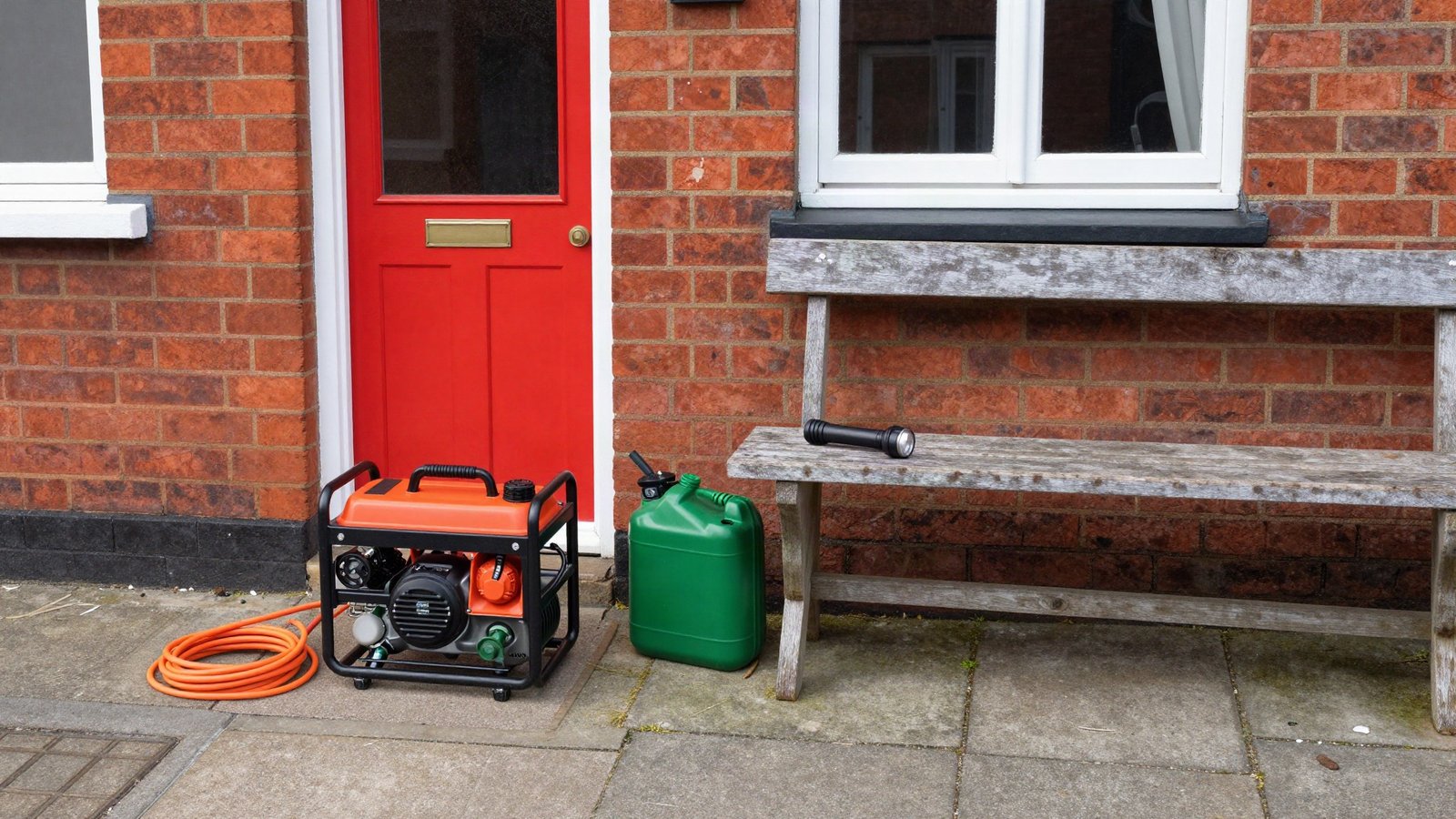
And never run petrol indoors — not in a garage with the door open, not a porch, not a conservatory, not under a lean-to. Carbon monoxide is odourless, and a small generator makes more of it in an hour than a car. Five metres clear of any window, door or air brick, downwind, always.
- •Buying on peak watts. A '3,500W' generator running continuously at 2,800W is the honest number; the peak lasts seconds.
- •Leaving E10 petrol in the tank. It absorbs water and goes off in about three months, gumming carburettor jets solid. Use super unleaded with a stabiliser, or alkylate fuel at £25–£30 for five litres.
- •Forgetting the running cost: 0.8–1.2 litres an hour at half load, so £1.30–£1.90 per hour, or roughly £20 across a long storm cut.
- •Expecting solar to rescue you in winter. A 200W folding panel gives maybe 0.8kWh on a bright June day and under 0.2kWh in December — a bonus, not a plan.
- •Choosing portable when you needed permanent. Our portable versus standby comparison and the home battery backup guide cover the crossover point.
Found this useful?
There's plenty more — hundreds of guides and honestly-tested product reviews for every corner of your home.
Browse All Guides