Product Reviews · 6 min read · 3 July 2026
The Best Home Battery Backup UK (2026): Picks That Actually Fit an Older House
Most battery reviews assume a double garage and a 2015 consumer unit. Here is what actually works when the walls are lime-plastered lath and the fuse board still has rewireable carriers.
By the Nims Casa editorial team — written from professional cleaning experience and checked against our editorial standards.
Affiliate disclosure: if you buy through links in this article we may earn a small commission at no extra cost to you. Our recommendations come from professional cleaning experience and are never influenced by retailers or brands.
Storm Arwen left roughly a million UK homes without power in November 2021, and several thousand were still off a week later. That is the event most people are buying against, but it is not what most batteries are sold for. The bulk of the market is arbitrage kit — charge at 7p on an off-peak tariff, discharge at 26p in the evening, save £350 to £600 a year. Backup is a secondary function, and on plenty of units it is a single socket rated at 3 kW.
The gap widens once your house predates 1930. Installers quote a fixed price assuming a wall that will take an expansion bolt, an integral garage and a consumer unit fitted this century. In a Victorian terrace with lath-and-plaster partitions, a damp cellar and a PME earth, none of that holds, and the install cost moves by £1,500 before anyone touches the battery.
Our top picks at a glance
GivEnergy All in One 13.5 kWh
~£5,500–7,000 installedA floor-standing unit with the inverter, battery and backup gear in one IP65 cabinet, which removes the wall-fixing problem in a period house entirely. Support is UK-based out of Stoke-on-Trent, and the firmware has matured well over several winters.
Pros
- ✓ Floor-standing at 145 kg — no lath-and-plaster or lime mortar fixing headaches
- ✓ Whole-home backup capability with a fast changeover, not just a single EPS socket
- ✓ 12-year warranty with 80% retained capacity, and genuinely reachable UK technical support
Cons
- ✗ Physically large — you need roughly 700 x 400 mm of clear floor plus service clearance
- ✗ Backup changeover still requires a separate backed-up board, which is rarely in the headline price
Tesla Powerwall 3
~£8,500–10,500 installedThe most polished whole-home backup experience on the UK market, with a high continuous output that will actually carry an induction hob or an electric shower. You pay a clear premium for that headroom and for the app.
Pros
- ✓ High continuous backup output — comfortably runs heavy circuits, not just essentials
- ✓ Sub-second changeover; most households never notice the transition
- ✓ Integrated solar inverter reduces the total box count on the wall
Cons
- ✗ Wall-mounted and heavy, which is a real constraint in timber-framed or lath-and-plaster walls
- ✗ Ecosystem is closed, and the price premium over UK-assembled rivals is substantial
EcoFlow Delta Pro 3
~£2,200–2,800A 4 kWh plug-in power station that needs no DNO notification, no earth rod and no electrician, which makes it the pragmatic choice for a listed building or a rental. It is backup only — there is no meaningful tariff arbitrage.
Pros
- ✓ Zero installation and no grid paperwork; wheel it in and plug it in
- ✓ 3.6 kW output runs a fridge-freezer, boiler, router and lighting for two to three days
- ✓ Expandable with extra battery packs, and it moves house with you
Cons
- ✗ You have to run extension leads to whatever you want powered — nothing is hard-wired
- ✗ Capacity per pound is poor against a fixed system, and it will not cut your bills
Fogstar Energy 15.5 kWh Rack Battery
~£3,800–5,200 installedPaired with a Sunsynk or Solis hybrid inverter, this UK-supplied rack battery undercuts the branded all-in-ones by a wide margin per usable kilowatt-hour. It expects a competent installer who is comfortable specifying components rather than fitting a kit.
Pros
- ✓ Lowest cost per usable kWh of anything we would actually put in a customer's house
- ✓ Modular rack format fits a cupboard or outbuilding better than a single tall cabinet
- ✓ Open protocols — it works with several mainstream hybrid inverters
Cons
- ✗ Multi-vendor system means warranty claims can bounce between battery and inverter suppliers
- ✗ Backup wiring is entirely down to your installer's design; nothing is preconfigured
Who a home battery is genuinely for
Three groups get real value. Households on a time-of-use tariff with a heat pump, an EV or an electric shower, where the off-peak window is worth filling. Households on rural overhead lines that lose supply more than once a winter. And households with solar exporting most of their generation for 4 to 15p and buying it back at 26p.
If your annual consumption is under about 2,500 kWh and you are on a flat rate, the arithmetic rarely works. A £6,000 installed system saving £380 a year pays back in roughly 16 years against a 10-year warranty. Read that number honestly before you sign, and do not let an installer model a full cycle every day of the year — 300 to 330 annually is a fair assumption, not 365.
How we judge them, and what we have not done
We are installers and building surveyors, not a laboratory. These picks come from install experience across UK housing stock, manufacturer datasheets, warranty terms read in full, and owner reports over multiple winters. We have not run controlled cycle-life testing, and anyone claiming to have done so on a 10-year product after 18 months is guessing.
- •Usable capacity, not nameplate — a 13.5 kWh battery with 90% depth of discharge gives you 12.1 kWh.
- •Backup behaviour: does it offer a single EPS socket, a backed-up sub-board, or true whole-house changeover, and how fast does it switch?
- •Warranty in writing: cycles, retained capacity at year 10 (60% is poor, 70% is standard, 80% is good), and whether labour is included.
- •Physical reality: weight, floor-standing versus wall-hung, operating temperature range, IP rating and depth once the cover is on.
- •Company stability. A cloud-dependent battery from a firm that folds becomes a very heavy cupboard.
Siting a battery in a period property
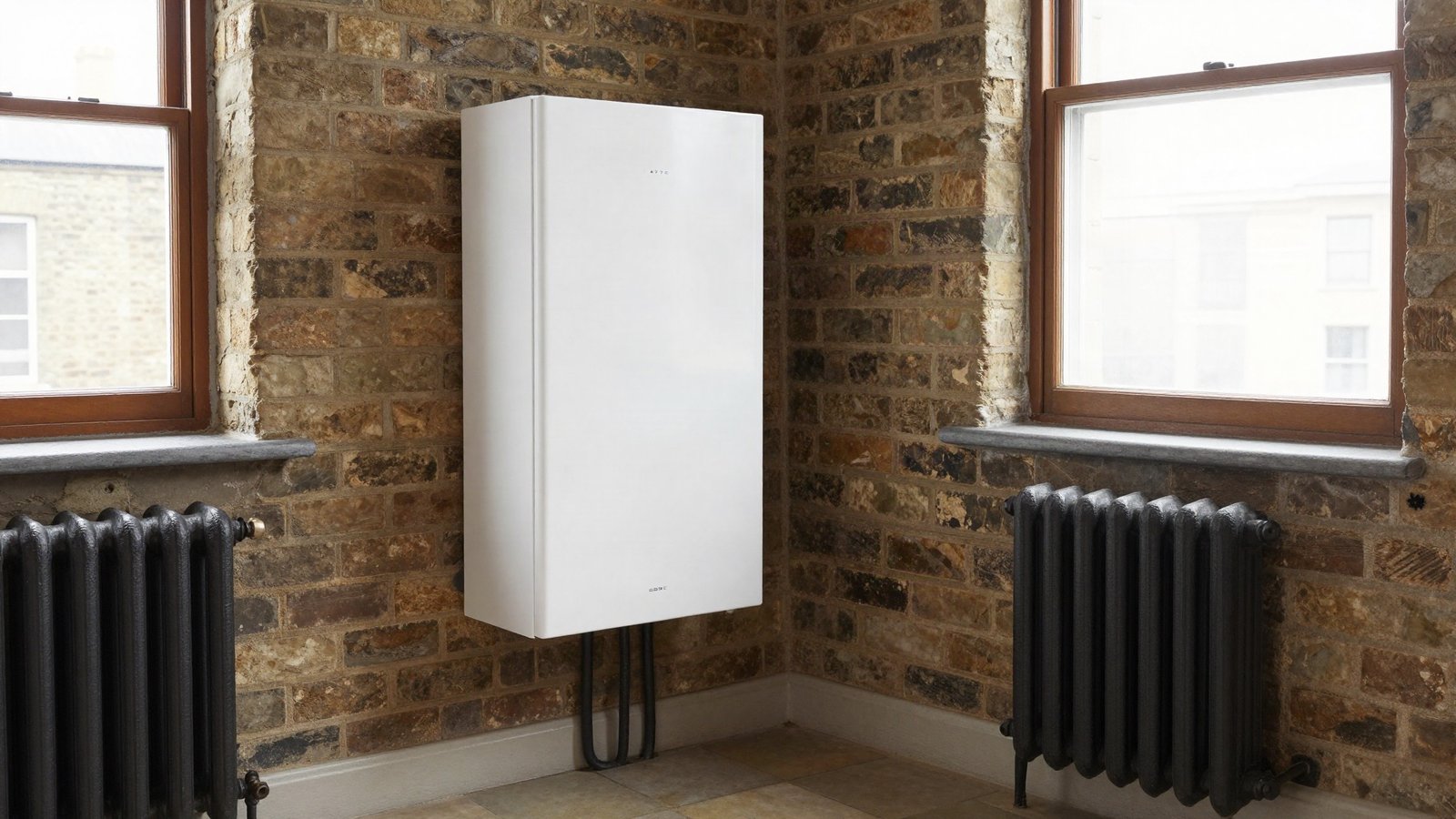
This is where most quotes fall apart. A Powerwall-class wall-mounted unit weighs 110 to 145 kg. Lath and plaster on 100 mm studs at 400 mm centres will not carry that, nor will a partition built from reclaimed timber in 1890. You are either fixing into solid brickwork or going floor-standing, and floor-standing is usually cheaper.
Solid Victorian brick brings its own problem. Soft red stock brick bedded in lime mortar crumbles under a sleeve anchor — use chemical resin anchors into the brick body, never the perpends, and never expansion bolts. The lime mortar versus cement question stops being academic when you are hanging 130 kg on it.
Cellars look tempting and often are not. A typical unheated Victorian cellar sits at 6 to 10°C in February with humidity above 75%, and LFP cells lose usable capacity below about 5°C — many refuse to charge at 0°C. Condensation on cold terminals is the bigger risk; dehumidify first if it is your only option. Lofts are worse: original 100 x 50 mm ceiling joists spanning 3.6 m were never designed for a point load, and PAS 63100:2024 discourages siting batteries where a fire would block the only escape route. An attached garage, an outbuilding or a ground-floor utility with masonry behind it is the sensible answer.
Wiring, earthing and the pre-1970s consumer unit
No installer will connect a hybrid inverter to a rewireable fuse board with a wooden back. If you have rubber or lead-sheathed cable, or lighting circuits with no protective conductor, that work comes first — budget £2,800 to £5,500 for a full rewire on a three-bed terrace, or £550 to £900 for a consumer unit upgrade if the cabling tests sound.
The detail that surprises people is earthing. Most urban homes have a PME (TN-C-S) supply, and PME earthing cannot be relied upon when the battery is running the house islanded from the grid. That means an earth electrode — a rod driven to a stable resistance, plus the switching arrangement. On a terrace with no front garden and a concreted rear garden, finding somewhere to drive a rod is a real site problem, and it adds £250 to £450.
Grid connection is paperwork, not optional. Up to 3.68 kW per phase is notified to the DNO under G98 after commissioning; larger systems need G99 approval before install, which can take 45 working days. Your installer should be MCS-registered and handle both. Before you commit, work out your actual electrical load so the inverter is sized around what you run, not the biggest number on the brochure.
What a battery will and will not run in an outage
Essentials are cheap. A fridge-freezer draws 1 to 1.5 kWh a day, a gas combi boiler and its pump about 150 W, a router 10 W, LED lighting 40 to 60 W. That is roughly 2 kWh a day, so 12 kWh of usable storage runs the important half of a house for five days. Getting the boiler onto the backup circuit is the most valuable thing you can ask for, and it means moving it onto a fused spur from the backed-up board.
What it will not do is heat a solid-walled house electrically. A 9-inch solid brick wall runs around 2.0 W/m²K against 0.28 for a modern cavity, so a 3 kW fan heater loses the fight in a Victorian front room with sash windows. Spend £150 on draught-proofing before £6,000 on storage — it pays every winter, not just the ones with a power cut. Keep our power outage checklist somewhere you can find it in the dark.
Common buying mistakes
Almost every regret we hear falls into one of these.
- •Buying capacity instead of power. A 20 kWh battery with a 3.6 kW inverter cannot run an oven and a shower at once, whatever the app says.
- •Assuming backup is included. Plenty of installs are commissioned with the EPS output unwired because it needed a second board and nobody priced it.
- •Ignoring the depth of the unit. A 200 mm-deep battery in a 750 mm hallway narrows the only escape route in a two-up two-down.
- •Accepting a single quote. Installed prices for identical kit vary by £2,000 across three local MCS firms — get all three, itemised, in writing.
- •Forgetting the future. If an EV is coming, size the inverter now; retrofitting later alongside an EV charger install costs more than doing both together.
Found this useful?
There's plenty more — hundreds of guides and honestly-tested product reviews for every corner of your home.
Browse All Guides