Product Reviews · 6 min read · 21 April 2026
The Best Pressure Washer UK (2026): Patios, Drives and a Renter-Safe Pick
A patio that looks past saving usually isn't. Here are the machines worth buying in 2026, the spec that actually decides how fast you finish, and how to do it all without touching your deposit.
By the Nims Casa editorial team — written from professional cleaning experience and checked against our editorial standards.
Affiliate disclosure: if you buy through links in this article we may earn a small commission at no extra cost to you. Our recommendations come from professional cleaning experience and are never influenced by retailers or brands.
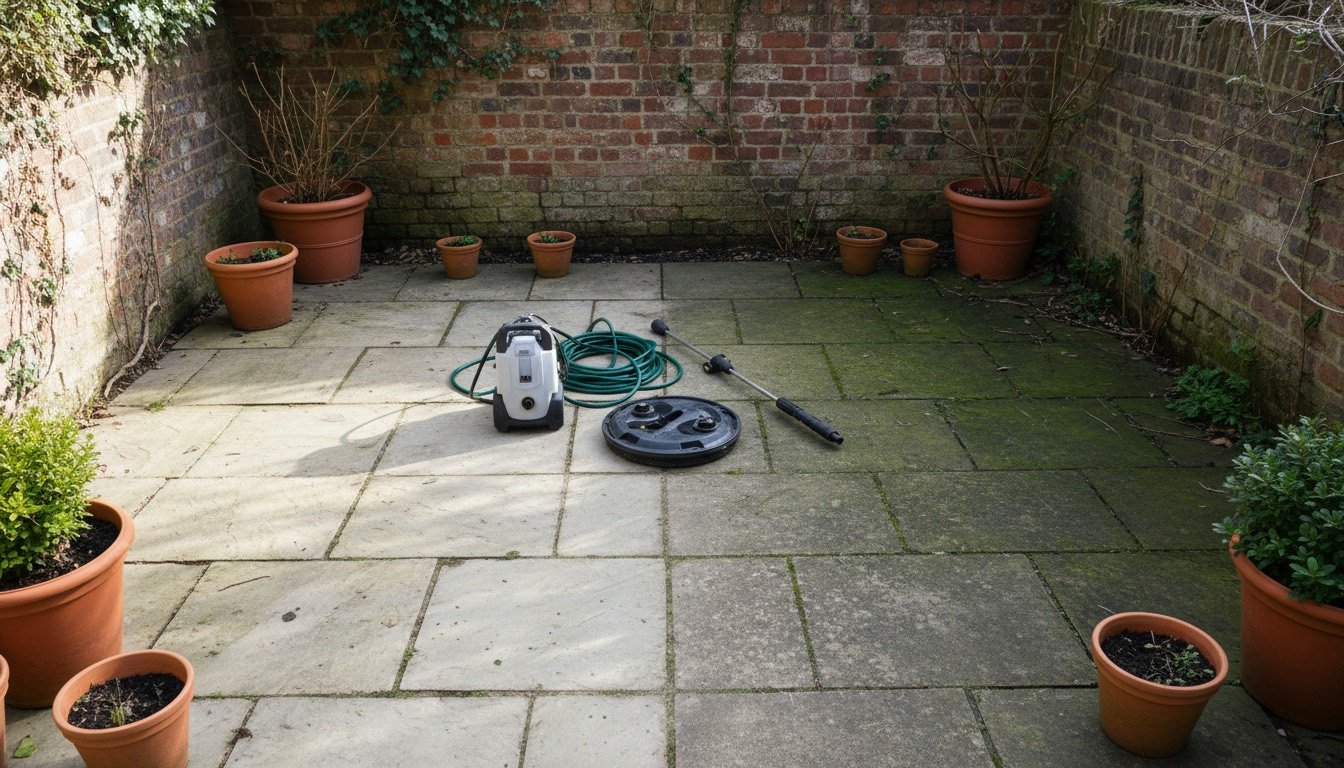
Two hours with a decent machine and a surface cleaner attachment will take a green, slippery sandstone terrace back to something you would put a table on. The same two hours with the wrong nozzle blasts the jointing sand out of block paving, leaves tiger stripes across the slabs and hands you a weed problem by August.
The gap between a £90 machine and a £450 one is almost never the headline pressure on the box. It is flow rate, motor type, and whether the thing still starts after its third winter in a damp shed. Below are the machines we would spend our own money on, and — because plenty of people asking this are renting — how to clean a garden without putting a deposit near the line.
Our top picks at a glance
Kärcher K5 Premium Smart Control Home
~£300-330A water-cooled induction motor, around 500 l/h of flow and a built-in hose reel make this the machine most UK gardens actually need. The app-based pressure presets sound like a gimmick until you use the decking setting and stop guessing.
Pros
- ✓ Induction motor is markedly quieter and rated for far longer service than universal-motor rivals
- ✓ Flow rate clears a 40 sq m patio in around two hours with the surface cleaner fitted
- ✓ 10m hose on a reel, plus a plug-in detergent bottle that lifts out for rinsing
- ✓ Warranty extends beyond the standard two years if you register the machine promptly
Cons
- ✗ At roughly 15kg with the reel it is not a machine you carry upstairs
- ✗ The bundled surface cleaner is the smaller head; a larger one is better on big terraces
- ✗ Needs a decent mains supply, and weak outside taps will make the pump pulse
Nilfisk Core 140 PowerControl Home & Car
~£150-180The one to buy if the machine comes out four or five times a year rather than four or five times a month. Roughly 470 l/h is enough for a normal patio and plenty for a car, and it weighs little enough to carry one-handed.
Pros
- ✓ Genuinely capable flow rate for the money
- ✓ Light and compact, so it stores in a small shed or under the stairs
- ✓ Pressure adjustment sits on the lance rather than buried in a menu
- ✓ Bundled patio head and car brush cover the two jobs most owners have
Cons
- ✗ Universal motor: noisier and shorter-lived than an induction unit
- ✗ 8m hose with no reel means more dragging and more kinks
- ✗ Plastic quick-connects are the first thing to wear on hard-used examples
Worx Hydroshot WG629E 20V Cordless
~£90-120Not a patio resurfacer, and it does not pretend to be. What it does is draw water from a bucket or water butt with no outside tap and no mains lead, which makes it the only realistic option for a lot of tenants.
Pros
- ✓ Self-primes from a bucket or water butt via the supplied suction hose
- ✓ Low enough pressure that it will not strip jointing sand, pointing or decking fibres
- ✓ Excellent on bikes, bins, muddy boots, garden furniture and wheel arches
- ✓ Packs into a box that fits in a hall cupboard
Cons
- ✗ Around 22 bar: it maintains a clean patio rather than rescuing a green one
- ✗ Battery gives roughly 10 to 15 minutes of continuous trigger time
- ✗ You get through buckets fast; a 100-litre water butt makes it far more usable
Kärcher K7 Premium Smart Control
~£450-520Roughly 180 bar and 600 l/h, with a proper water-cooled induction motor built for sustained work. Overkill for a courtyard, but the right call for a long block-paved drive that takes a full day with anything smaller.
Pros
- ✓ Highest flow rate here, so it covers large areas noticeably faster
- ✓ Water-cooled induction motor stays cool and quiet through long sessions
- ✓ Sturdy reinforced lance and a full-size hose reel
- ✓ Drives a large surface cleaner without the head losing rotation speed
Cons
- ✗ Around 18kg: heavy to move and it demands frost-free storage
- ✗ Genuinely needs a strong mains supply, so check your tap flow before ordering
- ✗ Easy to do damage with, as the extra power is unforgiving on soft brick and old pointing
Who Actually Needs One
A pressure washer earns its keep when you have area to cover and a surface that can take it. Under roughly 20 square metres, a stiff deck brush and a sodium-percarbonate patio cleaner get you 80 per cent of the result for £12 — the honest advice in our guide to cleaning a patio properly.
- •Worth buying: 25 sq m or more of patio, block paving or concrete drive; a car washed more than monthly; timber or composite decking that greens up each winter.
- •Borderline: a small courtyard or a couple of paths. Hire instead, at £30 to £45 a day.
- •Skip it: gardens that are all lawn and border, and anyone whose real problem is roof moss — a soft wash job for someone insured to be up there, never a lance.
How We Judge These Machines
Be clear about what this is. Nims Casa does not run a laboratory. These picks come from years of using domestic machines on end-of-tenancy and exterior work across UK housing stock — soft red brick terraces, 1930s crazy paving, new-build block drives — plus published specifications, UK warranty terms as sold in 2026, and the failure patterns we see when machines come back dead.
We weight water throughput over peak bar, then motor type and service life, hose length, and what the warranty covers once a machine leaves a domestic garden. Prices are typical UK street prices in spring 2026; treat them as bands, not quotes.
The Picks, in Short
Four machines, four jobs. Full pros and cons are below; this is who each one is for.
Whichever you choose, buy the surface cleaner attachment with it. That flat spinning disc on a skirt turns patio cleaning from a day of striping into two hours of even, boring, satisfying work.
- •Kärcher K5 Premium Smart Control Home — the sensible middle. Induction motor, enough flow for a 40 sq m terrace, quiet enough for a Sunday morning.
- •Nilfisk Core 140 PowerControl Home & Car — the value pick, for a machine used four or five times a year, not a month.
- •Worx Hydroshot WG629E — the renter's answer: cordless, self-priming from a bucket or water butt.
- •Kärcher K7 Premium Smart Control — for long block drives, if your tap can feed it.
The Specs That Actually Matter
Pressure gets printed on the carton and it is the least useful figure there. Bar tells you how hard the water hits; litres per hour tells you how much dirt leaves the surface per minute. On a green patio, flow does the work — a 145 bar machine pushing 500 l/h finishes faster than a 165 bar machine pushing 380 l/h, every time.
Motor type is the other line worth reading. Universal motors are light, cheap and loud, typically 92 to 97 dB, and built for perhaps 50 hours of use. Induction motors are heavier, quieter, cooler-running, and comfortably do ten times that.
- •Flow: 400 l/h is adequate, 500 l/h comfortable, 600 l/h needs a strong mains supply.
- •Test your tap first — time filling a 10-litre bucket. Under 60 seconds feeds almost anything; over 90 and a big machine will cavitate and eventually kill its own pump.
- •Hose: 8m is the practical minimum. Ten to twelve metres on a reel stops you dragging the unit through wet moss and over the garden furniture.
- •Nozzles: a 25-degree fan is your default. The rotary turbo belongs on concrete and nothing else.
- •Warranty: two years standard, often three to five if you register within 28 days.
The Renter-Safe Version: Clean the Garden, Keep the Deposit
Tenants get caught out in a specific way. Cleaning a garden is almost always allowed and often expected; altering it is not. A pressure washer sits between the two, because one careless afternoon strips kiln-dried sand out of paving joints, washes out pointing, furs up softwood decking or lifts stain off a fence. All of that reads as damage at check-out, and all of it is avoidable.
The reversible approach: no permanent change, nothing removed you cannot put back, and dated photos of the joints, decking and render before you start — the same discipline that protects you elsewhere in a rented home, as in our guide to rental-friendly decor.
- •No outside tap? A self-priming cordless unit fed from a bucket or water butt is the only category that works from a flat with a shared garden.
- •Stay off the joints: hold the lance 30 to 40cm back on block paving, angle across joints rather than into them, and never use the turbo nozzle. If sand lifts, top it up with kiln-dried sand at about £8 a bag.
- •Decking: 60 to 80 bar maximum, fan nozzle, along the grain. Above that you raise the fibres and the boards go rough, the failure covered in our decking guide.
- •Leave alone entirely: render and external wall insulation, lime-mortared brick, roof tiles, tarmac drives and uPVC window seals.
- •Communal areas in a leasehold block belong to the managing agent — ask in writing first.
- •Keep to 08:00 to 20:00 and warn next door if their washing is out. A noise complaint reaches your landlord.
- •Six months left on the tenancy? Hire rather than buy.
Buying Mistakes We See Every Season
Most pressure washer regret is bought rather than caused. One point that is not a spec at all: pressure washing is a hosepipe activity. During a Temporary Use Ban, most UK water companies restrict cleaning paths and patios with a hosepipe, and a mains-fed machine counts.
- •Buying on bar. A 180 bar badge on a 350 l/h pump is marketing. Read the litres.
- •Skipping the surface cleaner. It costs £45 to £90 and halves the job. Buy it with the machine, not after you have ruined a patio.
- •Choosing petrol for a domestic garden. Electric is quieter, lighter and needs no servicing.
- •Ignoring the tap. Feeding a 600 l/h machine from a 400 l/h supply kills pumps in a manner the warranty will not cover.
- •Storing it wet through a British winter. Drain the pump and keep it above freezing; split pump heads are the commonest March failure we see.
- •Turning the lance on your guttering because the machine is out. Forcing water under a joint or into a soffit puts it exactly where you do not want it — use the scoop method in our gutter cleaning guide.
Found this useful?
There's plenty more — hundreds of guides and honestly-tested product reviews for every corner of your home.
Browse All Guides