Product Reviews · 6 min read · 22 April 2026
The Best Robotic Pool Cleaner UK (2026): Honest Picks and the Wiring You Must Not DIY
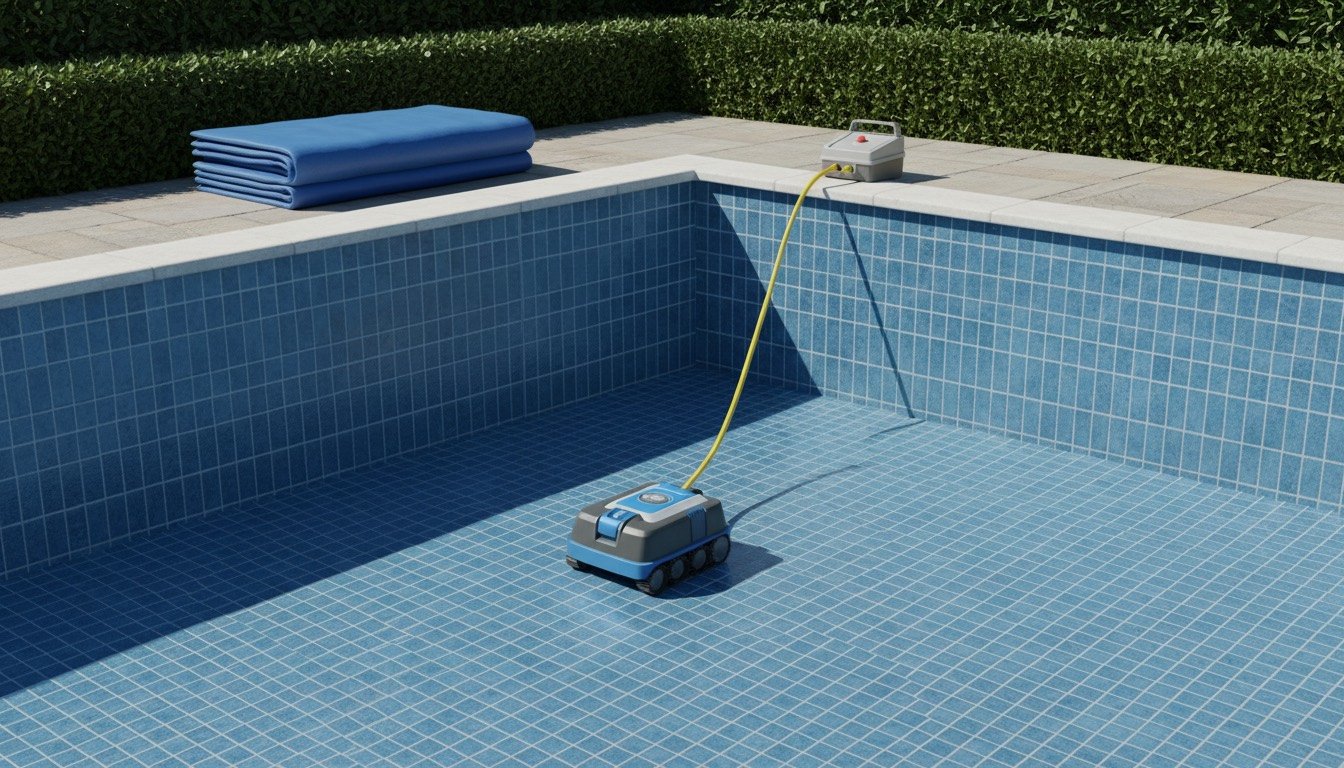
British pools get swum in for four months and cleaned for twelve. Here is what actually earns its keep in that gap, and the one part of the job that is never a DIY decision.
By the Nims Casa editorial team — written from professional cleaning experience and checked against our editorial standards.
Affiliate disclosure: if you buy through links in this article we may earn a small commission at no extra cost to you. Our recommendations come from professional cleaning experience and are never influenced by retailers or brands.
Most British pools get swum in for about four months and need cleaning for twelve. That mismatch — a cold, covered, leaf-strewn pool from October through April — is the real job, and lime leaf fall, May pollen and three weeks of horizontal rain are a different workload from the Arizona dust the American round-ups are written around.
The honest position after years of servicing domestic pools: a robot is the best labour-saving purchase a pool owner makes, the cheapest ones are disposable, and the part people get wrong is not the machine at all. It is the socket they plug it into.
Our top picks at a glance
Maytronics Dolphin Explorer E30
~£1,000-£1,300The machine most UK pool engineers put on their own pools, with the deepest spares and service network in Britain. Gyroscope-assisted scanning, genuine waterline scrubbing and a top-loading multi-layer filter you can empty without soaking your forearms.
Pros
- ✓ Excellent coverage on pools up to 12m, including walls and waterline
- ✓ Top-load filter with coarse and fine media, changed by season
- ✓ Three-year warranty through UK Maytronics dealers, with repairable parts
Cons
- ✗ Around 11kg wet — you will want the caddy, which adds cost
- ✗ Replacement power supply unit is expensive once out of warranty
Zodiac CNX 30 iQ
~£600-£800A sensible in-ground choice for pools up to about 10m where you want floor and wall cleaning without paying flagship money. The lift system that brings it up to the waterline for retrieval is genuinely useful rather than a gimmick.
Pros
- ✓ Strong floor and wall performance for the price
- ✓ 15m cable with swivel and easy filter cartridge access
- ✓ Widely stocked by UK pool suppliers, so spares arrive quickly
Cons
- ✗ Filter capacity fills fast in heavy leaf fall
- ✗ App connectivity adds little for most owners
Maytronics Dolphin E10
~£380-£480Floor-only, no app, no wall climbing — and exactly right for a 3.6m to 5.5m above-ground pool. At about 6.5kg it lifts out one-handed, and the 1.5-hour cycle covers a small pool properly rather than partially.
Pros
- ✓ Light enough to lift over an above-ground wall without help
- ✓ Cheap, widely available filter cartridges
- ✓ Plug-and-drop operation with no setup
Cons
- ✗ Will not climb walls or scrub the waterline
- ✗ No caddy and no scheduling
Aiper Scuba S1
~£500-£650The most convincing cordless option for pools under 8m, with no floating cable to tangle and an auto-park routine that brings it to the waterline as the battery runs down. The convenience is real; longevity is the open question.
Pros
- ✓ No cable, so nothing to tangle, damage or splice
- ✓ Handles floor, walls and waterline on smaller pools
- ✓ Quick to deploy — genuinely a two-minute job
Cons
- ✗ Battery capacity fades noticeably after three or four seasons
- ✗ Thin UK service network compared with established pool brands
Who a robotic cleaner is actually for
This is a labour purchase, not a chemistry one. If you spend forty minutes a week walking a manual vac head around a liner pool, a robot pays for itself in a season and a half. If your pool is a 3.6m above-ground you drain every September, a £1,200 tracked machine is money set on fire. Construction and size decide it, so the difference between an above-ground and an in-ground pool changes the answer completely.
- •In-ground liner, tiled or one-piece pool 8m x 4m or larger: yes, and buy wall climbing with waterline scrub.
- •In-ground pool under 8m with simple geometry: a mid-range corded or cordless robot is plenty.
- •Above-ground steel or resin pool, 3.6m to 5.5m: a floor-only robot at £350-£500 is the right answer.
- •Indoor pool: earns its keep all year — no leaves, but constant dust, hair and body oils settling out.
- •Pool under mature trees: prioritise canister volume over clever navigation.
How we judge these machines, and what we did not test
Being straight about this matters more than the picks. These recommendations come from servicing domestic pools, from manufacturer specification, and from checking UK spare-part availability, plug type and warranty terms with British dealers in spring 2026. They are not a controlled side-by-side lab test, and we will not dress a spec sheet up as one. What we weight, in order:
- •Spares and service in the UK — brushes, tracks, impellers and a repairable power supply, not a sealed throwaway.
- •Filtration fineness: 60-100 micron cartridges for pollen and dead algae, 200 micron-plus baskets for leaf season.
- •Realistic cycle time against pool size. Two hours on a 10m pool means partial coverage.
- •Warranty length and who honours it — a UK dealer network beats a returns label to a European warehouse.
The picks, matched to the pool
Four machines cover almost every domestic UK pool. Treat app control as a tiebreaker, not a reason to spend another £300.
None of them clean a pool that is chemically out of control. A robot lifts settled debris and scrubs surfaces; it will not touch a green bloom caused by low free chlorine, and running one through cloudy water just packs the filter. Get the water balanced first.
What to look for in a machine that lives in a British garden
Specifications that read as marginal in a warmer climate decide it here. Damp storage, long covered seasons and heavy organic debris kill these machines, not swimming hours.
- •Top-loading filter baskets over bottom-mounted bags — you will empty it three times a week in October.
- •Dual filtration: a coarse basket for leaves plus fine cartridges for pollen, swapped by season.
- •At least 18m of cable for a 10m pool, with a genuine swivel. Tangling is the commonest complaint we see.
- •Waterline scrubbing on liner pools, where sunscreen and airborne grime collect as a scum line.
- •Cordless: expect 60-90 minutes of real run time and a three-hour recharge. Fine under 8m, frustrating above it.
The safety line: what you can do, and what needs an electrician
This is the part with actual consequences. The robot runs on low-voltage SELV supply at the machine end, so handling it is safe — but the power supply plugs into mains a few metres from a body of water, and pool areas fall under Section 702 of BS 7671. Socket-outlets are not permitted in Zone 1, which extends 2m from the pool edge, and anything nearby needs 30mA RCD protection in a weatherproof IP-rated enclosure.
In England and Wales a new outdoor circuit is notifiable under Part P of the Building Regulations, and a room containing a swimming pool is a special location where alterations to existing circuits are notifiable too; Scotland handles it through building standards. In practice an outdoor socket for a pool robot is a £180-£350 job for a registered electrician including the certificate. Our guide to electrical repairs you should never DIY covers the same reasoning, and what an electrician costs shows whether a quote is fair.
The dangerous shortcut we see every summer is a household extension lead run out through a patio door to a poolside table. No reliable RCD, no weather rating, and a trip hazard between a person and open water.
- •Safe DIY: setup, rinsing and fitting filter cartridges, replacing brushes, tracks and rollers, clearing the impeller housing, checking the floating cable for nicks and swelling.
- •Safe DIY: siting the power supply at least 3.5m back from the pool edge on dry ground as the manufacturer specifies, and isolating it before lifting the machine out.
- •Electrician only: any new outdoor socket, spur or circuit; consumer unit work; fitting or replacing the 30mA RCD; supplementary bonding of pool structure, ladders and pipework.
- •Electrician only: burying SWA cable to the pool house at proper depth, testing it and issuing an Electrical Installation Certificate.
- •Service centre only: any repair to the floating cable. Never tape, heat-shrink or splice a cable that sits in chlorinated water.
- •Never: run the robot with anyone in the pool, pull it out by the cable, or open a power supply to chase a fault.
Common buying mistakes
- •Sizing on pool length alone. Steps, a Roman end or a freeform shape defeats basic navigation whatever the stated maximum.
- •Buying a suction-side cleaner believing it is robotic. If it plugs into the skimmer rather than its own power supply, it is a different product entirely.
- •Expecting it to replace routine care — brushing corners, skimming, backwashing and dosing are still yours, as covered in keeping a pool clean all season.
- •Leaving it in the water permanently. Chlorine and UV degrade seals and cable jackets, and most makers treat it as a warranty exclusion.
- •Storing it in an unheated shed. Bring it indoors above 5°C, dry, filters out — build it into your end-of-season shutdown.
- •Grey imports with a two-pin plug and no UK spares.
Running costs and realistic lifespan
A robot draws roughly 150-200W, so a two-hour cycle uses about 0.35kWh — around 9p at 26p a unit. Three cycles a week across a 26-week season is under £8 of electricity, nothing beside the pump. Consumables are the real number: fine cartridges £30-£50 a set, brushes £35-£55, tracks or drive belts £50-£80 every two to three seasons.
Rinsed with fresh water after use and stored properly, a mid-range machine gives five to eight seasons; sub-£300 units rarely see four. When a power supply fails out of warranty at £200-£300 against a £550 replacement machine, the maths favours replacing at year six. A cover between swims cuts the debris load and extends its life.
Found this useful?
There's plenty more — hundreds of guides and honestly-tested product reviews for every corner of your home.
Browse All Guides