Garden & Outdoor · 6 min read · 15 June 2026
Pool Closing Checklist for UK Pools (Printable): Winterising Without the Spring Bill
Almost every expensive pool failure we see in April started in the plant room the previous November. Here is the closedown that prevents it, sorted by the pool you actually have.
By the Nims Casa editorial team — written from professional cleaning experience and checked against our editorial standards.
The shell is almost never the problem. It is the 50mm pipework, the pump volute, the multiport valve and the heat exchanger that split when water sits in them and freezes — £400 for a pump wet end, £600 upwards for a heat exchanger.
British winters are not cold enough for the full drain-down American guides describe, and not mild enough to ignore. Work out which of three closedowns your pool needs before buying a chemical.
Start here: which closedown does your pool need?
Three jobs get called closing a pool here, and they are not interchangeable. Stop at your first yes.
- •Indoors, or under an enclosure never below 4°C? Route B, a running winter: nothing drained, circulation cut to four hours a day, free chlorine at 1 to 2 mg/l.
- •Above-ground steel-frame, inflatable or soft-sided? Route C, full drain, dry and store. Frost wrecks liner seams and splits filter housings left standing.
- •Outdoor in-ground with a heat pump you want running into December? Route B, but only with a frost stat starting the pump below 2°C, and only if the plant room stays above freezing.
- •Anything else — an outdoor liner or tiled pool unused until May? Route A, wet winterisation: water in, level below the skimmers, lines blown and plugged. That is what follows.
- •Worried about buried pipework? UK ground frost rarely bites past 300mm. It is the plant room and anything under a single slab that freezes.
Timing: close on water temperature, not the calendar
Close once the water has held below 15°C for a week and will not climb back. Algae goes dormant below 12°C, which is why a late close holds far better than a nervous early one. Until then the ordinary swimming pool maintenance routine applies.
- •Southern England, South Wales and sheltered coastal sites: late October to mid-November. Midlands, northern England and Northern Ireland: mid to late October. Scotland and upland sites: early October.
- •Never close a warm pool. Water shut under a cover at 18°C with leaves in it goes green by Christmas: £120 of shock and a fortnight of filtration to recover.
- •Work on a dry, still day — a cover fitted single-handed in a 30mph wind tears at the fixings.
Supplies for a typical 8m x 4m pool
Order in early October; UK suppliers run three weeks behind by half term. Prices assume 60,000 litres.
- •Winterising kit (algaecide plus non-stabilised shock), £45 to £75, and a drop test kit or photometer, £25 to £90 — strips are not accurate enough for the alkalinity call.
- •Winter debris cover and fixings, £180 to £450 for mesh; £700 to £2,000 for a solid safety cover fitted. The pool cover comparison explains where the extra goes.
- •Gizzmo expansion bottles, one per skimmer, £12 to £18 each; return line plugs £3 to £8 each; non-toxic antifreeze £12 to £18 per 5 litres, allowing 5 litres per 10m of exposed pipe.
- •Compressor or wet-and-dry vacuum to blow the lines, £60 to buy or £35 a day to hire, plus £15 to £30 of lagging. Total: £110 to £180 and about six hours across two visits.
The closing checklist, in the order an engineer works
The two-week gap matters: cold water will not let you correct chemistry properly.
- •TWO WEEKS BEFORE (2 hrs, £40–£70) — Balance while the water is still warm: pH 7.2 to 7.6, alkalinity 80 to 150 ppm, calcium hardness 200 to 275 ppm. Work through balancing pool water now; aggressive winter water eats grout, liner plasticiser and heat exchangers. Backwash, then chemically clean the filter.
- •CLOSING DAY, WATER (3 hrs, £45–£75) — Brush walls and waterline, vacuum to waste, net every leaf. Anything organic left in there feeds algae all winter.
- •Shock to 10 to 15 mg/l free chlorine with non-stabilised hypochlorite, run the pump eight hours, then let it fall below 5 mg/l before adding algaecide — high chlorine destroys the algaecide outright.
- •Drop the level 100 to 150mm below the skimmer mouths, or below the returns on a tiled pool. Never empty a liner pool: the liner shrinks and a groundwater-loaded shell can lift.
- •CLOSING DAY, PLANT ROOM (2 hrs, £15–£30) — Isolate at the plant room switch, not the timeclock. Pull the pump drain plugs and basket, storing the plugs in the basket so you find them in May.
- •Blow the suction and return lines clear, fit expansion plugs to the returns and a Gizzmo in each skimmer, and pour antifreeze into anything you cannot fully drain.
- •Drain the filter, remove the sight glass plug, and park the multiport on Winter or midway between positions so the spider gasket is not compressed all winter.
- •Take both plugs out of the heat pump or heater and leave them out — that accounts for most of the £600 to £1,400 heater repairs we see each spring. Lag exposed pipework and drain the outdoor tap; the logic behind preventing frozen pipes applies harder in an unheated plant room.
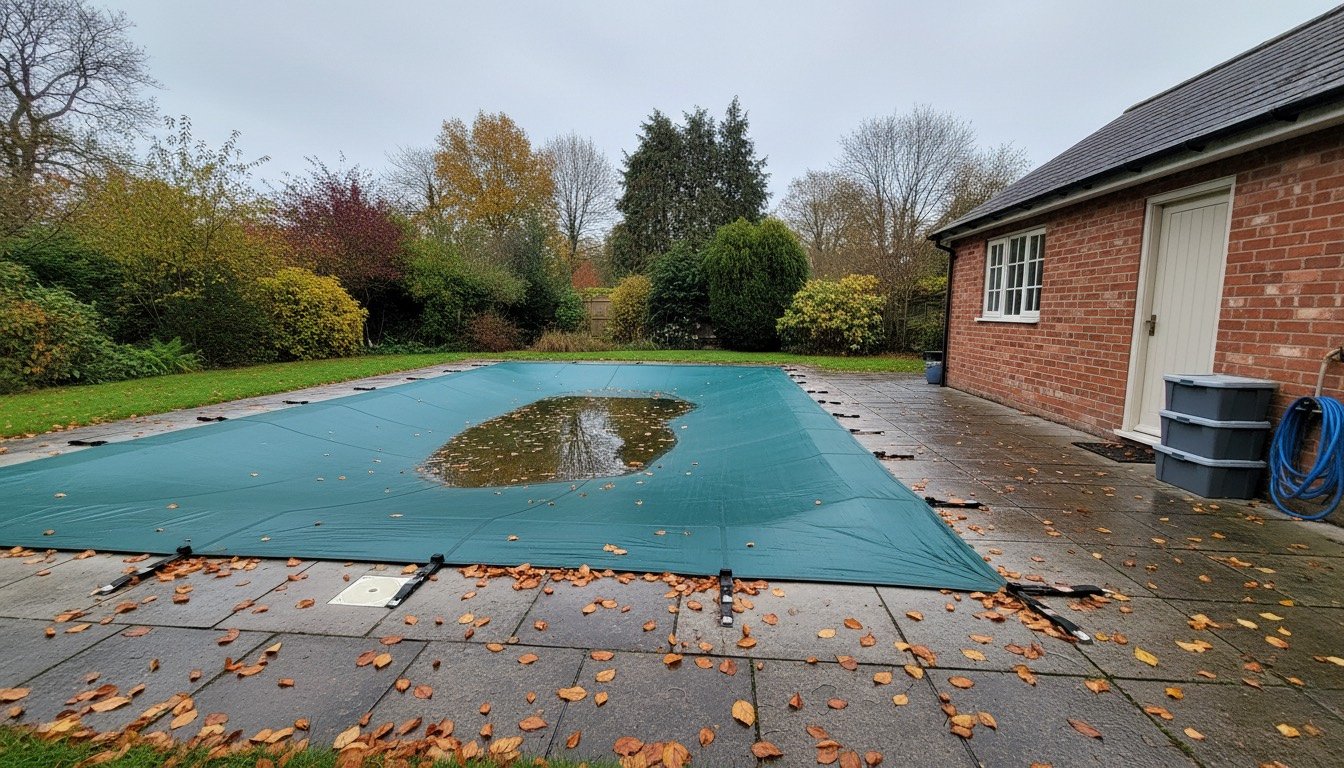
- •COVER UP (1 hr) — Fit the cover taut, with an air pillow underneath on a liner pool so surface ice pushes inward, not against the walls.
Through the winter: what stops spring being expensive
A closed pool is not a finished pool. Under half an hour a month, between them.
- •Weekly, 5 minutes, free: clear leaves and standing water off the cover. 100mm of water on a mesh cover is roughly 300kg hanging on the fixings.
- •Monthly, 20 minutes, £5–£10: lift a corner, check clarity, confirm rain has not pushed the level back above the skimmers, test chlorine, top up algaecide.
- •After every named storm, 10 minutes: check cover straps, anchor points and the plant room door.
- •January, 30 minutes: confirm no water has collected in the pump or filter body and every plug is still out. Six weeks before opening, book the service.
Short on time? The five that actually prevent damage
Two hours rather than six? Do these and let the rest wait.
- •Get every drain plug out of the pump, filter and heater. Ice in a cast pump body is a replacement, not a repair.
- •Drop the water below the skimmers and plug them.
- •Correct pH and alkalinity while the water is still above 15°C.
- •Cover it. Recovering a green pool in April is 10 to 15 hours and about £150 in chemicals.
- •Kill the power at the isolator so a frozen pump cannot start on an old timeclock setting.
DIY or pay a pool company?
A professional closedown runs £250 to £450 across most of the UK, or £350 to £600 with a heat pump and automatic cover. Against £110 to £180 of consumables the sums favour DIY — but pay for the first one and watch, because the order of operations is what goes wrong.
Hand it over outright for an automatic slatted cover, an in-floor cleaning system, a gas-fired heater (Gas Safe work), or a pool serving a holiday let, which brings PWTAG record-keeping with it. Salt cells must come out and be stored dry indoors, so check saltwater versus chlorine first. And do not close a hot tub from habit — most UK tubs cost less to run through winter than to drain and refill, and the hot tub cleaning routine carries on regardless.
Found this useful?
There's plenty more — hundreds of guides and honestly-tested product reviews for every corner of your home.
Browse All Guides