Garden & Outdoor · 5 min read · 12 June 2026
How to Balance Pool Water: The UK Method, in Litres Not Gallons
Nine times out of ten, cloudy water and stinging eyes are a pH problem wearing a chlorine costume. Here is the order a pool engineer works in, dosed in litres.
By the Nims Casa editorial team — written from professional cleaning experience and checked against our editorial standards.
Chlorine at pH 8.0 does roughly a quarter of the disinfecting work it does at pH 7.2. That single fact explains most of the frustrated calls we take in July: the owner has tipped granules in all week, the water is still hazy, and the problem was never the chlorine. It was the reading they never took.
Balancing means getting five numbers into range in a set order, because each one shifts the next. What follows is the sequence a UK pool engineer works through on a domestic pool, dosed per 10,000 litres rather than the US gallons almost every online guide quotes. It applies equally to an 8m x 4m liner pool, a 12ft above-ground and a plug-in spa. For the routine around it, see our guide to maintaining a swimming pool.
Safety first: the combinations that actually hurt people
Pool chemicals are the most hazardous things most households own, and the risk is almost entirely about storage and sequence. Gloves, wraparound eye protection, and always stand upwind of the scoop.
- •Never store dry acid (sodium bisulphate) beside chlorine. Damp together, they produce chlorine gas. Separate sealed tubs, separate shelves.
- •Never mix trichlor tablets with calcium hypochlorite, even in the same dosing bucket. That pairing has started fires in UK sheds.
- •Add chemical to water, never water to chemical, and never dose two products within the same hour. Dose one, run the pump, wait.
- •Store everything locked and above 1.5m. Chlorine granules look exactly like sugar to a four-year-old.
- •Don't swim until free chlorine is back below 5 mg/l and pH sits between 7.2 and 7.6 — usually 12 to 24 hours after a shock dose.
- •Fixed wiring in the zones around a pool is notifiable under Part P in England and Wales. That is an electrician's job.
Tools, materials and what they cost
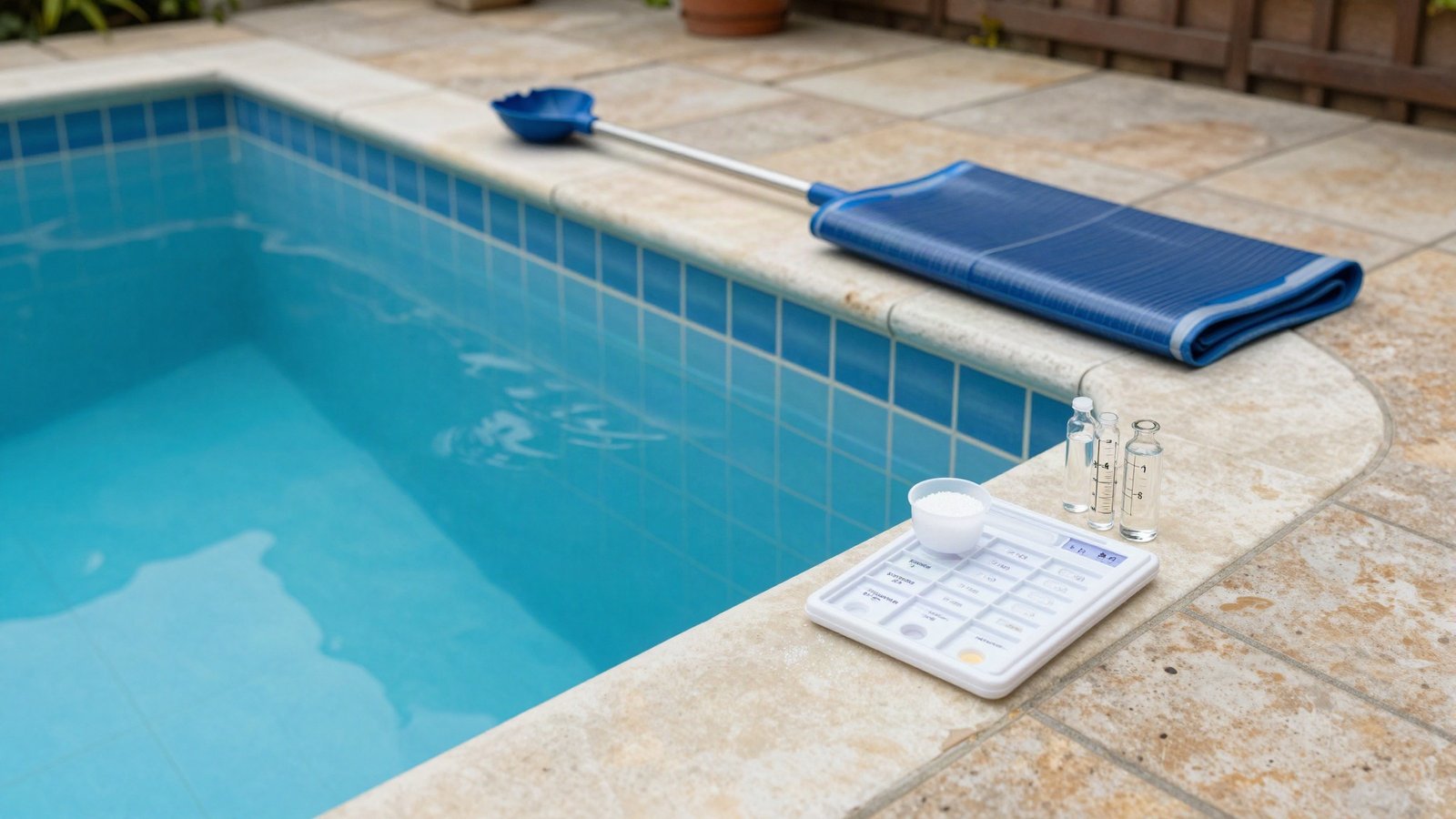
Skip the free strips that came with the pool. They read chlorine badly above 3 mg/l and cannot see cyanuric acid at all — the reading that quietly ruins summers.
- •Tablet comparator kit (Palintest-style, DPD No.1 and Phenol Red): £25-£35, refills about £10 per 250 tablets.
- •Test strips for quick weekly checks: £12-£18 for 50. Bin them six months after opening.
- •pH Minus / dry acid, 5kg: £12-£18. pH Plus / soda ash, 2kg: £10-£14.
- •Alkalinity increaser, 5kg: £15-£20. Plain bicarbonate of soda is the identical chemical and often cheaper.
- •Calcium hardness increaser, 5kg: £18-£25. Rarely needed in the hard-water south-east.
- •Stabilised chlorine granules or 200g multifunction tablets, 5kg: £30-£50.
- •A dedicated 10-litre bucket, a marked scoop and kitchen scales that never go back indoors.
Time, cost and the numbers you are aiming for
A full balance from cold is 30 to 45 minutes of hands-on work spread across a day or two, because you must circulate 4-6 hours between adjustments before retesting. Once in range, weekly upkeep is a five-minute test and one dose. Budget £250-£450 a season for chemicals on a 45,000-litre outdoor pool used May to September; an indoor heated pool run year-round costs £600-£900.
Work out your volume first: length x width x average depth. An 8m x 4m pool averaging 1.4m holds 44,800 litres. A 12ft round above-ground is about 7,000 litres. Every dose below is per 10,000 litres.
- •Total alkalinity 80-120 mg/l. Adjust this first — it is the buffer that stops pH bouncing.
- •pH 7.2-7.6, ideally 7.2-7.4. Below 7.0 corrodes ladders and heat exchangers; above 7.8 wastes chlorine.
- •Free chlorine 1-3 mg/l in a pool, 3-5 mg/l in a spa.
- •Combined chlorine below 1 mg/l. Above that is what stings eyes and creates the 'over-chlorinated' smell, which actually means too little chlorine.
- •Calcium hardness 200-400 mg/l. Much of Scotland and Wales needs calcium added; the south-east fights scale instead, the same battle as limescale indoors.
- •Cyanuric acid 30-50 mg/l outdoors, near zero indoors. Over 100 mg/l locks up your chlorine and only a partial drain fixes it.
The step-by-step method
Keep the pump running throughout. Take samples elbow-deep and away from the return jets — a surface scoop by the skimmer reads wrong every time.
- •1. Test everything before touching anything: TA, pH, free and total chlorine, calcium hardness, cyanuric acid. Write the numbers down.
- •2. Correct total alkalinity first. To raise TA by 10 mg/l, broadcast 180g of sodium bicarbonate per 10,000 litres across the deep end. To lower it, trickle roughly 200g of dry acid per 10,000 litres over a return jet.
- •3. Circulate 6 hours, then retest. Don't stack doses to save time — you will overshoot and spend a week walking it back.
- •4. Now set pH. Up: about 50g of soda ash per 10,000 litres, dissolved in a bucket of pool water first. Down: about 100g of dry acid. Both assume TA is near 100. Retest after 4 hours.
- •5. Adjust calcium hardness only if it reads under 150 mg/l. Around 120g of calcium chloride per 10,000 litres lifts hardness 10 mg/l. It heats the bucket noticeably — stir and stand two minutes before pouring.
- •6. Set stabiliser outdoors if cyanuric acid is under 30 mg/l: 100g per 10,000 litres raises it 10 mg/l. Add it in a skimmer sock and leave the pump running 24 hours without backwashing.
- •7. Chlorinate last, once pH is in range. Per 10,000 litres, 1 mg/l of free chlorine takes roughly 18g of dichlor granules, 15g of calcium hypochlorite or 70ml of liquid. Dose at dusk; UV strips it out in hours.
- •8. Retest at 12 hours and again at 48. Water is only balanced when the same numbers hold across two consecutive tests.
The renter-safe version: pools and spas without losing your deposit
Few UK tenancies come with an in-ground pool, but plenty of renters buy an above-ground or an inflatable spa. The chemistry is identical at 1,000 to 7,000 litres — just weigh doses on 0.1g scales instead of eyeballing a scoop. Get written landlord consent first: many agreements prohibit these outright, and a full 12ft pool weighs seven tonnes, which is a real structural question on a raised deck.
- •No drilling, no new outdoor tap, no hard-wired socket. Use an existing external socket with a plug-in RCD adaptor.
- •Site on a ground sheet plus insulating mat over paving, not grass. Lawn under an inflatable dies in 48 hours; on hard standing the damage is nil.
- •Dissolve every chemical in a bucket first. Dry granules spilt on sandstone or decking bleach a permanent white patch within minutes.
- •Keep the chemical box indoors in a locked cupboard, not in the landlord's damp shed.
- •Before draining, stop chlorinating for 48 hours and confirm free chlorine is under 0.5 mg/l. Release slowly onto gravel or a soakaway — never a surface water drain, never over borders or a pond.
- •Cover it when unused. A cheap insulating lid halves both heat loss and chemical use, the same economics as a proper pool cover.
Troubleshooting readings that refuse to move
- •pH climbs daily: normal on a saltwater system, where the cell generates it — see saltwater vs chlorine pools. Otherwise suspect new render or aeration from a water feature.
- •pH bounces after every dose: total alkalinity is too low. Fix TA properly and pH settles.
- •Chlorine reads fine but the water is dull and smells: that is combined chlorine. Shock with non-chlorine oxidiser at 100g per 10,000 litres.
- •Chlorine vanishes within hours: cyanuric acid over 100 mg/l, or phosphates from lawn feed and leaf litter. Drain and replace a third of the volume.
- •Cloudy despite good readings: hardness over 400 mg/l, or a filter needing a backwash. Check the pressure gauge before buying clarifier.
- •Everything drifts after heavy rain: 40mm of rain dilutes a small pool measurably. Retest the day after a downpour, not to a fixed diary.
When to stop and call a professional
Balancing is well within a competent owner's reach; three situations are not. Call an installer if the water stays green after 48 hours at 10 mg/l free chlorine with correct pH — that is a circulation or filter fault, not a dosing one. Call one if you see pitting or rust around the ladder and light housing, because acidic water is already eating metal. And call one for anything electrical, which is specified work under BS 7671.
Book a £120-£180 service visit at the start of the season if the pool stood over winter; it is far cheaper than a replacement heat exchanger. At season's end follow a proper pool closing routine, and if you run a spa as well, the hot tub cleaning method matters more than the chemistry — biofilm in the pipework eats chlorine faster than you can add it.
Found this useful?
There's plenty more — hundreds of guides and honestly-tested product reviews for every corner of your home.
Browse All Guides