Product Reviews · 6 min read · 1 June 2026
The Best Tools for New Homeowners of 2026 (Tested for Older UK Houses)
Most starter tool lists are written for new-builds. If your first home is a Victorian terrace or a 1930s semi, half of that kit is useless in the first solid wall you drill.
By the Nims Casa editorial team — written from professional cleaning experience and checked against our editorial standards.
Affiliate disclosure: if you buy through links in this article we may earn a small commission at no extra cost to you. Our recommendations come from professional cleaning experience and are never influenced by retailers or brands.
Hand a first-time buyer a 20-piece boxed kit and a 12V drill and they will survive a weekend in a new-build flat. Give them the same kit in an 1890s terrace and the drill stalls in the first wall, the picture hooks pull out of the lime plaster, and the sash still rattles on Sunday night.
Britain's housing stock is old: roughly one home in five predates 1919 and about a third predates 1945, so a first purchase in most towns means solid brick, lath and plaster, timber sashes, clay drains and wiring that may be older than the moon landings. These are the tools we would buy first for that house, in that order, at what they cost in 2026.
Our top picks at a glance
Makita HR2470 SDS-Plus Rotary Hammer
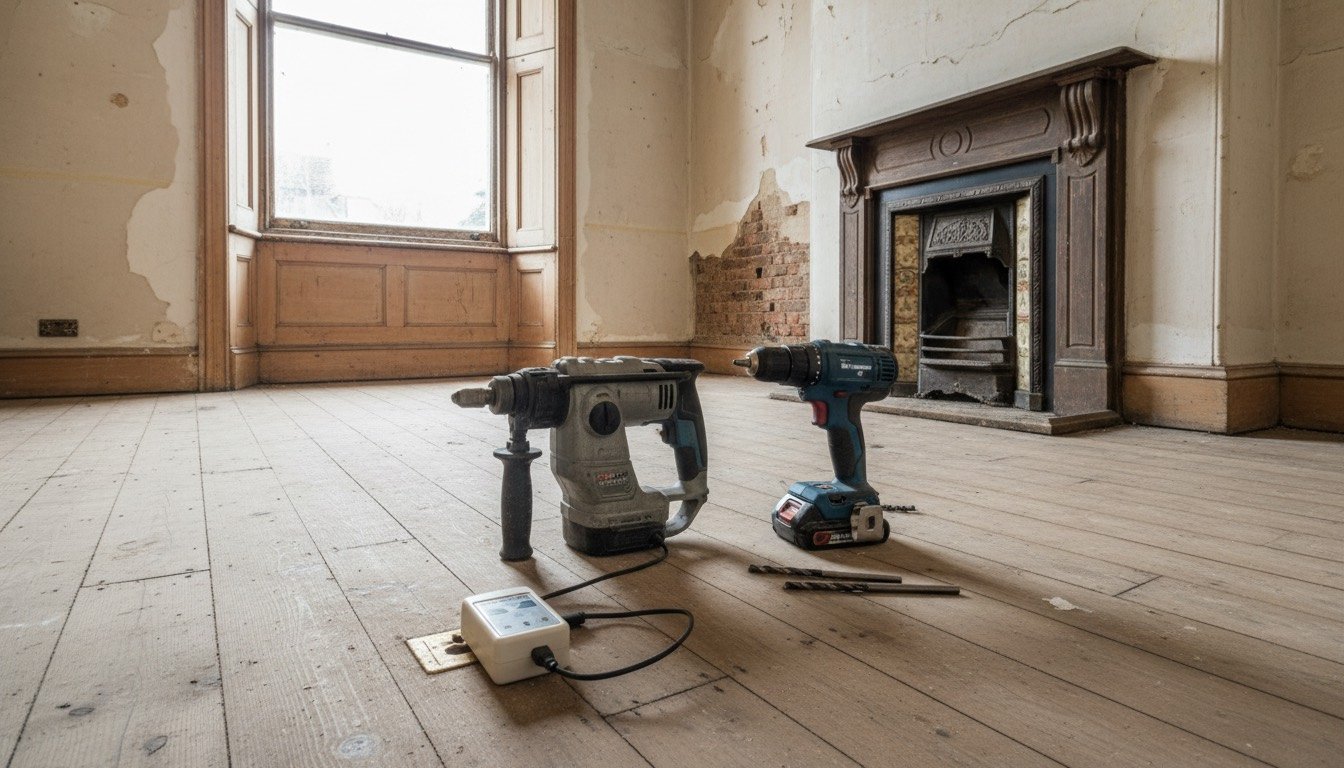
~£130-£1752.4 joules of impact energy from a 780W corded motor, which is enough to put a clean 7mm hole through hard Victorian stock brick without glazing the bit or wrecking your wrist. Corded is the right call for a first house, because you use it in short bursts and this one will outlast three sets of batteries.
Pros
- ✓ Chisel-only mode lifts old hearth tiles and hacks off blown render without hiring a breaker
- ✓ Carbon brushes and spares still available from UK dealers a decade after purchase
Cons
- ✗ At 2.8kg it is tiring for overhead work into ceiling joists
- ✗ Corded, which means an extension lead in rooms that have only one or two sockets
DeWalt DCD778 18V XR Brushless Combi Drill
~£85-£190Brushless, roughly 65Nm of torque and light enough at 1.6kg to hold one-handed on a ladder while you refit a curtain pole into a timber lintel. Bare tool sits around £85; a twin 4.0Ah kit with charger and case runs £150-£190 in most UK sheds.
Pros
- ✓ Covers everything an old house needs short of solid masonry, from sash ironmongery to floorboard screws
- ✓ 18V XR batteries fit a very wide tool range, so the platform grows with the house
Cons
- ✗ Hammer mode is weak in hard brick and will polish the hole rather than cut it
- ✗ Kits sold with 1.5Ah batteries are undersized; add £55-£70 for a 4.0Ah
Martindale Classic CP501 Socket Tester
~£25-£35Plug it into every socket on the day you collect the keys and it flags reversed polarity, a missing earth or a lost neutral in about two seconds. In a house that still has a rewireable fuse box, this is the cheapest possible answer to whether you need an electrician urgently or eventually.
Pros
- ✓ Catches the classic pre-1970s faults: no earth, borrowed neutrals and live-neutral reversal
- ✓ Costs less than half an hour of an electrician's time at £45-£70 per hour
Cons
- ✗ Cannot test RCD trip times or insulation resistance, so it screens rather than certifies
- ✗ Useless on round-pin sockets, which need an electrician regardless of what it says
Trotec BM22 Pin-Type Moisture Meter
~£30-£45Two pins and a percentage, which is all you need to separate condensation on a cold solid wall from a genuine leak. Take readings every 300mm up the wall: a high reading that fades as you climb points one way, an isolated damp band at mid-height usually means a failed gutter or a bridged sill.
Pros
- ✓ Turns a vague musty smell into mapped, comparable readings before anyone quotes you
- ✓ A fraction of the cost of the survey a damp-proofing firm will do free and then quote against
Cons
- ✗ Pins leave two small holes, so keep off finished plaster you intend to keep
- ✗ Salts in old plaster give falsely high readings, so treat it as a pointer, not proof
Who this guide is for, and how we judge
This is written for someone who has just picked up keys to a pre-1970s house and has perhaps £250 to £400 for tools before the first jobs start. If your home was built after about 1980 you have cavity walls, plasterboard on dabs and a modern consumer unit, and a good all-round starter set will serve you better than anything here.
On judging: these are not lab-tested against a rig. They are the tools we and the trades we work with buy for our own period properties, cross-checked in spring 2026 against UK trade counter and shed pricing, warranty terms and spares availability. Where a tool has a real weakness in an old house we say so. Prices are bands, because bare tool and kit pricing swings by 60% depending on batteries.
Why a Victorian or 1930s house changes the tool list
Old buildings are built to breathe and to flex, and almost every fixing decision follows from that. Before you buy anything, walk the house and confirm which of these you are dealing with, because it is the difference between a £40 tool and a £160 one.
- •Solid walls: 215mm brick with no cavity, bedded in soft lime mortar. A percussion drill chatters, glazes the bit and ends up polishing the brick. SDS-plus cuts it cleanly.
- •Lath and lime plaster: hollow wall anchors spin uselessly in it. Anything over about 5kg goes into the stud or joist behind, or into a spring toggle rated well past the load.
- •Sash windows: no trickle vents and no modern beading, but cords, weights and parting beads. You want a sash tool or a stiff 25mm scraper, not a wrecking bar.
- •Victorian drainage: salt-glazed clay at shallow gradients, often with an interceptor trap under the front path. A 10m set of drain rods beats any bottle of caustic.
- •Pre-1970s wiring: rubber-insulated cable perishes into dust, lighting circuits frequently have no earth, and rewireable fuse boxes offer no RCD protection.
The four tools we would buy first
Buy them in this order. The rotary hammer first, because until you can fix into solid brick nothing gets hung, mounted or supported. The combi drill second, because it does everything else. The socket tester third, ideally on day one. The moisture meter last, but before you let any damp-proofing firm through the door with a free survey. If you will be working above head height, read our ladder buying guide before you buy a step stool you outgrow in a fortnight.
The rest of the first-year kit, priced
Beyond the headline four, this is what genuinely gets used in an older house. It totals roughly £150 to £200, or about one call-out fee.
- •Two-pole voltage indicator, £25 to £40. Not a screwdriver neon, which is unreliable and unsafe on old circuits.
- •Brick bolster and lump hammer, £25. For lifting a single cracked quarry tile or cutting back blown render.
- •Drain rod set, 10m with plunger and worm, £25 to £35. Pays for itself on the first blocked gully.
- •Spring toggles and 100mm frame fixings, £15. The two fixings that actually work in lath and in soft brick respectively.
- •Filling knives at 50mm and 150mm plus a hawk, £20. Plaster repairs need a wide blade, not a tube nozzle.
- •Sash cord, 6mm waxed cotton, £8 for 15m, plus a sash tool at £12.
- •Torch and a 25m extension reel, £35. Old houses have two sockets a room and unlit cellars.
What to look for before you spend
Impact energy matters far more than wattage on a rotary hammer. From about 2.2 joules you will take a 7mm hole through hard Victorian stock brick; below 1.8J you are back to chattering. On a combi drill, read torque and weight together: 60Nm at 1.6kg beats 90Nm at 2.4kg in a stairwell.
For fixings, drill into the mortar bed rather than the brick face wherever the load allows, because soft lime mortar is easier to repair than a spalled Victorian brick. In lath and plaster, find the timber first: our guide to finding a stud without a stud finder covers the knuckle-and-nail method that still beats most detectors in old walls. And before you take a sander to any pre-1992 paintwork, read up on lead paint safety in older houses, because a random orbital with no extraction is the single fastest way to contaminate a room.
Buying mistakes we see in period properties
The pattern is almost always the same: tools bought for the house the buyer imagined, not the one they own.
- •Buying a 12V or 18V combi and expecting it to drill masonry. It will do a handful of 6mm holes in soft brick and then cook the bit. In hard brick it will not start.
- •Buying a multi-tool before a rotary hammer. Oscillating tools are excellent for undercutting skirting, but they fix nothing to a wall.
- •Spending £300 on a boxed 200-piece set. Most of it is bit sizes you will never touch and a hammer that loosens on the shaft by the third use.
- •Buying a pressure washer in year one. On lime mortar and soft brick it drives water into the wall and blows out the pointing.
- •Ignoring battery platform lock-in. A brand nobody local stocks means a dead £60 battery in four years and no replacement.
What not to buy, and what to leave to a professional
There is a hard line in an older house, and it is worth knowing where it sits before you own the tools to cross it. Any work on a consumer unit, any new circuit and most work in a bathroom is notifiable under Part P of the Building Regulations in England and Wales, and must be done by a registered electrician or signed off by building control. If the house still has a rewireable fuse box or rubber-sheathed cable, get an EICR at £150 to £300 first and budget £4,500 to £7,500 for a rewire of a three-bed terrace. Anything touching gas is Gas Safe territory, full stop.
Structural work is the other boundary: removing a chimney breast or opening up a wall with no clear lintel needs a structural engineer, not a bigger drill. Resist chemical damp injection sold off a free survey until you have read our rundown of common problems in 100-year-old houses and taken your own readings. For patching and skimming, our guide to repairing old plaster walls shows what is genuinely DIY-able, and the new homeowner checklist covers the first fortnight in order.
Found this useful?
There's plenty more — hundreds of guides and honestly-tested product reviews for every corner of your home.
Browse All Guides