Product Reviews · 6 min read · 28 June 2026
The Best Vacuum Cleaners UK (2026): What Professional Cleaners Actually Use
Ask ten cleaners what vacuum they trust and you'll hear the same few names. Here's our shortlist for every budget — and why the red one never dies.
By the Nims Casa editorial team — written from professional cleaning experience and checked against our editorial standards.
Affiliate disclosure: if you buy through links in this article we may earn a small commission at no extra cost to you. Our recommendations come from professional cleaning experience and are never influenced by retailers or brands.
Ask ten professional cleaners which vacuum is in their kit and you'll hear the same handful of names again and again. It's rarely glamour that earns a machine that reputation — it's whether the belt survives daily use, whether spare parts are still on shelves in five years, and whether suction holds up on a stair carpet at hour three of a working day.
This guide sets out what we look for before recommending a vacuum, which specs are worth paying for and which are marketing noise, how to keep whichever machine you buy running well past its warranty, and the buying mistakes that send people back to the shop within a year.
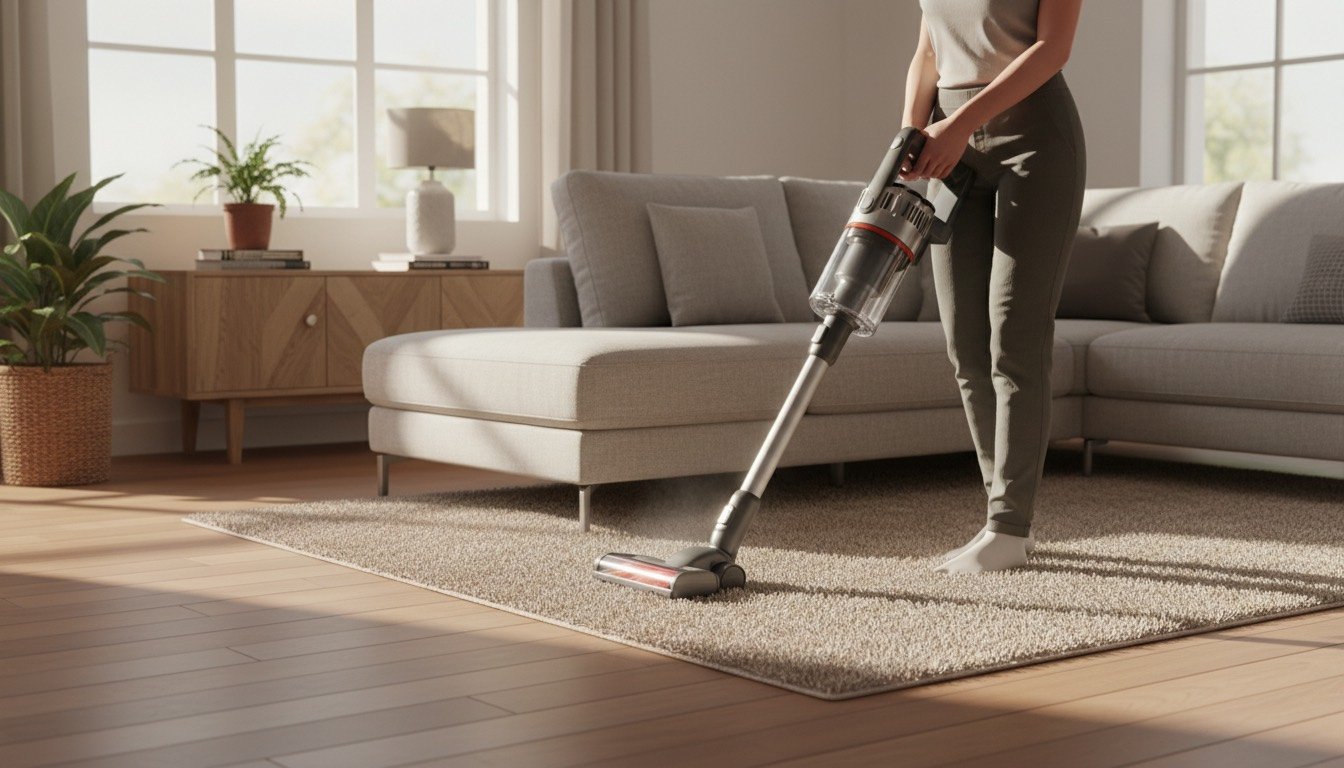
One thing worth saying upfront: regular vacuuming is the cheapest thing you can do to make your carpet last longer — grit ground into the pile by foot traffic wears carpet out far more than the odd spill. The vacuum you'll actually use twice a week beats a flagship model gathering dust in the cupboard.
Our top picks at a glance
Shark Stratos Cordless (IZ400UKT)
~£330The best all-round family vacuum right now: strong on carpet and hard floor, anti-hair-wrap actually works, and the flexible wand folds to reach under sofas — the feature you didn't know you needed.
Pros
- ✓ Anti-wrap brush genuinely defeats long hair
- ✓ Folding wand reaches under furniture
- ✓ Good real-world run time
Cons
- ✗ Heavier than some rivals
- ✗ Dust cup on the small side
Numatic Henry (HVR200)
~£140There's a reason every tradesperson and half the UK's professional cleaners own a Henry: huge capacity, monstrous reliability, cheap bags and parts you can still buy in 15 years. Not glamorous. Unkillable.
Pros
- ✓ Legendary durability and serviceability
- ✓ Big 9L capacity, long cord
- ✓ Excellent bagged filtration for allergies
Cons
- ✗ No motorised brush head as standard
- ✗ Dragging a tub around isn't for everyone
Dyson V15 Detect
~£600The laser that reveals floor dust is half party trick, half genuinely motivating. Filtration, suction and the particle counter are class-leading. You're paying flagship money, but it's the best cordless clean available.
Pros
- ✓ Class-leading suction and filtration
- ✓ Laser head shows what you're missing
- ✓ Great tools for stairs and upholstery
Cons
- ✗ Expensive
- ✗ Trigger grip tires the hand on long sessions
Vax Blade 5
~£180Most of the everyday performance of the big names at a much friendlier price. Ideal for flats and smaller homes where 45 minutes of runtime covers the whole clean.
Pros
- ✓ Strong value for money
- ✓ Light and easy to handle
- ✓ Decent carpet performance
Cons
- ✗ Battery fades on max mode quickly
- ✗ Build feels less premium
How We Test: What Separates a Good Vacuum From a Great One
Every vacuum we shortlist has been used in real UK homes, not a test lab — carpeted stairs, hallway runners, pet hair on hard floors, the lot. We run each machine on its standard 'auto' setting rather than the boosted mode reserved for marketing demos, because that's how most people use them day to day.
We score against a consistent list of criteria rather than a single suction figure, because peak airwatts rarely matches how a machine feels on a real carpet after a long clean:
- •Pick-up on carpet and hard floor, using the same test debris on every pass
- •Run time in genuine auto mode, not the optimistic eco-mode figure
- •Bin or bag capacity, and how easily it empties without a dust cloud
- •Noise level, checked close to a room where someone might be sleeping
- •Weight and manoeuvrability up and down stairs, one-handed
- •Availability and price of spare parts, filters and bags two years after launch
What Actually Matters When Choosing a Vacuum (And What to Skip)
Corded models still edge out cordless for sustained cleaning on deep-pile carpet and larger homes — mains power doesn't fade the way a battery does. Expect £90–£180 for a reliable corded upright, and £250–£450 for a commercial-grade machine like a Henry, the sort a tradesperson would actually buy.
Cordless sticks have closed the gap for everyday use and, because they live by the front door rather than a cupboard, get used more often. Budget models start around £120–£200, mid-range machines with a decent motorised head and 40-plus minutes of real runtime sit at £250–£400, and flagship models with laser dust detection push past £500–£650.
A few features are worth the extra pound; most aren't. Sealed HEPA filtration matters if anyone has asthma or hay fever — see our guide to air purifiers for allergies for pollen-season help too. A motorised brush head is essential for carpet but pointless on hard floors, where a soft roller lifts debris without scattering it; if hard floors dominate your home, pair your vacuum with a good pick from our best mops round-up rather than expecting one machine to do both jobs well.
Bagged machines cost more to run — bags typically £3–£6 for a pack of five — but seal dust in properly and suit allergy households; bagless saves money but means emptying the bin over a bin bag, briefly putting dust back into the air. Not sure what's underfoot? Our guide to carpet types explains why a deep wool pile needs different brush settings to a low, dense polypropylene loop.
Care & Maintenance: Making a Vacuum Last a Decade, Not Two Years
Most vacuums don't die of old age — they die of a blocked filter nobody washed. Rinse foam and HEPA filters under a cold tap every four to six weeks (never hot; it warps the pleats) and let them dry fully for 24 hours before refitting — a damp filter is the single most common cause of a burnt-out motor.
- •Empty the bin or change the bag before it's completely full — suction drops off sharply in the last third of capacity
- •Cut hair and thread out of the brush bar weekly with the tool most machines now include, or a seam ripper if not
- •If suction suddenly weakens, check the hose for blockages by holding it up to a window
- •Charge cordless batteries fully before any long storage period, then top up every few months — lithium batteries degrade faster left flat
- •Replace the belt on corded uprights roughly once a year if used weekly; belts typically cost £4–£8 and take five minutes to fit
Common Vacuum-Buying Mistakes We See Constantly
Most disappointment with a new vacuum traces back to one of these:
- •Buying on peak suction (airwatts or kPa) alone — pick-up depends far more on brush head design and how well the system is sealed
- •Choosing a lightweight stick for a home with thick carpet throughout, then being disappointed by run time and pick-up
- •Ignoring bin capacity in a hairy-dog household, then emptying the machine every five minutes
- •Paying extra for a motorised head on a hard-floor-only home, a feature that never touches the floor
- •Expecting an everyday vacuum to handle spilled liquids — that's a job for a proper wet & dry vacuum, not your Henry
- •Assuming bagless is always cheaper — replacement filters on some models cost more over three years than a lifetime of bags
Frequently asked questions
**How often should I vacuum?** High-traffic hallways and lounges need vacuuming twice a week; bedrooms and spare rooms can usually manage with once. With pets or allergy sufferers in the house, daily quick passes on the worst-affected rooms make a genuine difference to air quality and carpet lifespan.
**Is a cordless vacuum powerful enough to replace a corded one?** For most UK homes, yes — a mid-range cordless with a proper motorised head will out-clean an ageing corded machine on carpet and hard floor alike. The exception is a large house with thick, deep-pile carpet throughout, where sustained mains power still edges ahead over one long session.
**Do I need a separate vacuum for pet hair?** Not usually — look for anti-hair-wrap technology and a decent-sized bin rather than a specific 'pet' model, often the same machine with a different accessory bundle and a higher price. If accidents rather than shedding are the recurring issue, our guide to removing pet urine smell from carpet covers the deeper clean a vacuum alone won't fix.
**How long should a good vacuum last?** A well-maintained corded machine like a Henry can run for 10–15 years; a cordless stick with a replaceable battery should manage 5–7 years before the battery becomes the limiting factor. Machines that die younger than that are usually let down by a neglected filter, not a genuine fault.
**Are robot vacuums worth having alongside an upright?** They're a maintenance tool rather than a replacement — a robot handles daily dust so your main vacuum only needs to come out weekly for a proper deep clean, particularly on stairs and upholstery a robot can't reach. Our robot vacuum guide covers which models cope with UK homes' door thresholds and stairs.
Which Vacuum Should You Buy?
Match the award to your household rather than the price tag alone. Want one vacuum that handles carpet and hard floor equally well in a family home? The Best Overall Cordless is built for that. Landlords and tradespeople who want a machine still working in fifteen years on £5 bags should go straight for the Best Corded Workhorse. If air quality and the best possible clean matter more than budget, the Best Premium pick earns its price — and in a flat where every pound counts, the Best Budget Cordless covers the fundamentals.
Whichever you choose, remember a vacuum only lifts loose dirt. For ground-in grime and odours vacuuming can't shift, an occasional deep clean with a carpet cleaning machine — or a professional — keeps carpets looking new for years longer.
Found this useful?
There's plenty more — hundreds of guides and honestly-tested product reviews for every corner of your home.
Browse All Guides