Cleaning Guides · 5 min read · 8 May 2026
Cleaning Mistakes That Damage Your Home (And What Each One Costs to Put Right)
Most of the damage we are called out to repair was not caused by neglect. It was caused by someone cleaning enthusiastically with entirely the wrong product.
By the Nims Casa editorial team — written from professional cleaning experience and checked against our editorial standards.
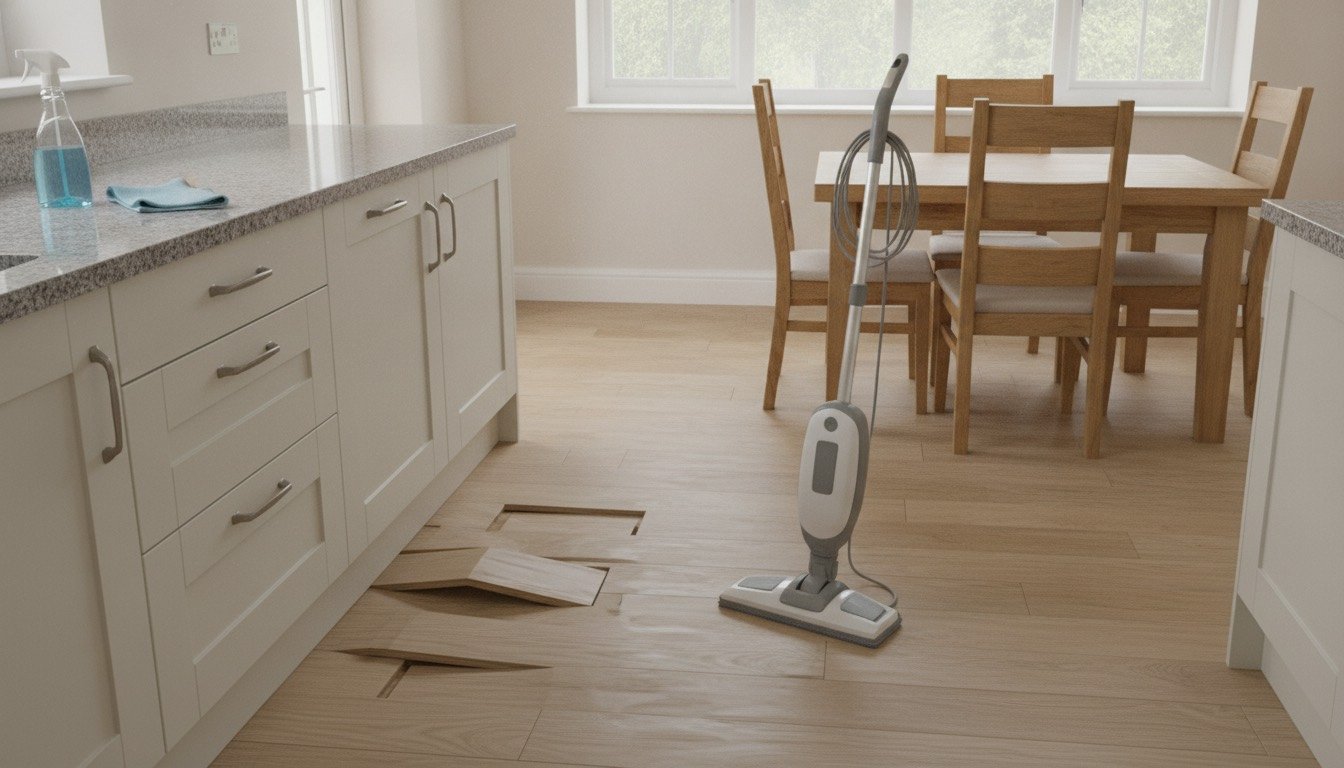
Neglect leaves dirt, and dirt comes off. Enthusiasm leaves marks that do not. The jobs we get called to rescue are almost never filthy houses; they are a steam mop run over engineered oak, a limescale spray wiped across a marble splashback, a hired carpet machine emptied into a wool twist that then took four days to dry.
What follows is ranked by what it costs to undo rather than by how alarming the mess looked on the day. Two of these can put you in A&E rather than out of pocket. And because a third of UK households rent, there is a section on the reversible version: what a tenant can safely do without the inventory clerk finding it at check-out.
Ranked by what it costs to put right
Consequence is the only sensible ranking. A burnt oven shelf is an afternoon of annoyance; a steamed floating floor is a re-fit. These are the six we see most often across British homes, with realistic 2026 costs to reverse them.
- •Steam mop on laminate or engineered wood: £900-£2,200 to lift and relay a typical 25 m² lounge and hall. Comfortably the most expensive cleaning mistake in the country.
- •Acidic cleaner on marble, limestone or travertine: £200-£600 for a stone restorer to hone and repolish a worktop or bathroom floor. There is no DIY version of this fix.
- •Over-wetting a carpet with a hired machine: £400-£1,200 to replace carpet and underlay in one room once the backing delaminates or the underlay turns sour.
- •Weekly bleach on grout: £250-£500 to rake out and re-grout a family bathroom after the joints go chalky and start shedding.
- •Cream cleaner or wire wool on hob glass and UPVC: £180-£400 for a replacement induction glass panel; dulled UPVC can only be sprayed at £60-£120 a frame, never polished back.
- •Painting over mould instead of treating it: £120-£250 to strip, wash down with a fungicidal solution and repaint, and it returns every winter until the condensation is dealt with.
The mistakes that ruin a surface permanently
Steam leaves the plate at around 100°C and on a floating floor it drives moisture straight down the joints into the fibreboard core. Laminate then swells from the edges up, a defect the trade calls crowning, and it does not settle back when it dries. Engineered boards with a 2-3 mm wear layer lift at the lacquer instead. Manufacturers void guarantees for steam use and they are right to: a barely damp flat microfibre mop lifts the same soil, and the safe routine for timber is set out in our guide to cleaning hardwood floors.
The second tier comes from assuming natural means gentle. White vinegar is roughly 5% acetic acid and it dissolves calcium carbonate, which is precisely what marble, limestone, travertine and most polished concrete are made of. One confident wipe leaves a dull etch that buffing will not remove. The same applies to limescale spray drifting onto a stone floor and to toilet cleaner splashed on a chrome waste. We set out where it genuinely earns its place in our guide to cleaning with vinegar.
- •Never steam: laminate, engineered wood, solid timber, vinyl with a visible seam, unsealed stone, or any board that sounds hollow underfoot.
- •Never acid: marble, limestone, travertine, terrazzo, polished concrete, aluminium, and any plated fitting left to soak overnight.
- •Never abrasive: induction and ceramic hob glass, brushed stainless (always work with the grain), acrylic baths and shower trays, UPVC, anodised handles.
- •Never bleach: coloured grout, silicone seals you intend to keep, wool or silk fibres, and anything draining to a septic tank.
- •Never a spinning brush bar: loop-pile wool and Berber carpets, sisal and seagrass, and any rug with a fringe. Switch to suction only.
Water damage in slow motion
The mistakes that surface three weeks later are the ones that catch people out. A hired carpet machine puts down far more water than it recovers. The working rule is one wet pass, two dry passes, windows open, and a pile that is dry to the touch inside six to eight hours. Miss that window and you get wicking, where old stains rise back through the fibre, then a sour underlay, then in bad cases the latex secondary backing letting go entirely.
Bathrooms are the other slow burner. Spraying mould, wiping it off and admiring the white ceiling removes the pigment and leaves everything else behind; four weeks later it is back in the same corner, because the real fault is a cold surface, a tired extractor and washing drying on the radiators. Treat the growth by all means, but fix the ventilation or you have signed up to repeat the job forever. The causes, the cures and the myths are covered in our damp and mould guide.
- •Mop water grey by the second room is spreading soil, not lifting it. Two buckets, or fresh water every 15 m².
- •Spray the cloth, never the appliance. Fluid sprayed at a socket, an oven fascia or an extractor grille runs inside and stays there.
- •Do not let oven cleaner or bleach dwell on aluminium trays, racks or window sills. Sodium hydroxide attacks it and the pitting is permanent.
- •Pressure washing block paving on full power strips the kiln-dried jointing sand, after which the blocks rock underfoot and weeds root deeper than before.
- •Hot water sets protein stains. Blood, milk, egg and gravy come out with cold water and time, not a kettle.
The genuinely dangerous ones
Everything above costs money. These can cost you your lungs. Chlorine bleach mixed with an acidic descaler, which includes limescale spray, most thick toilet cleaners, brick acid and strong vinegar, releases chlorine gas. Mixed with an ammonia-based glass cleaner it produces chloramine instead. In a 2 m by 2 m bathroom with the door shut and a dead extractor fan, that reaches an irritant concentration in seconds, and people keep scrubbing because they assume the smell is just the product working.
- •Never combine bleach with limescale remover, toilet cleaner, brick acid or vinegar, and not sequentially in the same bowl either. Rinse thoroughly between products.
- •Never mix bleach with ammonia-based glass or floor cleaner, and never decant anything into an unlabelled bottle.
- •Ventilate before you start, not once you notice: window open, door open, extractor on. If you cough, leave the room and stay out for 15 minutes.
- •If breathing still feels tight several minutes after exposure, ring 111, or 999 if it is worsening. Photograph both product labels before you go.
- •Never sand, wire-brush or aggressively scrub textured coatings or Artex in a property built or refurbished before 2000. Assume it contains asbestos until it is tested.
- •Never work above head height off a dining chair or the rim of a bath. Most cleaning injuries we hear about are falls, not chemicals.
The renter-safe version: cleaning without risking the deposit
Cleaning is consistently the single most common cause of deposit disputes in England and Wales, and a good share of the rest is damage the tenant caused while trying to clean. If you rent, the governing word is reversible: nothing abrasive, nothing that etches, nothing that leaves a permanent mark on a surface the inventory clerk photographed on day one. You are not being paid to restore the property, only to hand it back in the same condition minus fair wear and tear.
- •Photograph everything on move-in day, including grout, oven interior, silicone seals and any existing chips, and email the set to yourself so the date is fixed.
- •Stick to pH-neutral on anything you do not own. A neutral floor cleaner, washing-up liquid at roughly 5 ml per litre and a good microfibre will handle 90% of a rented flat.
- •Test any stronger product somewhere hidden, behind the loo or inside a cupboard door, and wait ten minutes before committing to the visible area.
- •Report damp, mould or a failed extractor fan in writing the week you notice it. In England the Homes (Fitness for Human Habitation) Act 2018 puts that repair on the landlord, but only a written record protects you at check-out.
- •Never paint over mould in a rented home. The paint fails within a season and redecoration becomes a deduction.
- •For hooks and shelving, use removable adhesive strips rated well above the item's weight, and never on fresh emulsion or wallpaper. More reversible ideas are in our rental-friendly decor guide.
- •Budget £150-£350 for a professional end-of-tenancy clean on a one or two-bed flat. It is almost always less than the deduction it prevents.
When to stop and call someone in
Knowing the boundary saves more money than any product. Stop and hand it over at these points.
- •Mould covering more than roughly 1 m², or returning within a month of proper treatment: book a damp survey at £150-£300, frequently credited against the remedial work.
- •A carpet that has been flooded or badly over-wet and still smells after 48 hours: an NCCA-registered cleaner with air movers, before the underlay is written off.
- •Any etch, burn or deep scratch in natural stone or a solid worktop: a stone restoration specialist, not a polish out of a tin.
- •Persistent scale or a weep behind a boiler, shower valve or under a sink: get the leak fixed before you clean anything around it.
- •Anything needing a ladder above ground-floor height, over a stairwell, or on a wet patio.
Quick answers
One rule covers most of it: match the product to the substrate, and when you cannot identify the substrate, use less. Our cleaning guides take each surface in turn, so start with whichever one you were about to attack this weekend.
- •Is a steam mop ever safe? Yes, on sealed porcelain or ceramic tile and on sealed concrete. Nowhere else, and never on a floating floor.
- •Does bicarbonate of soda damage anything? It is mildly abrasive. Fine on stainless sinks and oven glass, poor on acrylic baths, hob glass and painted woodwork.
- •Is a magic eraser safe on paint? It is fine sandpaper in sponge form. It will burnish matt emulsion to a shiny patch that only repainting hides.
- •How often does a house actually need deep cleaning? Twice a year whole-house, with kitchen and bathroom on a monthly cycle. The full timings are in our cleaning schedule.
- •Is professional deep cleaning worth paying for? For a neglected property or a check-out, yes: expect £180-£350 for a two-bed done properly.
Found this useful?
There's plenty more — hundreds of guides and honestly-tested product reviews for every corner of your home.
Browse All Guides