Organisation & Storage · 6 min read · 23 May 2026
Closet Organisation Systems Compared: DIY Kits to Fitted Wardrobes
The choice between a £60 wire kit and £3,000 of fitted joinery is usually framed as a budget question. In a pre-1919 house it is a structural one first.
By the Nims Casa editorial team — written from professional cleaning experience and checked against our editorial standards.
Strip a bedroom back in a 1900 terrace and the same three problems turn up every time: almost nothing behind the plaster worth screwing into, an alcove 20mm wider at the top than the bottom, and a floor that falls away towards the window. Every wardrobe system on the market is instruction-written for a house with none of those problems.
That matters more than the price tier. Get the fixing method wrong on a solid wall and the system either will not hold the weight or will not hang square, and the next product up fixes neither fault. So the four real options are compared here by how they carry load, what they cost, and how they behave in older housing stock.
What a closet organisation system actually is
The term covers any set of rails, shelves, baskets and drawers replacing the single rail and shelf most UK bedrooms were built with. There are really only four families, separated by where the weight ends up: on the floor, on the wall, or on both.
Load is not trivial. A metre of hanging rail carrying winter coats runs to 25-40kg, and a 2m double-hung run — rail at 1,050mm and a second at 2,000mm — reaches 80-100kg before shelves. That is what the wall has to take, and in a Victorian house it decides everything. For what goes inside, see our wardrobe organisation guide.
The four systems, compared
Ranked by how much load each pushes into the wall.
- •Freestanding rails and modular boxes (£25-150). No fixings beyond an anti-tip strap. Right for rented flats and anyone waiting on a rewire, though canvas wardrobes sag within a year.
- •Wall-mounted track systems (£130-600 for 2m). Ikea BOAXEL, Elfa and similar hang everything from one horizontal top rail with uprights clipping in. Best choice for old houses by a distance: one straight line of fixings into sound masonry, after which a sloping floor and an out-of-square alcove stop mattering.
- •Floor-standing modular carcasses (£300-900 per 2m run). Ikea PAX and equivalents. The floor takes the weight and the wall only stops it toppling, so soft brick matters less — but a 15mm fall over 2m means packing every plinth, and deep moulded skirting must be scribed round or units stand proud.
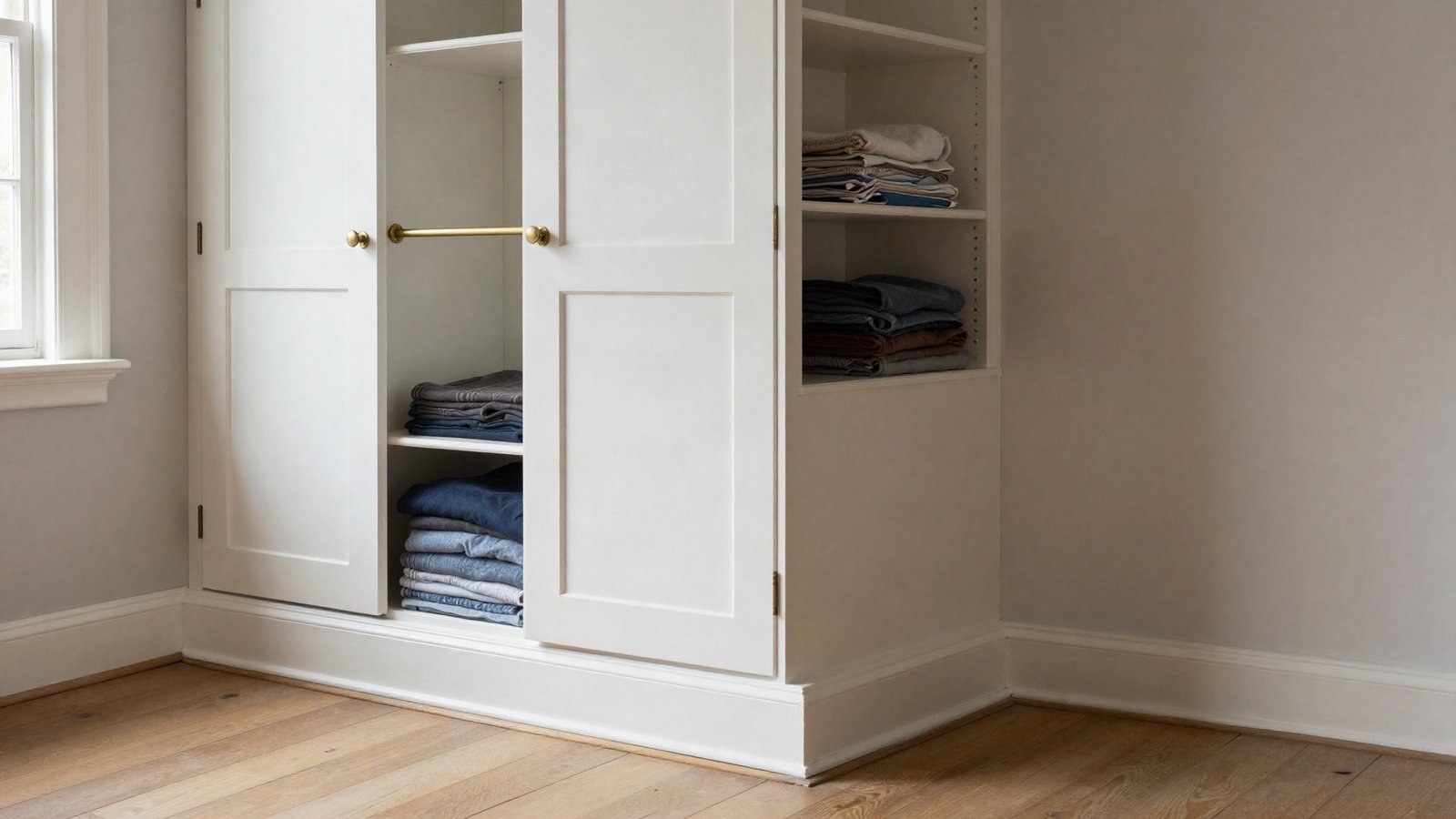
- •Bespoke fitted joinery (£1,200-4,500 per run). Built to your actual dimensions, working round chimney breasts and picture rails. The only option that truly fills a Victorian alcove, and the only one that recovers the dead space above a picture rail in a 2.9m room.
How the load gets into an old wall
This is where most self-fits fail. Pre-1919 external walls are usually 225mm solid brick with no cavity, finished in lime plaster. Internal partitions are almost always lath and plaster on studs at irregular 350-450mm centres.
In lath and plaster, nothing but the stud holds. Spring toggles and Gripit-type anchors are designed around a 12.5mm board with a void behind; lime plaster over 25mm laths crumbles instead of clamping. Find the timber, drill a 3.5mm pilot and use 5.0 x 80mm screws — Victorian timber is bone dry and splits without one.
In solid brick, forget the standard yellow plug. Soft London stock blows out under hammer action: a 7mm hole becomes a 12mm crater. Drill on rotary only with a sharp masonry bit, aim for brick rather than perished lime mortar, and use 10mm frame fixings or a styrene-free resin anchor with a perforated sleeve. Budget four fixings per metre of top rail, not the two the instructions show. If plaster spalls round the hole, patch it before loading, as when repairing cracks in plaster walls.
What it costs in the UK in 2026
On bespoke work labour is typically 45-55% of the total; on a self-fitted track system it is nil. A joiner charges £190-260 a day across most of the UK and £260-350 in London and the South East, and a pair of alcove wardrobes takes three to five days. Retailers quote per linear metre installed, commonly £750-1,100/m for sliding doors — check any quote against our custom wardrobe cost guide.
- •Freestanding rail or canvas unit: £25-90. Wire shelving kit fixed direct to wall, 1.8m: £70-160.
- •Ikea BOAXEL 2m run with rails, shelves and baskets: £180-280. Allow 2-3 hours in plasterboard, 4-6 in soft Victorian brick.
- •Elfa 2m run with drawers and shoe shelves: £400-700; Ikea PAX 2 x 100cm with doors and interiors: £450-750.
- •Retailer sliding-door fitted wardrobe, 2.5m: £1,900-3,200 installed. Bespoke joiner-built alcove pair, painted: £2,400-4,500.
- •Consumables people forget: resin anchor £15, frame fixings £12 for 10, a stud and cable detector £40-60.
The old-house problems nobody warns you about
Measure every alcove at three heights and two depths before ordering. A 15-25mm variation across a 2.4m wall is normal in a settled Victorian house, and flat-pack carcasses have no tolerance for it.
Condensation is the failure we are called out to most. A 225mm solid wall has a U-value around 2.0 W/m²K against roughly 0.3 for a modern wall, so the internal face runs cold. Seal a back panel hard against it and the surface can sit at 12-13°C in January while bedroom air holds a dew point of 11-12°C — black mould on the back board and on wool coats follows. Leave a 25-40mm gap and drill 25mm vent holes low in the plinth and high in the top rail. More in our guide to damp and mould in UK homes.
Pre-1970s wiring rarely respects the safe zones in BS 7671, so cable drops turn up mid-wall; isolate the lighting and socket circuits at the consumer unit before drilling deep near a switch or socket. And the wall beside a sash window often hides a shutter box — a void with no masonry behind the reveal. Never anchor a loaded rail into it.
DIY or bring in a joiner
Fit it yourself if the wall is sound plasterboard or hard brick, the run is under 2.5m, and you are using a top-track system where one line of fixings does the work. That is a genuine Saturday job, and the skill is careful setting-out rather than joinery.
Bring someone in when the wall is lath and plaster over an unknown stud layout, when the alcove is more than 20mm out of square, or when you want the space above a picture rail used. Stop entirely if the plaster sounds hollow over a wide area — that coat has blown and needs re-skimming first.
Questions we get asked
Will heavy-duty plasterboard anchors hold in lath and plaster? No. They clamp against a thin board, and lime plaster crushes instead of gripping. Locate the studs and confirm with a 2mm test hole rather than trusting the detector.
My box room is 2.1m wide — what works? Wall-mounted track with a single 900mm hanging section and open shelving above; anything with doors eats 600mm of floor before it opens. More layouts in our small-space storage ideas.
Do open systems attract moths? They make an infestation easier to spot, not more likely — moths follow keratin, not shelving. Vacuum the track and skirting line quarterly, and see our guide to carpet and clothes moths.
Found this useful?
There's plenty more — hundreds of guides and honestly-tested product reviews for every corner of your home.
Browse All Guides