Plumbing · 6 min read · 28 May 2026
Dishwasher Not Draining? The 10-Minute Fix Most People Miss (With UK Costs)
An inch of grey water over the filter usually means a 20mm blockage, not a dead machine. Here is the ten-minute check engineers do first, and what it honestly costs if it turns out to be worse.
By the Nims Casa editorial team — written from professional cleaning experience and checked against our editorial standards.
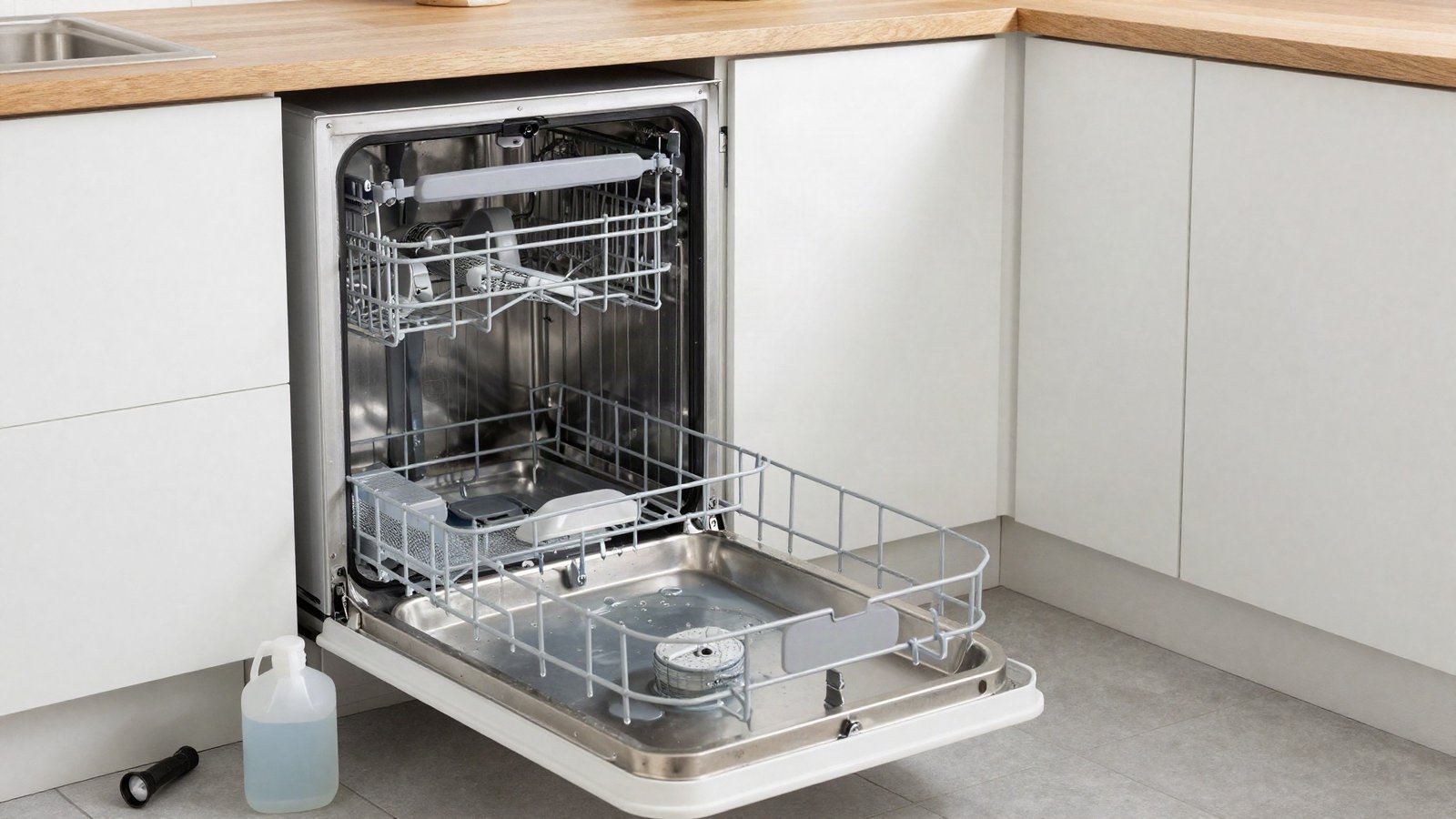
Open the door and there it is: an inch of grey water over the filter, a slick of grease on top, the cabinet smelling of last night's dinner. On a call-out like this the machine is usually fine. Something small has blocked a path barely 20mm across, and clearing it takes a jug, a cloth and ten minutes.
The mesh filter is only half the story. Underneath sits the sump, the pump impeller and a small non-return flap — where the olive stone or the corner of a broken glass ends up. What follows is the order an engineer works through, with honest UK prices at each stage.
How a dishwasher actually drains
At the end of a cycle a 30 to 40 watt drain pump — no stronger than a fish tank pump — pushes water up a corrugated hose, over a high loop fixed 600mm above the floor, and into a spigot on your sink trap or a standpipe. Low pressure by design, which is why a teaspoon of grit stops it dead. A hum with no water moving means a jammed impeller; silence points at the pump or the board; water reappearing overnight is siphoning, not a blockage.
- •Coarse filter and fine mesh plate — the commonest blockage of all
- •Sump and non-return flap beneath it — the part almost nobody lifts
- •Drain pump impeller — jammed by glass chips, fruit stones, cocktail sticks
- •Sink trap spigot — including the blanking plug fitters forget to knock out
The ten-minute fix most people miss
Switch off at the wall socket first, not just the control panel — dishwashers restart themselves and you are about to put your hands into standing water. Gloves on: it is warm, greasy and often has glass in it.
- •Bail the water out with a mug into a bucket, then mop the last 10mm with a towel so you can see into the base.
- •Twist out the cylindrical coarse filter, usually a quarter turn anticlockwise, and lift the flat mesh plate below it. Scrub both under a hot tap with a washing-up brush — never a wire brush — then hold the mesh to the light. If daylight barely shows through, that alone stops the drain.
- •The step everyone skips: with the filter out you are looking at the sump, a plastic well about 100mm across with a hinged flap in the outlet. Lift that flap — labels, seeds and glass collect underneath.
- •Turn the pump impeller a full revolution with a fingertip. If it grinds, something is wrapped round it.
- •Refit the mesh flat, lock the filter until it stops turning, and run the shortest hot programme empty.
If that did not fix it: causes by likelihood
Work down this list rather than jumping to the pump. In a fitted UK kitchen most stubborn faults sit outside the machine, in the hose or the sink waste. If the sink beside it is also slow, clear the kitchen sink first.
- •Blanking plug still fitted: the spigot on a McAlpine-type sink trap ships with a moulded plug that must be knocked out. If the machine has never drained since installation, this is it.
- •Kinked hose: pull the machine forward 200mm and look. Hoses get pinched against skirting when a unit is shoved back.
- •Grease plug: feel along the corrugated hose for a solid section, detach it into a bucket and flush with hot, not boiling, water.
- •Hose too far into a standpipe: 50 to 75mm maximum, or it siphons dirty water back in.
- •Blocked sink trap: strip and clean it, and think twice before tipping caustic crystals down — see chemical drain cleaners and pipework.
- •Failed drain pump: hums, nothing moves, impeller spins freely. A genuine parts job.
- •Control board or sensor: rare, usually flagged by a code (Bosch E24, Beko E01, Hotpoint F05). Not a DIY diagnosis.
What the repair really costs in the UK
Dishwasher drainage repairs are overwhelmingly a labour cost with a cheap part attached. A drain pump for a common Bosch, Beko, Hotpoint or Indesit is £22 to £45 aftermarket, £45 to £80 genuine, and takes 45 to 75 minutes to fit. On a £120 invoice that is roughly £30 of materials to £90 of labour — a 25/75 split, and normal rather than a stitch-up.
Independent appliance engineers charge a £55 to £85 first-visit fee, usually credited against the repair. Manufacturer fixed-price schemes run £130 to £190 all in, with a 12-month guarantee. A general plumber is £45 to £70 an hour plus a £50 to £90 call-out — fine for hose and waste work, but most will not open the machine. See our plumber rates and appliance repair costs; add 20 to 30 per cent for London and the South East. All figures below are 2026 weekday rates.
- •Sink trap with dishwasher spigot: £6 to £14, ten minutes to fit
- •Drain hose plus two jubilee clips: £12 to £25
- •Drain pump: £22 to £45 aftermarket, £45 to £80 genuine
- •Independent engineer, fixed-price drain repair: £90 to £160 including the pump
- •Manufacturer fixed-price repair: £130 to £190
- •Weekend or out-of-hours plumber: £90 to £150 for the first hour
- •Replacement machine: £260 to £400 freestanding, £330 to £650 integrated, plus £30 to £80 to fit
Fair quote or suspect quote
A trustworthy engineer opens the filter before quoting. A price given over the phone, without hearing the machine, is a guess dressed up as a diagnosis. Ask what has failed, then ask to be shown — a jammed impeller or a split hose can be pointed at.
- •Fair: itemised parts and labour, a named part number, a diagnostic fee credited against the repair, and 6 to 12 months' guarantee
- •Suspect: a fixed price quoted before the machine has been opened
- •Suspect: the control board blamed with no error code shown on the display
- •Suspect: a repair costing over half the replacement price on a machine past six years old
When to repair and when to stop
Our working rule: repair under five years old, think hard between five and eight, replace beyond that unless the fault is trivial. In hard-water areas — most of the South East, East Anglia and the Midlands — scale kills heating elements and pump seals early. If you are replacing, a machine built for hard water earns its keep.
Stop and call someone if there is water under the machine as well as inside it, if the plug feels warm, or if the anti-flood float has tripped: those are leak faults with a real electrical risk.
Questions we get asked
Will bicarbonate and vinegar clear it? No. It fizzes decoratively and does nothing to a mechanical blockage sitting in a sump. Bail the water and clear it by hand.
Should I run a cleaning tablet through it? Only once it drains — descalers treat smell and film, not blockages. Gritty plates with water that does drain away is a different fault: see dishwasher not cleaning properly.
How do I stop it recurring? Scrape plates, keep foil lids and fruit stones out, clean the filter monthly, and run a 65°C programme fortnightly so grease never sets in the hose.
Found this useful?
There's plenty more — hundreds of guides and honestly-tested product reviews for every corner of your home.
Browse All Guides