Plumbing · 6 min read · 1 April 2026
Are Chemical Drain Cleaners Safe for Pipes? A Plumber's Honest Verdict
Pour, wait, flush. It works often enough that people keep buying it — but whether it is safe depends far more on what your pipes are made of than on what is in the bottle.
By the Nims Casa editorial team — written from professional cleaning experience and checked against our editorial standards.
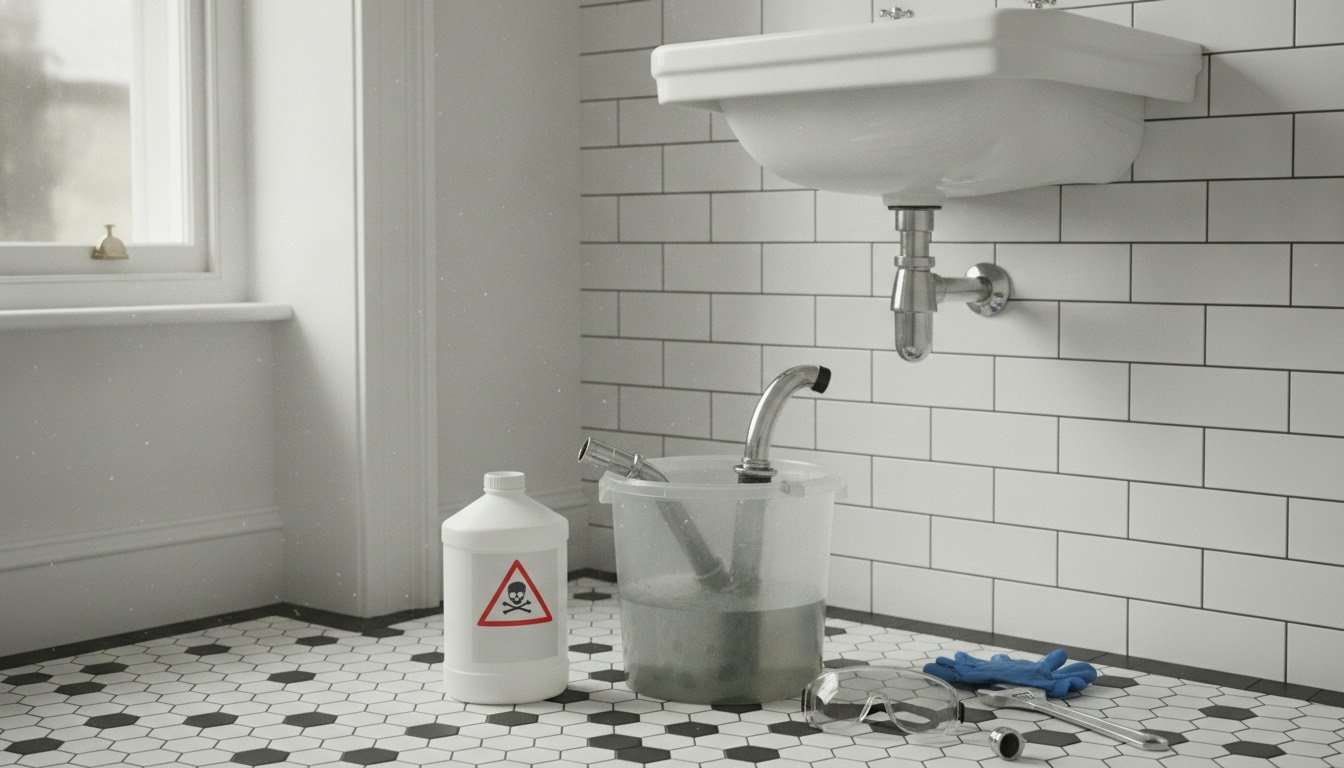
Pour it in, wait fifteen minutes, flush with hot water. On a soft soap-and-hair blockage in modern plastic waste pipe, that works often enough to keep the cleaning aisle stocked. But the bottle knows nothing about your house, and the honest answer turns on what sits under your floorboards.
In a 2005 estate house with solvent-welded uPVC throughout, an occasional dose is a nuisance rather than a hazard. In a Victorian terrace with a lead waste under the bath, a cast iron stack on the back wall and salt-glazed clay running to a boundary chamber, the same bottle is a bad idea. Here is what each chemistry does, and where a £4 purchase becomes a £700 repair.
What is actually in the bottle
"Drain unblocker" covers four unrelated products that behave nothing alike. Read the hazard panel, not the marketing — the active ingredient tells you the risk.
- •Caustic (sodium or potassium hydroxide), 2-10% in supermarket liquids and stronger in gels. It saponifies fat and breaks down the keratin in hair. The reaction is exothermic: standing trap water can reach 70-90°C and stay there for half an hour.
- •Acid (sulphuric acid at 90%+), sold mainly through trade counters. It destroys organic matter in minutes, but fumes, spits on contact with standing water, and attacks metal and mortar as readily as hair.
- •Oxidising gels based on sodium hypochlorite — thickened bleach. They kill the biofilm that makes a plughole stink and shift little else.
- •Enzyme and bacterial treatments. Not unblockers: they digest grease over weeks in a drain that still flows, and are harmless to every pipe material and to septic tanks.
What they shift, and what they never will
Chemistry only works on what it can dissolve, and only where it arrives undiluted. Caustic clears a greasy soap plug in a basin trap and usually softens a hair mat in a shower waste. It will not touch a wet wipe, tree roots or a dropped clay joint — and those are most of the calls we get.
There is a worse problem. The product has to reach the blockage, and by the time most people buy one the pipe is standing full. It sinks a little, dilutes, and stalls a metre short — leaving a trap of hot corrosive liquid you cannot safely plunge and should not open. Working through the mechanical options in our guide to unclogging a kitchen sink first is sequencing, not squeamishness.
The old-house problem: lead, cast iron and Victorian clay
Pre-war housing stock is where the real damage happens, and the reason is metallurgy: lead, zinc and aluminium are all attacked by strong alkali, which is precisely what older houses still have underfoot. Sulphuric acid does not care what it eats.
- •Lead wastes and traps, still under plenty of Victorian baths and basins. Wall thickness is often 2-3mm and already thinned. Caustic corrodes from the inside; the leak appears on the ceiling below weeks later.
- •Galvanised steel wastes from the 1930s to 1950s. Caustic strips the zinc and exposes bare steel; acid thins the steel directly. The bore is already scaled, so it blocks again and you dose again.
- •Cast iron soil stacks, standard until the 1970s. Acid attacks the iron and the lead-caulked joints, and where a stack is boxed in against lath and lime plaster a pinhole leaks invisibly for months.
- •Salt-glazed clay drains. The pipe is inert and will outlive us all; the lime or cement mortar joints are not. The cause is anyway usually root ingress or a settled joint — see signs of a blocked main sewer line.
- •The interceptor trap. Many Victorian houses have a disconnecting trap in the boundary chamber, its rodding eye sealed by a clay stopper. When that stopper drops into the pipe you get repeated blockages no chemical will ever reach.
- •Chrome-plated brass bottle traps and fibre washers. Caustic pits the brass and swells the seals — you find out when the trap weeps.
- •Septic tanks, still serving much older rural property. A litre of caustic sets the bacterial colony back weeks.
Costs: the bottle, the alternatives, the repair
The maths only looks bad once you set the bottle against what it can cost you. UK prices, spring 2026, inc VAT.
- •Supermarket caustic unblocker, 1 litre: £3-£6. Branded gel: £6-£12. Trade sulphuric acid: £25-£35 a litre. Enzyme maintenance, three months: £10-£18.
- •Force-cup plunger £5-£10; a 3-10m hand auger from Screwfix or Toolstation £12-£30; a 9m drain rod set £25-£40.
- •Plumber for an internal blockage: £80-£150 for the first hour, £60-£100 after; out of hours, a £150-£250 call-out before any labour. Our plumber cost guide breaks that down by region.
- •Drainage contractor jetting an external run: £120-£250. CCTV survey: £150-£350.
- •Replacing a corroded lead or galvanised waste in a first-floor bathroom, boards lifted and made good: £400-£900. A cast iron stack section: £600-£1,200.
- •Free and frequently missed: since October 2011 in England and Wales, shared and lateral drains beyond your boundary belong to the water companies. If the blockage sits past the boundary or serves more than one property, they will usually clear it free. Ring them first.
DIY, professional, and the rules that are not optional
A chemical cleaner is defensible in one narrow case: a slow but still-draining basin or bath, on plastic pipework, in a house built after roughly 1975, where you have already checked the trap. Everywhere else, mechanical clearing is faster and reversible — and stripping a trap, as covered in our P-trap cleaning guide, solves most basin problems in ten minutes.
Call someone when more than one fitting backs up at once, when the WC gurgles as the bath drains, when water rises in an external gully, or when the house predates 1940 and you do not know what the wastes are. Beyond the trap, read drain snake vs hydro jetting first: jetting is superb on grease and disastrous on cracked clay.
- •Splash goggles to EN 166 and nitrile gloves, window open, pets and children out. Spectacles are not eye protection.
- •Never mix products. Caustic plus acid, or bleach plus acid, gives heat and chlorine gas in a small bathroom.
- •Never plunge after dosing — the splash-back goes to your face — and never dose a pipe already standing full.
- •Never leave decanted product in an unlabelled container.
FAQs
- •Does bicarbonate of soda and vinegar work? The fizz is carbon dioxide and neutralises itself in seconds. A fair weekly deodoriser, nothing more.
- •Is a kettle of boiling water safe? Not on solvent-weld or push-fit plastic, and not into a WC pan, where thermal shock can craze the glaze. Water at 60-70°C does the same job to grease.
- •Safe for a macerator such as a Saniflo? No — caustic degrades the seals and impeller. Use the maker's descaler only.
- •I have poured it in and nothing moved. Do not plunge, do not undo the trap. Run cold water to dilute, and tell whoever attends exactly what went down there.
- •What keeps drains clear long term? Strainers on every waste, fat scraped into the bin, and a monthly enzyme dose — the habits in our guide to preventing clogged drains cost about £4 a month.
Found this useful?
There's plenty more — hundreds of guides and honestly-tested product reviews for every corner of your home.
Browse All Guides