Plumbing · 9 min read · 1 October 2026
How to Prevent Frozen Pipes Before the First Frost (2026)
Pipe protection is an October job done in an afternoon, or a January emergency that soaks a ceiling. Here is where pipes actually freeze in a British house, what the water fittings regulations expect of an installation, and what to check before the first hard frost.
By the Nims Casa editorial team — written from professional cleaning experience and checked against our editorial standards.
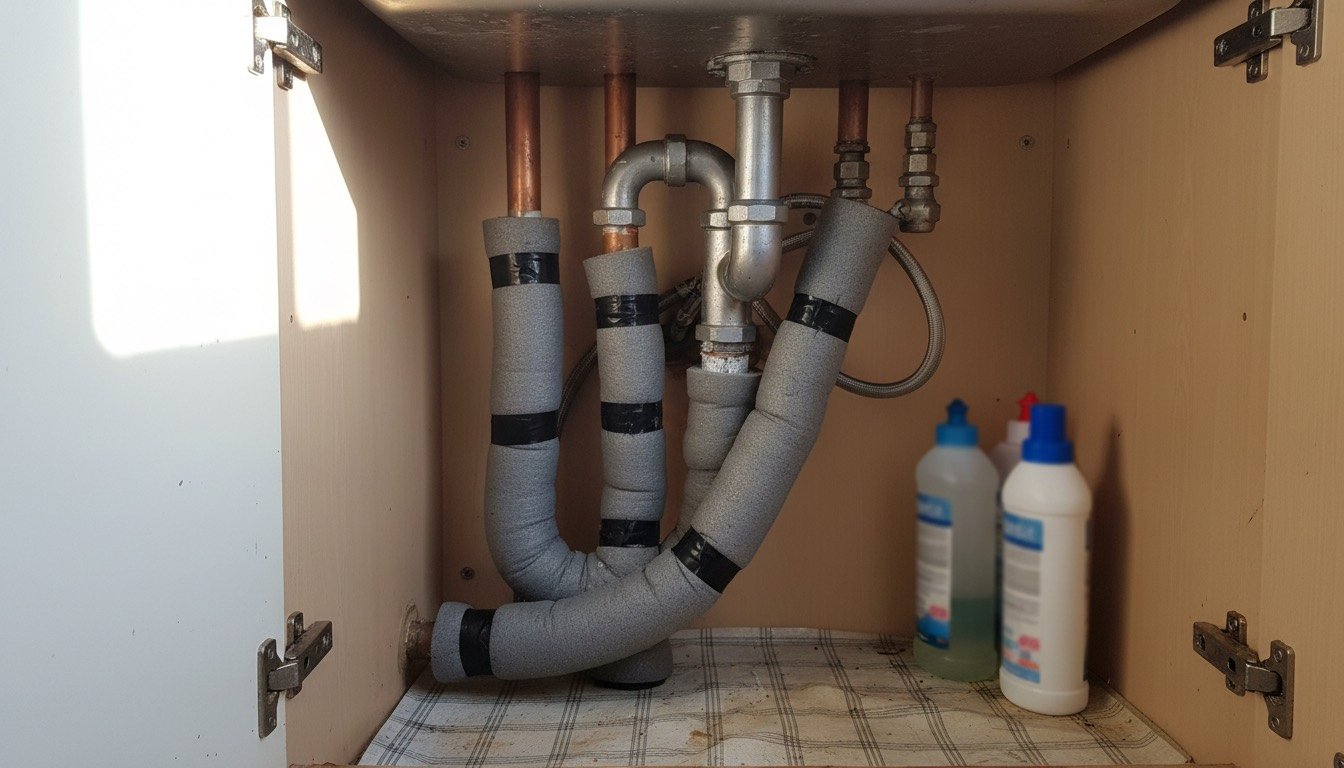
Nobody rushes out to buy pipe lagging in October. The weather is mild, the heating has only just gone on, and the idea of a pipe splitting feels like a January problem. That is exactly why it is worth doing now: the job needs an hour, a tape measure and about the price of a takeaway, and it has to be finished before the first hard frost rather than during it.
This guide covers where pipes genuinely freeze in a British house, what the regulations that govern plumbing installations actually say about freezing, and how to tell useful protection from the sort that looks tidy and does nothing.
One point of scope before anything else. The rules quoted here come from the Water Supply (Water Fittings) Regulations 1999, which set requirements for water fittings and the way they are installed. They are not a maintenance duty on an existing house, and nobody is going to inspect your loft. They are quoted because they describe what a competent installation is supposed to achieve, which makes them a far better yardstick than the general advice that circulates every winter.
Why Is October The Right Time, When The Cold Weather Is Weeks Away?
Because the forecast you are watching and the temperature your pipes experience are not the same number.
The Met Office separates two things that most people run together. An air frost is recorded when the air temperature falls to or below the freezing point of water, measured at a height of at least one metre above the ground. A ground frost refers to ice forming on the ground, on objects or on trees, where the surface temperature is below freezing. Crucially, the Met Office notes that when the ground cools faster than the air, a ground frost can occur without an air frost at all.
That gap matters for plumbing. The pipework at risk in a house is rarely sitting in open air a metre above a lawn. It is against a cold external wall, in an unheated garage, in a loft above the insulation, or clipped to a brick wall outside. Those surfaces behave like the ground in that description: they lose heat faster and reach freezing before the headline air temperature does.
So the first clear night that gets a mention on the regional forecast is not the start of the risk period. It is the point at which the risk has already been running for a while in the colder corners of the building. Work backwards from that and the sensible window for this job is now, while the loft is still a tolerable place to spend twenty minutes.
What Do The Water Fittings Regulations Actually Say About Freezing?
More than most people expect, and in plain language.
Schedule 2 of the Water Supply (Water Fittings) Regulations 1999 sets out requirements for water fittings. Paragraph 4 says every water fitting shall be watertight and shall be so constructed and installed as to prevent ingress by contaminants and to inhibit damage by freezing or any other cause. Freezing is named explicitly, and the obligation sits on the installation as much as on the product.
Paragraph 7(4) deals with anything buried: any water fitting laid below ground level shall have a depth of cover sufficient to prevent water freezing in the fitting. There is no DIY shortcut hiding in that sentence, but it tells you what the standard is for a garden supply or a run under a path.
Paragraph 16(4) covers storage cisterns, which in most older British houses means the cold water tank in the loft. Every storage cistern shall be fitted with an overflow pipe with a suitable means of warning of an impending overflow that excludes insects, a cover positioned so as to exclude light and insects, and thermal insulation to minimise freezing or undue warming. An uninsulated loft tank is not merely a bad idea; it falls short of what the schedule describes.
There is a detail in paragraph 9 that is easy to miss and useful in both directions. Any pipe supplying cold water for domestic purposes to a tap shall be installed so that, so far as is reasonably practicable, the water is not warmed above 25 degrees Celsius. Insulation on a cold pipe is not only about frost. It also keeps drinking water cold where a pipe runs through a warm airing cupboard or beside a hot flow and return.
None of this obliges you to retro-fit an untouched older house. It does mean that if a plumber is doing work for you this autumn, these are the outcomes the installation is meant to deliver, and they are reasonable things to ask about.
Where Do Pipes Actually Freeze In A UK House?
The pattern is consistent, and it is not the places people worry about.
Pipework inside a heated room almost never freezes, because the room keeps it company. The casualties are the runs that sit in spaces the heating does not reach, which in a typical British house means a short list.
If you are only going to check a few places this month, check these in this order, because this is roughly the order in which they fail.
- •The loft, above the insulation line, including the cold water cistern and the pipes feeding it
- •An integral or attached garage, especially where an outside tap or a utility supply has been run through it
- •Suspended timber floors with a ventilated void underneath, where pipes cross from an internal wall to an external one
- •Outside taps and the short length of pipe serving them, including the part that passes through the wall
- •Unheated utility rooms, porches and lean-to extensions added after the original build
- •Holiday lets, second homes and any property left empty with the heating off
Which Of Those Cold Spaces Catches People Out Most Often?
The loft deserves the extra attention, because insulating a loft well makes the space above it colder by design. That is the whole point of the insulation, and it is also why a tank and pipes left exposed up there are in a harsher environment after the work than before it. If your loft insulation is being topped up this autumn, our guide to insulating an attic is worth reading alongside this one, because the two jobs have to be planned together rather than in sequence.
Garages have the same trap in a different shape. A garage that has been lined and boarded still has a large uninsulated door, and the pipes inside it are frequently an afterthought from a much earlier plumbing job. Our guide to insulating a garage covers the fabric; the pipework inside needs treating separately.
Can You Find Your Stopcock In The Dark?
This is the single most useful ten minutes in the whole job, and it costs nothing.
Paragraph 10 of Schedule 2 says every supply pipe or distributing pipe providing water to separate premises shall be fitted with a stopvalve conveniently located to enable the supply to those premises to be shut off. Paragraph 11 goes further: water supply systems shall be capable of being drained down and be fitted with an adequate number of servicing valves and drain taps so that the discharge of water is minimised when fittings are maintained or replaced, and a sufficient number of stopvalves shall be installed for isolating parts of the pipework.
In other words, the system is meant to be shut off and drained without flooding the house. Most people discover whether theirs can be on the night it matters.
Do the dry run now. Find the internal stopcock, which in a British house is usually under the kitchen sink, in a downstairs cloakroom or near where the supply enters at the front of the property. Turn it fully off, then fully on again. If it is seized, stiff or weeping around the spindle, that is a job for a plumber in October rather than a discovery at two in the morning in January. While you are there, note which isolating valves serve which fittings, and whether there is a drain cock at the lowest point of the system.
Then tell everyone else in the house where it is. A stopcock that only one person can find is a single point of failure. If the worst does happen, our guide to the first ten minutes after a burst pipe sets out the order to do things in, and all of it starts with getting the water off.
What Does Pipe Lagging Have To Do To Be Worth Fitting?
It has to be continuous, and it has to actually fit. Those two things account for most of the difference between lagging that works and lagging that decorates.
Foam pipe insulation is sold by internal diameter and wall thickness. Buying the wrong bore is the usual mistake: too small and it will not close around the pipe, too large and it stands off with a gap of moving air inside, which is close to useless. Measure the outside diameter of the pipe before buying, and check whether you have 15mm or 22mm runs, because most houses have both.
Continuity is the part people skip. Cold gets in at the gaps, and the gaps are always at the same places: bends, tee joints, valves, brackets, the point where a pipe passes through a wall, and the last few centimetres before a tap or a tank connection. A run of pristine lagging with a bare elbow in the middle has a cold bridge precisely where water changes direction and slows down. Mitre the foam at bends rather than leaving the corner open, tape the butt joints, and treat valves and stopcocks as something to be boxed in rather than left proud.
Where a pipe crosses a draughty void, deal with the draught as well as the pipe. Moving cold air strips heat from an insulated pipe far faster than still cold air does, which is why pipes in a ventilated under-floor void or beside an airbrick fail before pipes in a sealed cupboard at the same temperature.
If the pipework you are lagging is already in poor condition, insulation will not improve it. Corroded, pin-holed or badly supported pipe wants attention first; our guide to the signs that pipes need replacing covers what to look for before you cover everything in grey foam and stop being able to see it.
What About The Cold Water Tank In The Loft?
Insulate the tank, not the ceiling under it. This is the one counter-intuitive rule in the whole job and it catches people out every year.
Schedule 2 asks for thermal insulation to minimise freezing or undue warming on every storage cistern, together with a close-fitting cover that excludes light and insects. In practice that means a jacket or boards to the sides and the lid of the tank, and the cover sitting properly rather than resting at an angle with a corner open.
The ceiling immediately beneath the tank is traditionally left clear of loft insulation so that a little warmth from the room below can reach the tank. If you insulate under the tank as well as around it, you remove that warmth and leave the tank in a colder space than before. Whether your loft follows that convention is worth checking while you are up there with a torch.
Check the overflow and warning pipe too. It should discharge where you would notice it, and it should be clear. An overflow that has been blocked by a bird or a nest is a problem in its own right, and anything that attracts wildlife into a loft tends to arrive at the same time of year; our guide to autumn rodent-proofing and the insurance gap covers the overlap between pest damage and what a policy will pay for.
Outside Taps, Garden Supplies And Anything Below Ground
An outside tap is the most exposed water fitting most houses own, and it is the one almost nobody turns off.
The useful question is whether the tap has an isolating valve on the inside of the wall. Many installations do, usually a small lever or screwdriver-slot valve on the pipe just before it passes through the brickwork. If yours has one, the autumn routine is simple: close the valve, then open the outside tap and leave it open so that any water in the exposed section can drain out and any remaining water has somewhere to expand into. A tap left closed with water trapped behind it is the classic split.
If there is no isolating valve, that is a sensible thing to have added while a plumber is doing something else, rather than a reason to do nothing. An insulated outdoor tap cover is a partial measure in the meantime. It slows heat loss, it does not drain the pipe, and it will not save a long exposed run on a north-facing wall through a hard week.
For buried supplies, paragraph 7(4) is the standard: a depth of cover sufficient to prevent water freezing in the fitting. That is not something to assess by looking at the lawn, and a shallow garden supply that has survived mild winters is not evidence of adequate cover. If a supply to a garage, a tap or an outbuilding was laid informally at some point in the past, treat it as unknown rather than proven.
What Does Getting This Wrong Actually Cost?
The insurance figures are worth looking at properly, because they are routinely misquoted.
The Association of British Insurers reported on 17 February 2026 that insurers paid out £6.1 billion in property claims in 2025, the highest annual total on its record, which the ABI notes begins in 2017. Across the year, insurers paid £1.2 billion in weather-related property claims, a 14 per cent increase on 2024 worth £142 million, of which £758 million was for weather damage to people's homes and possessions.
That £758 million figure is the one to hold on to, with an important caveat that the ABI itself supplies. Its footnote states that these weather-related figures cover damage caused by burst or frozen pipes, escape of water, and damage as a result of storms and flooding. In other words, frozen pipes are inside that number but are not broken out of it, and anyone quoting a precise frozen-pipe total is adding a precision that the published data does not contain.
The ABI also reported that in 2025 insurers paid out almost £3.4 billion across more than 560,000 home insurance claims, and that the average claim rose by 15 per cent year on year, up by almost £800 to £6,000. Set against an average combined buildings and contents premium of £379 in the final quarter of 2025, the arithmetic of a water escape is obvious enough: the claim is many times the premium, and the disruption of drying out a house is not a thing insurance can give back to you.
None of that is an argument for panic. It is an argument for an afternoon in October. If you want the whole seasonal round in one place rather than just the plumbing, our winter home maintenance checklist sets out the rest of it.
The Before-The-Frost Checklist
Six things, in the order that gives the most protection for the least effort. If you only get through the first three this month, you have covered the failures that cause the most damage.
- •Find the internal stopcock, close it and open it fully, and make sure at least two people in the house know where it is
- •Isolate and drain the outside tap: close the internal isolating valve, then leave the outside tap open
- •Check the loft cistern has a close-fitting cover and insulation to its sides and lid, with the ceiling beneath it left clear
- •Walk the cold spaces with a torch and list every bare pipe in the loft, the garage, the under-floor void and any unheated utility or porch
- •Measure the pipe diameters, buy lagging that matches, and fit it continuously through bends, tees, valves and wall penetrations
- •Set a minimum heating temperature for periods away from home rather than switching the heating off entirely, and ask a neighbour to check an empty property
Frequently asked questions
**Should I leave the heating on low all winter to stop pipes freezing?** Not all winter, but do not switch it off completely when the house is empty in cold weather. A low background temperature keeps the fabric and the pipework above freezing; the risk case is an unoccupied property with the heating off, which is the one situation where a freeze has time to develop undisturbed. Leaving loft hatches and under-sink cupboard doors open during a severe cold snap lets warmer household air reach the pipes behind them.
**Is foam lagging enough on its own?** It is the right first step for pipes in a space that is merely cool. Insulation slows heat loss, it does not add heat, so a pipe in a space that stays below freezing for days will still eventually freeze inside its lagging. For genuinely exposed runs the better answer is to reroute the pipe into a warmer space or to have trace heating fitted by an electrician, and that is a conversation to have before the weather turns.
**Why does the regulation talk about keeping cold water below 25 degrees?** Paragraph 9 of Schedule 2 requires that a pipe supplying cold water to a tap is installed so that, so far as is reasonably practicable, the water is not warmed above 25 degrees Celsius. It is a water quality provision rather than a frost one, but it has the same practical answer: insulate the cold pipe where it runs through warm spaces, which is why lagging is worth fitting in an airing cupboard as well as in a loft.
**Do the water fittings regulations mean I have to upgrade my existing plumbing?** No. Schedule 2 sets requirements for water fittings and for how they are installed, and it bites when work is carried out. An older house that has never been altered is not required to be brought up to it retrospectively. The reason to read the schedule is that it describes what good looks like, which is a more reliable guide than winter advice of unknown provenance, and it gives you something specific to ask a plumber about when work is being done anyway.
Found this useful?
There's plenty more — hundreds of guides and honestly-tested product reviews for every corner of your home.
Browse All Guides