Garden & Outdoor · 5 min read · 1 June 2026
Drip Irrigation vs Sprinkler System: UK Costs, Water Use and the Rules
One puts water at the roots and stays legal in a hosepipe ban. The other soaks the lawn and costs three times as much to fit. Here is how the two really compare in a UK garden.
By the Nims Casa editorial team — written from professional cleaning experience and checked against our editorial standards.
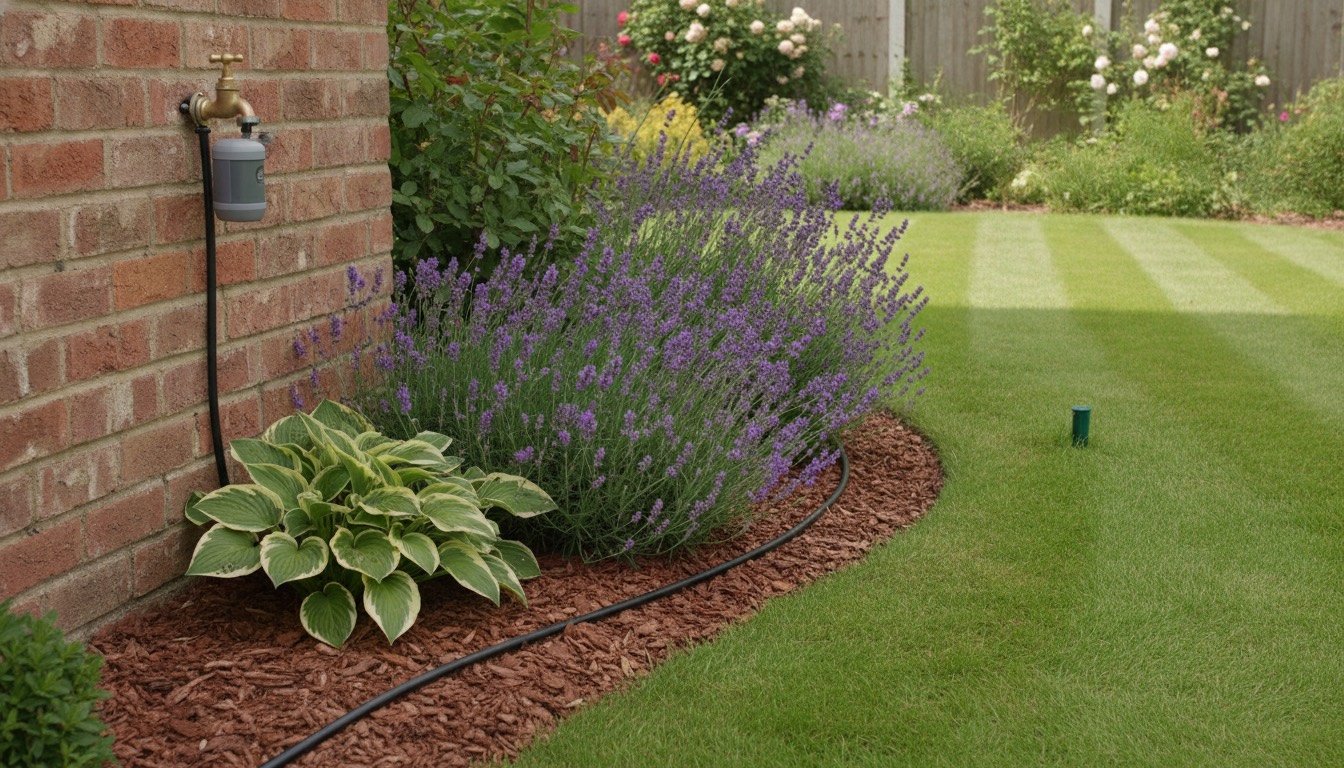
Most British gardens are watered badly: a sprinkler left running into a breezy evening, or a hose dragged round the borders until something visibly wilts. Both systems below fix that, but they fix different halves of it, and choosing on headline price is how people end up with two grand of pop-ups keeping a lawn green they would honestly have let go brown in August.
The short version, from twenty years of fitting these: drip wins for borders, pots, veg beds, hedging and greenhouses. Sprinklers only earn their keep when a green lawn genuinely matters and your mains supply can feed them. If you are still at the drawing stage, settle the garden layout first, because the planting plan dictates the irrigation, never the reverse.
Drip irrigation vs sprinkler system: the side-by-side
Six differences actually change the decision. The rest is marketing.
- •Delivery rate: drip emitters give 2 to 8 litres an hour at the root zone. One oscillating sprinkler throws 500 to 1,000 litres an hour over everything in range, paths included.
- •Efficiency: 85 to 95 per cent of drip water reaches roots. Sprinklers lose 25 to 40 per cent to evaporation, wind drift and overspray.
- •Pressure and flow: drip runs at 1 to 1.5 bar behind a reducer. Pop-up rotors want 2.5 to 3.5 bar and 15 to 20 litres a minute per zone, which many 15mm UK supplies cannot deliver.
- •Typical spend: £60 to £150 for a pot and border kit, £150 to £400 for a whole-garden DIY drip layout, £1,200 to £3,000 for a fitted three-zone pop-up system.
- •Hosepipe bans: a correctly specified drip system usually keeps running under a Temporary Use Ban. Sprinklers are the first thing switched off.
- •Service life: 7 to 10 years for surface dripline exposed to UV, 15 to 20 years for buried sprinkler bodies.
Performance: where the water actually ends up
A drip emitter creates an onion-shaped wetted zone below the surface. On sandy soil that plume is narrow, so emitters want spacing at 20 to 25cm; on heavy clay it spreads sideways and 40 to 50cm is plenty. Get it wrong and you water the gaps between plants, the fault we find most often on self-installed kits.
Sprinklers are judged on distribution uniformity, and British weather ruins it. Above roughly 10mph, uniformity drops below 60 per cent, so half the lawn gets double what it needs while the rest stays dry. Evening sprinkling also leaves grass wet overnight, an invitation to red thread and fusarium. Run either system between 4am and 8am, and check how long a UK lawn actually needs watering before assuming you need a system at all.
What the water regulations actually require
This is the part most American-written comparisons skip, and in Britain it changes the answer. Any permanent mains connection falls under the Water Supply (Water Fittings) Regulations 1999, and your water company can require bad work to be corrected or disconnect the supply.
- •Backflow protection: an outside tap needs a double check valve as a minimum. Porous hose or buried pipework in contact with soil is fluid category 5, calling for a type AA or AB air gap, or an RPZ valve commissioned by an approved installer.
- •Regulation 5 notification: you must notify your supplier before laying pipework outside a building at less than 750mm or more than 1,350mm below ground. Sprinkler laterals sit at 250 to 300mm, so a pop-up system is notifiable. It is free, and consent usually arrives within ten working days.
- •Hosepipe bans: most suppliers exempt drip or trickle systems that are not hand-held, are fitted with a pressure-reducing valve and timer, and sit on or below the soil surface. Exemption lists vary, so check yours in writing.
- •Outdoor electrics: since 2013 garden electrical work in England is notifiable under Part P only if it is a new circuit; in Wales outdoor work remains notifiable. A controller or pump needs RCD protection and an IP-rated enclosure either way.
- •Landlords: the Regulations bind the owner, not the tenant, so you inherit whatever a previous occupant plumbed into that outside tap.
Installation: what fitting each really involves
Drip is a genuine weekend job. Tap timer, pressure reducer, 120-mesh filter, 13mm or 16mm supply pegged behind the border, inline-emitter dripline through the beds, 4mm microtube to the pots. No trenching, and it reconfigures when the planting changes. Our step-by-step drip irrigation install guide covers the fitting order and pressure test.
A sprinkler system starts with a flow test, not a shopping list. Fill a 10-litre bucket at the outside tap and time it: under 20 seconds is roughly 30 litres a minute and proper rotor zones are viable; over 40 seconds and you are down to one small zone, or a break tank and booster pump at £400 to £900. Then comes lifting turf, trenching to 250 to 300mm, head-to-head arc overlap, a solenoid manifold in a valve box, controller and rain sensor. Three to four days DIY. Figures are in our sprinkler system cost breakdown.
The 10-year cost, worked properly
Take a 150m² garden with 60m² of lawn, borders and twenty containers, metered at roughly £3.50 per cubic metre once water and wastewater are combined.
- •Drip, fitted DIY: £280 in kit and pipework, about 18m³ a season at £63 a year, plus £220 for filters, emitters and fresh dripline in year eight. Ten-year total: about £1,130.
- •Pop-ups, professionally fitted: £2,200 for three zones including turf reinstatement, about 26m³ a season at £91 a year, plus £790 for winterisation, two heads and a solenoid. Ten-year total: about £3,900.
- •Hybrid, drip on beds plus one lawn zone: roughly £1,400 fitted, £2,600 over ten years, and where most gardens this size honestly end up.
- •The caveat: on an unmetered supply water is free at the margin, which halves the gap and explains why plenty of households still sprinkle happily.
Maintenance and the British winter
Drip asks little, but consistently. Flush the line ends each spring, and in a hard water area clean the filter monthly through the season, because limescale blocks 2-litre emitters far faster than grit does. Cover surface dripline with 50 to 75mm of bark: it stops UV degradation and halves evaporation. Our guide to mulch types and quantities gives the coverage per square metre.
Sprinklers need a proper shutdown. Drain the manifold or blow the lines through with compressed air at no more than 3 to 4 bar by mid-November; higher pressure wrecks the wiper seals you are protecting. Frost rarely reaches 300mm here, but 2010 and 2018 proved it happens. Each spring, check for heads sunk below turf level, risers weeping, and the one head quietly watering a fence panel.
Who each suits, and the verdict
Choose drip if you are metered, the value is in the borders rather than the grass, your region has seen bans in three of the last ten summers, you rent or may move, or you have clay that sheds sprinkler water onto the path. Choose sprinklers if the lawn genuinely is the garden, you have unmetered supply or strong flow, and the grass takes daily punishment from children or dogs.
For nine gardens in ten, drip is the better first investment and the only one still legally running when the bans arrive. Sprinklers are a lawn-specific luxury with a real running cost, and a lawn that browns in August greens up by mid-September unaided. Your next step takes ten minutes: time a 10-litre bucket at the outside tap, because that number decides whether pop-ups are possible at all. Then work through the rest of the Garden & Outdoor guides to price the wider project.
Found this useful?
There's plenty more — hundreds of guides and honestly-tested product reviews for every corner of your home.
Browse All Guides