Home Decor · 6 min read · 7 June 2026
Exterior Painting Mistakes to Avoid (Ranked by What They Actually Cost You)
Failed exterior paint fails on a timetable, and the timetable tells you which mistake was made. Here are the ones that cost the most, from falls and lead dust down to the wrong tin on the wrong wall.
By the Nims Casa editorial team — written from professional cleaning experience and checked against our editorial standards.
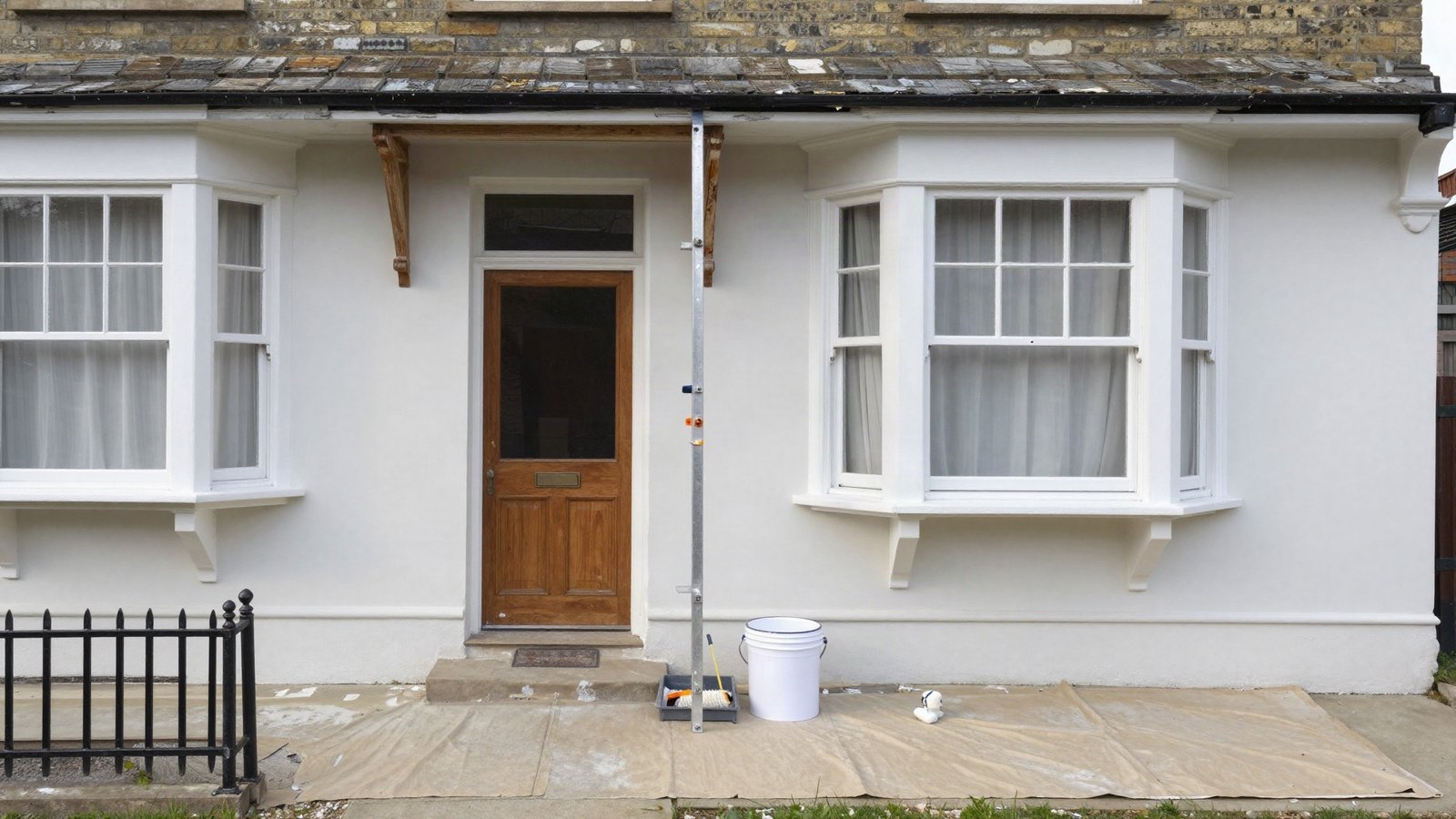
A failed repaint fails on a timetable, and the timetable tells you what went wrong. Blistering along the bottom of the render inside eighteen months means moisture came from behind. Crazing across pebbledash in year three means the film was too rigid for the substrate. Chalky masonry after one winter means the surface was never stabilised.
None of that is bad luck. It is a decision taken on a bright Saturday in April that the wall then remembers for a decade. The mistakes below are ranked by consequence: the first three can genuinely hurt somebody, and the rest cost you the price of doing the job twice — on a three-bed semi, another £1,800 to £3,500 in labour and access.
The three that can actually hurt you
Working at height is the big one. The Work at Height Regulations 2005 bind anyone doing this for a living, and the logic holds in your own garden too: a ladder is for short, light work, and a full gable end is neither. Anything over thirty minutes in one position wants a tower, and aluminium tower hire is only £60 to £90 a week. Pitch a ladder at 75 degrees, tie the stile off, and stay off the top three rungs.
The second is lead. Lead pigments were only banned from retail decorative paint in the UK in 1992, so anything on a pre-1970s property is a fair bet — window frames, front doors and cast iron especially. Dry-sanding it, or a heat gun above roughly 450°C, turns it into inhalable dust and fume. Wet-sand, use a low-temperature infrared stripper, bag the waste and keep children clear; see our guide to lead paint safety in older houses.
The third is the one nobody mentions: painting over things that need to breathe. Boiler flue terminals, gas meter box vents and air bricks must be left clear. Clogging an air brick starves sub-floor ventilation and, where an open-flued appliance depends on it, combustion air — a Gas Safe callout at best. Mask them, do not coat them.
Prep mistakes that guarantee an early repaint
Roughly 80% of an exterior job is preparation, and close to 100% of premature failures start there. These are the ones we see most on remedial visits.
- •Painting over sound-looking but unstable render. If a dry palm comes away chalky, it needs a stabilising solution first — one coat, left 24 hours.
- •Scraping only what falls off. Feather the edges back with 120-grit until you cannot feel the step, or every patch telegraphs through. Our walkthrough on removing peeling exterior paint covers where to stop.
- •Pressure washing at close range. A 2,000 psi lance held 100mm from render drives water into the wall and shreds soft mortar. Stand back 300mm on a 25-degree fan.
- •Painting damp. Masonry should read below about 16% on a protimeter, and new render needs four weeks to carbonate or alkali attack will bleach the film.
- •Interior-grade filler outside. Use an exterior cementitious or polymer-modified filler — and never seal a window frame's bottom drainage slots.
Using a paint your wall cannot breathe through
This is the most expensive mistake in the British housing stock. Pre-1919 homes were mostly built with solid walls, lime mortar and no damp-proof course; they manage moisture by letting it evaporate out through the fabric. Coat one in modern acrylic or pliolite masonry paint and you have put a raincoat on it. Water still gets in through cracks and driving rain but can no longer leave, so it pushes the film off from behind.
For solid-wall, lime-rendered or soft brick elevations, use a vapour-permeable mineral system: silicate or traditional limewash. Look for permeability class V1 to EN ISO 7783, not marketing language. Cavity-walled post-1930s homes with sand-cement render are fine with conventional masonry paint.
Getting the UK weather window wrong
The tins say 'apply above 5°C'. That is a surface temperature, not the figure on your weather app — a north-facing wall in October sits several degrees below air temperature all day.
Working rules: surface above 8°C and rising for masonry paint, above 10°C for oil-based trim, humidity below 85%, and the surface at least 3°C above dew point or the film blooms. Allow 24 rain-free hours after water-based masonry paint, 48 for oil-based. That means late April to mid-September across most of England and Wales, and a tighter May-to-August window in Scotland and the north-west. Stop applying by 3pm in September — dew lands early and a chilled, half-cured film finishes patchy and soft. Our guide on the best time of year to paint outside breaks the season down further.
Timber, joinery and decking mistakes
Bare end grain absorbs water several times faster than face grain, and it is the commonest entry point on window frames, fascias and cladding. Prime every cut end, including the ones nobody will see, and the back face of any board you replace.
Other habits worth breaking: laying opaque stain over old decking oil without stripping, because it will not key; and putting film-forming paint on horizontal timber such as handrails and deck boards, where standing water gets under the film and lifts it. On decking, allow two dry days either side and follow our deck staining guide rather than working off a freshly jet-washed board.
Where UK rules genuinely bite
Painting the outside of a normal house needs no planning permission and no building control approval. There are five real exceptions, and getting them wrong costs more than time.
- •Listed buildings. Repainting in a different colour or paint type can need listed building consent, and unauthorised work is a criminal offence carrying an unlimited fine. Ring the conservation officer first.
- •Article 4 Directions. Many conservation areas have had permitted development rights withdrawn for external alterations, including painting previously unpainted brick or stone. Check the council's planning portal.
- •Scaffolding on the pavement or road. That needs a highway authority licence under the Highways Act 1980, typically £80 to £250 for a few weeks. Confirm your scaffolder has obtained it.
- •Re-rendering more than 25% of an elevation. Past that threshold it becomes a controlled thermal element under Part L: building control notification, and usually an insulation upgrade.
- •Landlords. Section 11 of the Landlord and Tenant Act 1985 puts the structure and exterior on the landlord, and the Homes (Fitness for Human Habitation) Act 2018 makes damp from failed exterior fabric actionable.
When to stop and call a decorator
Stop if the wall is wet and will not dry, if render sounds hollow across more than a small patch, if pre-1970s paint cannot be kept wet, or if the elevation is above two storeys. Those need diagnosis or proper access, and improvising either is a false economy.
How often should a UK exterior be repainted? Masonry paint on a sheltered wall lasts 8 to 12 years, an exposed west-facing elevation 6 to 8, and exterior joinery 3 to 5. Is one coat ever enough? Only over the same colour on a sound film. Can you paint UPVC? Yes, with a degrease and a multi-surface coating, but it voids most frame guarantees. More exterior guides sit in our Home Decor hub.
Found this useful?
There's plenty more — hundreds of guides and honestly-tested product reviews for every corner of your home.
Browse All Guides