Product Reviews · 6 min read · 18 April 2026
The Best Deck Stain UK (2026): What Actually Survives a British Winter
Most decking finishes fail because of what was underneath them, not what was in the tin. Diagnose the deck first, then pick from four products that hold up to a British winter.
By the Nims Casa editorial team — written from professional cleaning experience and checked against our editorial standards.
Affiliate disclosure: if you buy through links in this article we may earn a small commission at no extra cost to you. Our recommendations come from professional cleaning experience and are never influenced by retailers or brands.
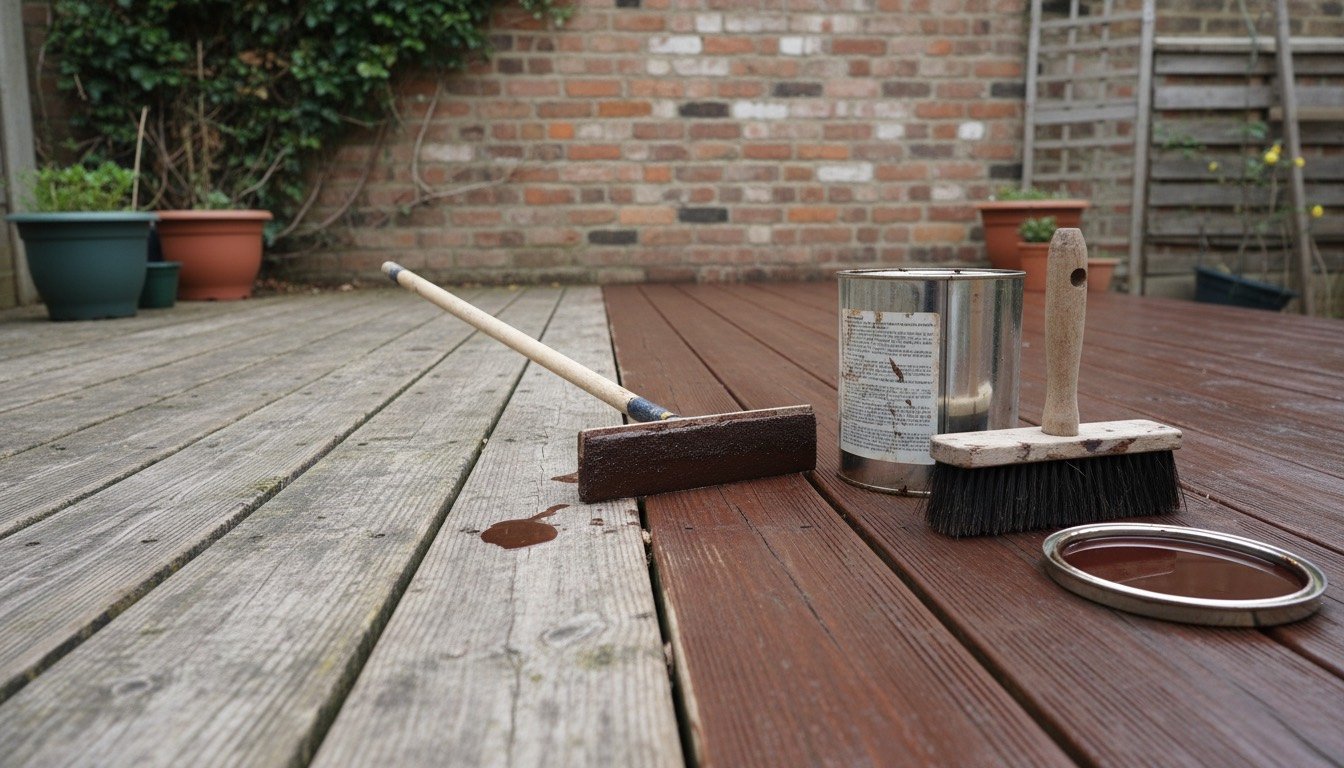
Nine times out of ten, when someone says their decking treatment "only lasted one summer", the tin was not the problem. The deck was damp inside, or still carried a film of old varnish, or was new tanalised timber that had never weathered enough to absorb anything. The product is a third of the outcome; prep and diagnosis are the rest.
So this guide diagnoses first. Ten minutes of testing tells you whether you need a penetrating oil, a water-based semi-transparent, an anti-slip finish, or a stripper and a free weekend.
Our top picks at a glance
Ronseal Ultimate Protection Decking Stain
~£38–45 (5L)A water-based semi-transparent that soaks into weathered softwood rather than sitting on it, and holds colour noticeably better through a British winter than the cheaper alkyd stains. It is the safe default for a standard pressure-treated deck that has weathered for a season or more.
Pros
- ✓ Rain-resistant in about an hour, a real advantage in an unsettled UK spring
- ✓ Fades evenly instead of peeling, so the next recoat is a wash rather than a strip
Cons
- ✗ Coverage on grooved boards is nearer 6 m² per litre than the claimed figure
- ✗ Colour on the lid is optimistic — always test a board first
Osmo Decking Oil (009 Larch / 016 Bangkirai)
~£58–70 (2.5L)A natural oil blend that feeds dense hardwood such as balau, iroko and ipe instead of trying to form a skin on it, which is exactly what general decking stains get wrong on these timbers. Expensive per tin, but the coverage is genuinely high and it is nearly impossible to apply badly.
Pros
- ✓ Very high real coverage — one 2.5L tin does a 20 m² hardwood deck for a maintenance coat
- ✓ No lap marks and no peeling; upkeep is a light single coat, not a strip
Cons
- ✗ Costly upfront and hard to find outside specialist merchants and online
- ✗ Slow to cure in cool weather — allow 24 hours between coats, not the optimistic 12
Cuprinol Anti-Slip Decking Stain
~£28–34 (2.5L)Fine aggregate suspended in a coloured stain, aimed squarely at the north-facing deck that turns into an ice rink after October rain. It works, and it is the cheapest fix for a genuine slip hazard short of retrofitting grip strips.
Pros
- ✓ Measurably better grip when wet, which matters most on steps and by doorways
- ✓ Widely stocked in the big DIY sheds, so topping up mid-job is easy
Cons
- ✗ Must be stirred every 10 minutes or the grit settles and traction goes uneven
- ✗ The textured finish traps dirt and needs a firmer scrub at the annual wash
Barrettine Decking Oil
~£28–35 (5L)A straightforward penetrating oil with an added fungicide, sold in 5-litre tins at a price that makes treating a 40 m² deck properly rather than thinly affordable. The finish is plainer than the premium options, but it soaks in well and never peels.
Pros
- ✓ Lowest cost per square metre of the four by a clear margin
- ✓ Forgiving on tired, grey timber where film-formers look blotchy
Cons
- ✗ Limited colour range and fairly muted tones
- ✗ Needs recoating annually on exposed boards — plan for it rather than hoping
Start here: six tests that tell you which product you need
Do these on a dry day, at least 48 hours after rain. They head off the two costliest mistakes in decking: coating over a live film, and coating over damp timber.
- •The splash test. Flick a mug of water onto three boards — under the eaves, mid-deck, and at the exposed edge. Beads still sitting after 60 seconds mean a working finish is present and needs no recoat. Timber that darkens within 10 to 20 seconds is bare and thirsty.
- •The scrape test. Drag a coin edge across a hidden patch. Chips or sheets lifting means a film-former — old varnish, yacht coating or solid stain — which must come off entirely, or anything brushed over it peels within a year. Coloured dust alone means a penetrating finish you can clean and recoat.
- •Timber identification. Sawn softwood with an olive-brown cast is pressure-treated redwood — the standard UK deck, and what nearly every stain on the shelf is formulated for. A dense, dark off-cut that sinks in a bucket is hardwood (balau, iroko, ipe) and wants a hardwood oil. Ribbed boards with a plastic sheen are composite: never coat them.
- •The black-mark test. Scrub a black patch with a sodium-percarbonate deck cleaner. If it lifts, it was algae and a biocidal stain will hold it off. If it stays and radiates from a screw head, it is iron tannate staining and needs oxalic acid. If a screwdriver sinks 5 mm, that board is rotten.
- •The moisture check. A £20 pin meter should read under 18 per cent after two dry days. Above 20 per cent, water-based stains go patchy and oils sit on top and stay tacky.
- •The age check. New pressure-treated boards are saturated with preservative and reject oil. Weather them 8 to 12 weeks through spring or summer, splash-test again, then treat. Hardwood needs six months.
How we judged these — and what we did not do
Straight disclosure: this is not a lab test. There is no accelerated weathering cabinet behind it, and we would not trust one to predict a Manchester winter. Behind it is repeat trade use — the same products applied and reapplied on domestic decks in the north-west and on the south coast across several seasons — plus each maker's technical data sheet, read properly.
Scoring came down to real coverage against the claim on grooved softwood, how forgiving the wet edge is across a 20 m² deck in sun, whether the quoted recoat interval matches reality, high-street availability, and grip once wet.
The four we keep buying
The picks cover the four realistic UK scenarios: sound softwood needing colour, hardwood needing feeding rather than coating, a shaded deck that turns lethal after rain, and a large deck where cost per square metre outweighs looks. If you have not applied one before, read our step-by-step method for staining a deck alongside this.
What to look for on the tin
Labels are written by marketing departments; technical data sheets are not. Check these before the till.
- •Penetrating or film-forming. Penetrating finishes soak in and fade; film-formers look better for longer, then peel. On boards walked on and rained on, penetrating wins — the failure mode is gentler.
- •Coverage per coat, not per tin. Claims are measured on planed timber; on grooved boards expect 60 to 70 per cent of that.
- •Binder type. Water-based acrylics dry fast and hold colour; natural and alkyd oils penetrate deeper and forgive tired timber. Our breakdown of oil-based against water-based stain covers the trade-off.
- •Opacity. Semi-transparent shows grain and fades evenly; solid hides mismatched boards but behaves like paint. Read solid stain versus semi-transparent first — solid is a one-way door.
- •Biocide and anti-slip. Under trees or facing north, added fungicide earns its extra £5 a tin. Suspended grit works, but stir every 10 minutes or it settles and you get grip at one end only.
- •Rain-safe time, not touch-dry. Find the shower-resistance figure, usually 1 to 6 hours, and check the forecast against it.
What it actually costs, and how often you will redo it
Take a typical 20 m² deck. Bare, weathered grooved softwood drinks roughly 6 m² per litre on the first coat and 8 on the second, so budget 5 to 6 litres for two coats — two 5-litre tins, about £70 to £85. Add cleaner at £12 to £18 and a pad and pole at £20 and you are at £105 to £125, a little over £5 per square metre. A decorator charges £9 to £15 per square metre to clean and treat the same deck.
Recoat intervals, honestly: a water-based semi-transparent on a south-facing deck looks tired at 12 to 18 months; a hardwood oil at about 12 months on exposed boards, two years under a pergola; a solid stain holds three years, then needs stripping rather than recoating. The cheapest way to stretch any of them is an annual wash — see cleaning and reviving wooden decking — plus a maintenance coat on the sunniest third only.
Common buying mistakes
Each of these has cost someone a weekend of stripping.
- •Buying a stain to fix a slip problem that is actually algae. Clean first, then decide whether you need anti-slip at all.
- •Buying colour from the lid. Decking shade varies hugely with the timber underneath, and most stains dry two shades lighter. Test one board at the back.
- •Buying one tin. Running out mid-deck leaves a lap line where the wet edge died, plus batch shade variation. Buy for both coats at once.
- •Buying a film-former for boards that move. Softwood cups and twists through a British year, and rigid films crack along the grooves within two winters.
- •Buying in August for a job in October. Below 8°C, or above about 80 per cent humidity, most stains will not cure — the best time to paint outside applies here too.
- •Treating a deck that needs joinery. Two soft boards, treat it. Six, replace first.
When no stain is the right answer
If the splash test shows a live coating everywhere, this year is a wash and nothing else. If the scrape test lifts sheets of film, budget for stripping or sanding first — two days on a 20 m² deck, and the point at which many hand it over. If the joists are soft where they meet the ground, stop and call a carpenter.
Otherwise put the diagnosis on a repeatable footing with our deck maintenance checklist, wash every April, and treat on the first settled dry week in May or September. That rhythm, not any particular tin, keeps a timber deck respectable for fifteen years.
Found this useful?
There's plenty more — hundreds of guides and honestly-tested product reviews for every corner of your home.
Browse All Guides