Home Decor · 6 min read · 14 August 2026
Coffee Table Styling: The Three-Layer Rule and Other Designer Tricks
The tray-books-organic method, height triangles and the cup test: how professional stagers dress a coffee table that survives real life, mostly from charity shops.
By the Nims Casa editorial team — written from professional cleaning experience and checked against our editorial standards.
A styled coffee table photographs beautifully right up until someone wants to put a mug down. The gap between magazine styling and a table your household can actually live with is what this guide closes, using the same tricks we lean on when staging homes for sale, where a table has to look considered in the photographs yet survive a full week of viewings.
Little of it requires real money. Most tables we dress carry under £40 of accessories, and half of that comes from charity shops. What it does require is working out which problem your table actually has, because the fix for clutter is the opposite of the fix for flatness.
First, Diagnose What's Actually Wrong
Before buying a single vase, spend thirty seconds matching your table to one of the faults below. The honest answer to what to put on a coffee table depends entirely on which fault you have — a beautiful tray added to a cluttered table just gives the clutter a frame.
- •The flatline: everything sits under 5 cm tall — remotes, coasters, a slim paperback. Nothing draws the eye. Fix: height triangles (below), not more objects.
- •Genuine clutter: post, chargers, homework, yesterday's plates. That is a storage problem, not a styling one. Fix: a lidded box and the routine in how to declutter room by room, then style what remains.
- •The lonely object: one candle adrift on a metre of oak. Fix: grouping in odd numbers, not a bigger candle.
- •No landing space: styled so completely there is nowhere to set a cup. Fix: subtraction, until roughly 40% of the surface is clear.
- •Scale mismatch: the table itself is wrong for the sofa or the room, and no accessory fixes that. Fix: sort the layout first with how to arrange furniture in a small living room before spending a penny on decor.
The Three-Layer Rule: Tray, Books, Organic
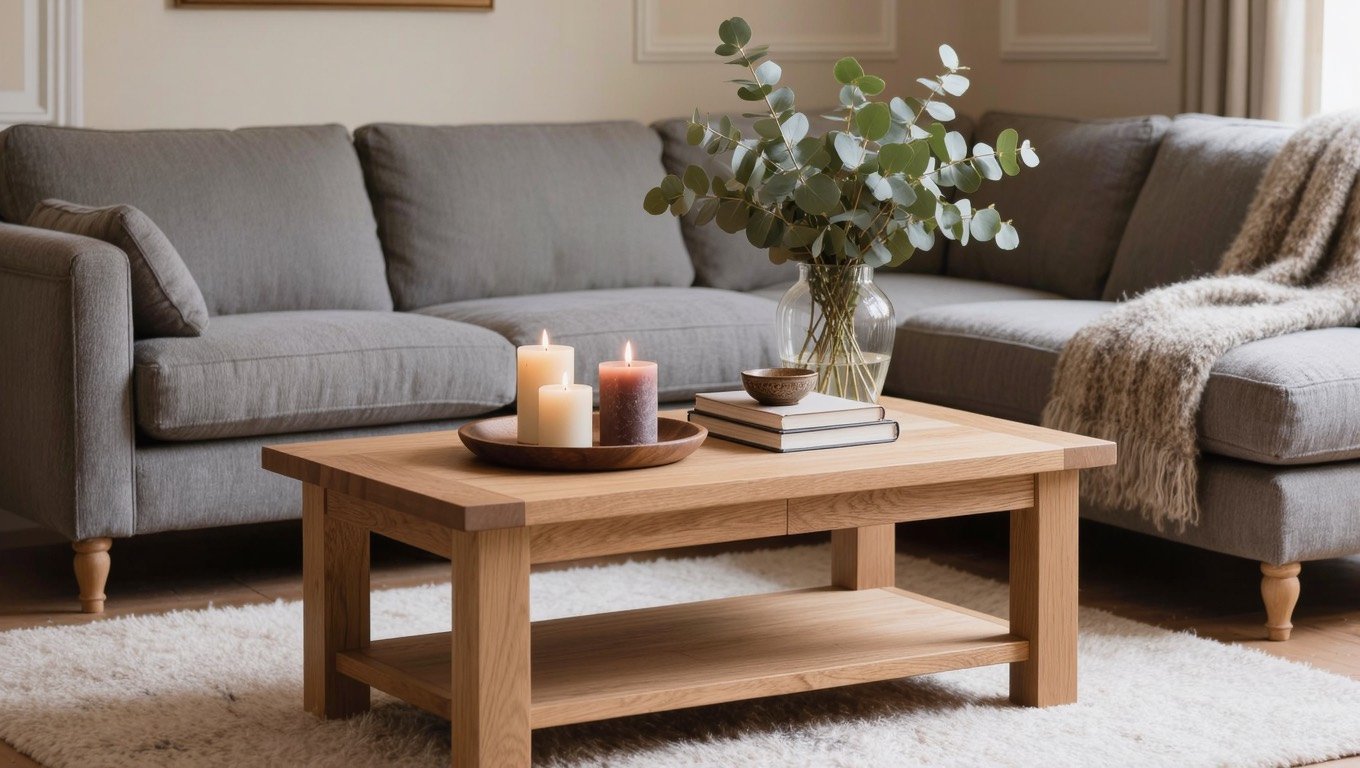
This is the method stylists reach for first, and it answers most coffee table decor ideas in one pass. Layer one is a tray. It draws a boundary, pulls small objects into one deliberate shape and makes tidying a ten-second job because everything lifts off at once when you need the whole surface. For a standard 110–120 cm table, a 35–45 cm tray is about right, and it should never cover more than a third of the top.
Layer two is books. Two or three stacked hardbacks, largest at the bottom, spines facing the seating, add 8–12 cm of lift and a clean block of colour. New coffee table books run £25–£50; charity shops sell the same photography, travel and interiors titles for £3–£6, and no guest has ever checked a publication date.
Layer three is something organic, which is what stops the arrangement looking like a shop display. A small potted plant, a jug of garden stems, a bowl of lemons or unshelled walnuts all work. It does not need to be alive: dried hydrangea heads or a piece of driftwood do the same job right through winter for nothing.
Height Triangles and the Cup Test
Sit on your sofa and look at the table straight on. The objects should form a loose triangle: one tall element at 25–35 cm (a vase with stems), one middle at 12–18 cm (the book stack topped with a small bowl or candle), one low at under 8 cm (the tray and its contents). Even heights read as a flatline; the triangle gives the eye a route around the surface.
Then run the cup test, which is where most styling falls over. Sit down, reach out and put a cup exactly where your hand naturally lands. If you had to move anything to do it, remove an item — permanently, not to the shelf behind you. A working table keeps 40–50% of its surface empty, and that negative space is a design feature, not a gap you have failed to fill.
Budget Tiers and Where the Money Goes
Styling is one of the few decor jobs where the £15 version can genuinely stand next to the £150 one, because charity shops are stocked with exactly the objects stylists buy: trays, vases, brass odds and ends, hardbacks.
Where the money actually goes is weight and material. A £70 solid marble tray and an £18 resin copy look identical in photographs; in the room, the heavy one reads expensive and stays put when a child knocks the table. If you are splitting a small budget, put it all into one heavy object and fake the rest.
- •Under £15: wooden or lacquered tray £3–£5, two hardbacks £6, small stoneware or glass vase £2–£4, foliage cut from the garden for free. Charity shops in wealthier postcodes are reliably the best hunting grounds.
- •£15–£60: TK Maxx, Homesense, Dunelm and IKEA own this bracket — a ceramic vase £12–£20, a marble-effect tray £15–£25, one new coffee table book at £25 as the centrepiece.
- •£60–£150: one investment object — a handmade ceramic bowl, a solid marble tray, a proper brass candlestick — surrounded by cheap supporting pieces that borrow its credibility.
Small Tables, Nests and Ottoman Variants
A 60 cm table in a compact British sitting room cannot take three layers — one layer, done well, is the ceiling. A single tray holding a small plant and one book looks intentional; the full triangle looks like a car boot sale. Nests of tables solve the space problem more honestly: style only the largest, keep the smaller ones bare as landing pads, and steal the rest of the layout thinking from our small living room ideas.
Upholstered ottomans need a rigid tray as a foundation, because nothing sits level on foam. Go larger than you would on a hard table, 45–55 cm, and treat the tray as the entire styling zone — anything placed outside it will slide the first time someone sits down.
Kid-Proof, Pet-Proof and Seasonal Swaps
With small children or a tail-wagging dog, style for the crash: wood instead of glass, woven instead of ceramic, nothing precious below shoulder height on an adult. Skip lit candles entirely and choose greenery from the pet-safe houseplants list — lilies within reach of a curious cat are a vet bill, not a styling choice. Coasters are non-negotiable on solid timber, and if the white rings have already happened they are usually fixable; see how to repair wood furniture before you consider replacing anything.
Seasonal swaps need a shoebox, not a budget. Keep the tray and books constant all year and change only the organic layer plus one accent: fresh stems and pale linen coasters through summer, then dried seed heads, an amber candle and a rust-toned book jacket from late September. Two swaps a year is plenty. Finally, check the arrangement after dark as well as at noon — a table that works in daylight can vanish completely at night, and our lighting layers guide explains why a lamp within reach of the sofa changes everything.
Ten minutes twice a year, £40 of mostly secondhand objects and a ruthless cup test: that is the entire trade secret.
Found this useful?
There's plenty more — hundreds of guides and honestly-tested product reviews for every corner of your home.
Browse All Guides