DIY & Maintenance · 10 min read · 30 September 2026
Is Your Extractor Fan Actually Working? Trickle Vent Checks 2026
A practical check of the extract fans and trickle vents most UK homes already have, including what a tissue test can and cannot tell you.
By the Nims Casa editorial team — written from professional cleaning experience and checked against our editorial standards.

The first cold nights of autumn are often when ventilation problems show themselves. The windows are streaming in the morning, the bathroom mirror stays wet long after a shower, and that little extract fan on the wall is making the same noise it has made for years.
I have tested plenty of domestic fans that sounded busy but were shifting very little useful air. I have also found trickle vents painted shut, clogged with dust or closed because nobody was quite sure what they were for. These are simple pieces of kit, but they depend on air being able to enter, move through and leave the home.
Before getting into the checks, one important point about standards. Approved Document F is the statutory guidance for Part F of the Building Regulations in England. Its current dwelling guidance came into force on 15 June 2022, and its requirements apply when relevant building work is carried out, such as fitting a new fan, creating a wet room, replacing windows or doing certain energy-efficiency work. It does not mean an untouched older house must be retro-fitted to current standards. I use its figures here as the benchmark a competent installer designs towards and as a useful yardstick for judging existing kit. Scotland, Wales and Northern Ireland have their own building standards, which this article does not cover.
Is My Bathroom Extractor Fan Actually Working?
The quickest check is to listen and look, but neither tells you very much on its own. A fan can spin, make noise and still fail to clear moisture effectively.
In England, Approved Document F gives minimum extract rates for intermittent fans of 15 litres per second in a bathroom and 6 litres per second in a WC. A utility room is 30 litres per second. Kitchens need 30 litres per second where a cooker hood extracts outside, or 60 litres per second where there is no extracting cooker hood or the hood does not discharge outdoors.
Those figures are useful because they remind us what a fan is supposed to do: move a measurable quantity of air out of the building. You cannot judge litres per second by sound.
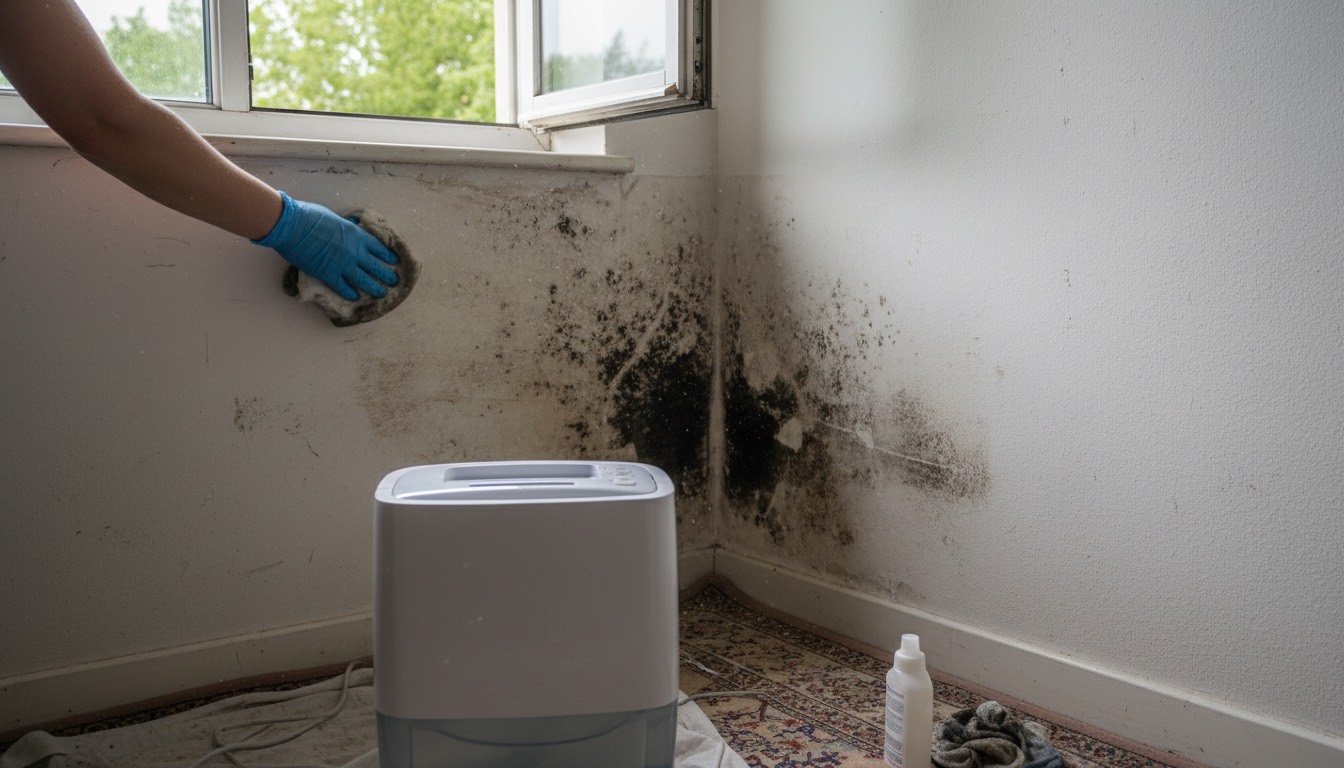
If you regularly see condensation lingering on bathroom surfaces, patches of mould or persistent moisture around windows, compare what you are seeing with these signs of poor home ventilation. Approved Document F's checklist for existing homes specifically tells installers to look for mould or condensation and to consider additional ventilation or specialist advice where either is present.
Position matters as well. Extract fans other than cooker hoods should be fitted as high as practicable and no more than 400mm below the ceiling. Warm, moisture-laden air rises, so a fan low down the wall is starting with a disadvantage.
How Do I Test My Extractor Fan At Home?
There are several useful checks you can make without dismantling anything. I normally start with the simple ones before reaching for measuring equipment.
The tissue test is only a first check. It proves that the fan is moving some air; it does not tell you how much air it is moving in litres per second.
For that, you need an anemometer or a flow hood, which is what a commissioning engineer uses to measure airflow properly.
This distinction matters because a fan can pass the paper test and still be nearly useless. I have seen bathroom fans discharging into loft spaces rather than outside, and fans connected to long flexible ducts with deep sags. Both arrangements can produce enough suction at the grille to hold tissue while doing a poor job of removing moisture from the home.
- •Switch the fan on and hold a single piece of lightweight tissue or paper loosely against the grille. If it pulls towards the grille, the fan is moving some air.
- •Let the fan run and check whether air is actually leaving through an outside grille or terminal rather than disappearing into a loft, ceiling void or cupboard.
- •Look at any visible ducting for crushed sections, sharp bends or long runs of flexible duct that sag between supports.
- •Clean obvious dust from the fan grille and make sure the shutters or external grille are not stuck.
- •With the bathroom or kitchen door closed, check whether there is a reasonable gap beneath the door so replacement air can reach the room.
- •If the fan runs after you leave a windowless room, check that the overrun continues for at least 15 minutes, which is the benchmark in Approved Document F for an intermittent fan in a room with no openable window.
Why Is My Extractor Fan Running But Not Clearing Steam?
A working motor is only one part of the ventilation path. Air has to enter the room, reach the fan, travel through the duct and discharge outside.
One common problem is resistance in the duct. Flexible ducting that is unnecessarily long, sagging or tightly bent makes life harder for a small domestic fan. Another is a blocked or dirty terminal outside. Sometimes the fan itself is coated with fluff and dust.
The route into the room is just as important. Approved Document F says internal doors should allow air to move through the home, using a free area equivalent to the gap created by a 10mm undercut on a 760mm-wide door. The principle is straightforward: if the fan is trying to push air out, replacement air must be able to get in.
That is where trickle vents become part of the same story. Closing every window vent because the house feels draughty can reduce the path that supplies air to an extractor. If cold air around windows is the problem, it is better to work out how to fix a draughty window than to assume every controllable ventilator should remain permanently shut.
In kitchens, also check what the cooker hood actually does. Some hoods recirculate air through filters rather than extracting outdoors. Approved Document F treats a kitchen with no externally extracting hood differently from one where the hood genuinely vents outside.
What Are Trickle Vents And Should I Leave Them Open?
Trickle vents are the small controllable openings normally built into the upper part of a window frame. Approved Document F calls them background ventilators.
Their job is different from an extract fan. The fan removes air from a wet room; background ventilators provide controlled openings through which outdoor air can enter the home. They help create a route for air to travel across the dwelling towards extract points.
The existing-home checklist in Approved Document F asks directly whether all background ventilators have been left in the open position. That does not mean you should ignore a genuinely uncomfortable cold draught, but permanently closing every vent can undermine the ventilation strategy.
If you are trying to keep a room warmer, remember that controlled ventilation and uncontrolled leakage are not the same thing. Sealing unwanted gaps can make sense, but you still need deliberate ventilation. Our guide to stopping heat escaping through windows explains the wider distinction.
A window left slightly open on a night latch is not treated as adequate background ventilation in Approved Document F. The guidance gives three reasons: the risk of draughts, security concerns and the difficulty of measuring the equivalent ventilation area.
Where a facade is close to sustained loud noise, such as a main road, the guidance says a noise-attenuating background ventilator should be fitted rather than simply abandoning background ventilation.
How Can I Tell If My Trickle Vents Are Big Enough?
This is one area where appearances are misleading. Approved Document F sizes background ventilators by equivalent area, measured in square millimetres, rather than simply by the visible slot size or "free area". The equivalent area should be marked somewhere that is easy to see from inside the room.
For naturally ventilated homes in England, the current benchmark is 8,000mm² equivalent area in each habitable room and kitchen of a multi-storey dwelling, and 10,000mm² in a single-storey dwelling. Bathrooms have a benchmark of 4,000mm². There is no stated minimum in that table for utility rooms or WCs.
Across the dwelling, the guidance says there should be background ventilators in at least five habitable rooms and kitchens, or four in a one-bedroom property.
Do not assume that a new-looking window automatically has suitable ventilation. When existing windows with background ventilators are replaced, Approved Document F says the replacement windows should include ventilators that are not smaller than the originals and are controllable either automatically or by the occupant.
Where replacement windows are being fitted and the originals had no background ventilators, one route described in the guidance is at least 8,000mm² equivalent area in habitable rooms, 8,000mm² in a kitchen and 4,000mm² in a bathroom.
If you are dealing with condensation after new glazing has gone in, it is worth reading our September condensation prevention guide alongside these checks.
Why Do Extract Fans And Trickle Vents Need Each Other?
Domestic ventilation works as a path, not as a collection of isolated products. Air comes in through controlled openings, passes through living spaces and under internal doors, reaches wetter rooms and is extracted outside.
Approved Document F says a fan and a background ventilator in the same room should be at least 500mm apart. The reason for checking the whole path is practical: you want fresh air to travel through the room rather than immediately entering beside the fan and leaving again.
Everyday moisture loads also matter. Showering, cooking and drying laundry indoors all add water vapour to the air. If indoor drying is unavoidable, our guide to drying clothes indoors without damp covers ways to manage the moisture rather than relying on a small fan to deal with everything afterwards.
If the existing fans and background ventilation are working properly but the house still needs a more comprehensive approach, that becomes a different conversation. PIV, MEV and MVHR are whole-house systems, and I would assess those separately rather than treating them as an automatic upgrade from a dirty fan or closed trickle vent. Our whole-house ventilation system guide covers those options.
What Should I Do If My Ventilation Is Not Working Properly?
Start with the inexpensive faults: clean the grilles, open controllable trickle vents, confirm the duct actually reaches outside and make sure air can move beneath internal doors. Those checks solve some very ordinary problems without turning the job into a major project.
If the fan still seems weak, have its extract rate measured rather than guessing from the noise or tissue test. The result can then be compared with the relevant benchmark for the room.
For a replacement fan or altered wet room in England, the installer should be designing to the current Part F requirements that apply to that work. In a kitchen, check whether the cooker hood genuinely extracts outside. If no manufacturer dimension is given for an externally extracting hood, Approved Document F gives a position between 650mm and 750mm above the hob surface.
With replacement windows, make sure the ventilation provision is considered as part of the installation rather than after the frames are fitted. Removing existing background ventilation without suitable replacement can change how air moves through the home.
Most importantly, separate a ventilation fault from a wider heat-loss problem. A cold surface can encourage condensation, but blocking deliberate ventilation to make a room feel warmer can create another problem. The aim is controlled airflow with unnecessary leakage reduced, not a completely sealed home.
Frequently asked questions
**Does the tissue test prove my bathroom fan is powerful enough?** No. If tissue is drawn towards the grille, it shows that the fan is moving some air. It does not show whether the fan is achieving 15 litres per second or any other rate. Measuring airflow properly requires an anemometer or flow hood.
**Should trickle vents stay open in winter?** Approved Document F's checklist for existing homes asks whether background ventilators have been left open because they form part of the intended ventilation path. If a vent creates an uncomfortable draught, investigate the installation and the wider window condition rather than assuming that permanently closing all background ventilation is the best answer.
**Is a bathroom fan allowed to vent into the loft?** The ventilation guidance is based on extract ventilation discharging to the outside. A fan that simply pushes moist bathroom air into a loft is not performing that function, even if it passes a tissue test at the bathroom grille.
**Do I need a whole-house ventilation system if I have condensation?** Not necessarily. First establish whether the ventilation already installed is actually working: check the fans, ducts, trickle vents and airflow paths. Whole-house PIV, MEV or MVHR systems are a separate option to consider where a broader ventilation strategy is appropriate.
Found this useful?
There's plenty more — hundreds of guides and honestly-tested product reviews for every corner of your home.
Browse All Guides