Heating & Cooling · 6 min read · 13 May 2026
Whole House Ventilation Systems: The Complete UK Guide to PIV, MEV and MVHR
British homes used to ventilate themselves by accident, through sash boxes, suspended floors and open chimneys. We sealed all that up and kept the moisture. Here is how to put designed ventilation back in.
By the Nims Casa editorial team — written from professional cleaning experience and checked against our editorial standards.
Most British houses were never ventilated on purpose. They leaked — sash boxes, suspended timber floors, open chimneys, gappy skirtings — and that accidental air change carried moisture away before anyone thought about it. Then we sealed them: double glazing, loft insulation, filled cavities, capped flues. The leaks went. The four to six litres of water a family of four puts into the air each day did not. Black mould in the coldest bedroom corner is the arithmetic catching up.
In England and Wales this is not a matter of preference. Approved Document F sets the airflow rates a dwelling must achieve, and since June 2022 it applies to work in existing homes far more often than people realise.
What a whole house ventilation system actually is
It is a designed, continuous means of replacing air throughout a dwelling — not a bathroom fan bolted on wherever the damp showed. Part F sets a whole-dwelling rate of 0.3 litres per second per square metre of internal floor area, with bedroom-count minimums of roughly 19 l/s for a one-bed, then 25, 31 and 37 l/s. Separately it sets local extract: an intermittent kitchen fan needs 30 l/s over the hob or 60 l/s elsewhere, a bathroom 15 l/s, a WC 6 l/s.
Continuous systems run to lower figures — 13 l/s in a kitchen, 8 l/s in a bathroom, 6 l/s in a WC — because they never stop. A quiet fan at 6 l/s around the clock removes far more moisture than a noisy 30 l/s fan somebody switches off at the wall. Before spending, check the signs of poor home ventilation and where you sit against the ideal indoor humidity level.
The four systems Part F recognises, and the fifth Britain buys
Knowing which strategy you are being sold saves a great deal of arguing with installers.
- •System 1 — intermittent extract fans plus trickle vents. Cheapest and most common; only works if the vents are open, which in most homes they are not.
- •System 2 — passive stack. Vertical ducts from wet rooms to ridge terminals, driven by warm air rising. No electricity, no filters, but unpredictable in still, mild weather.
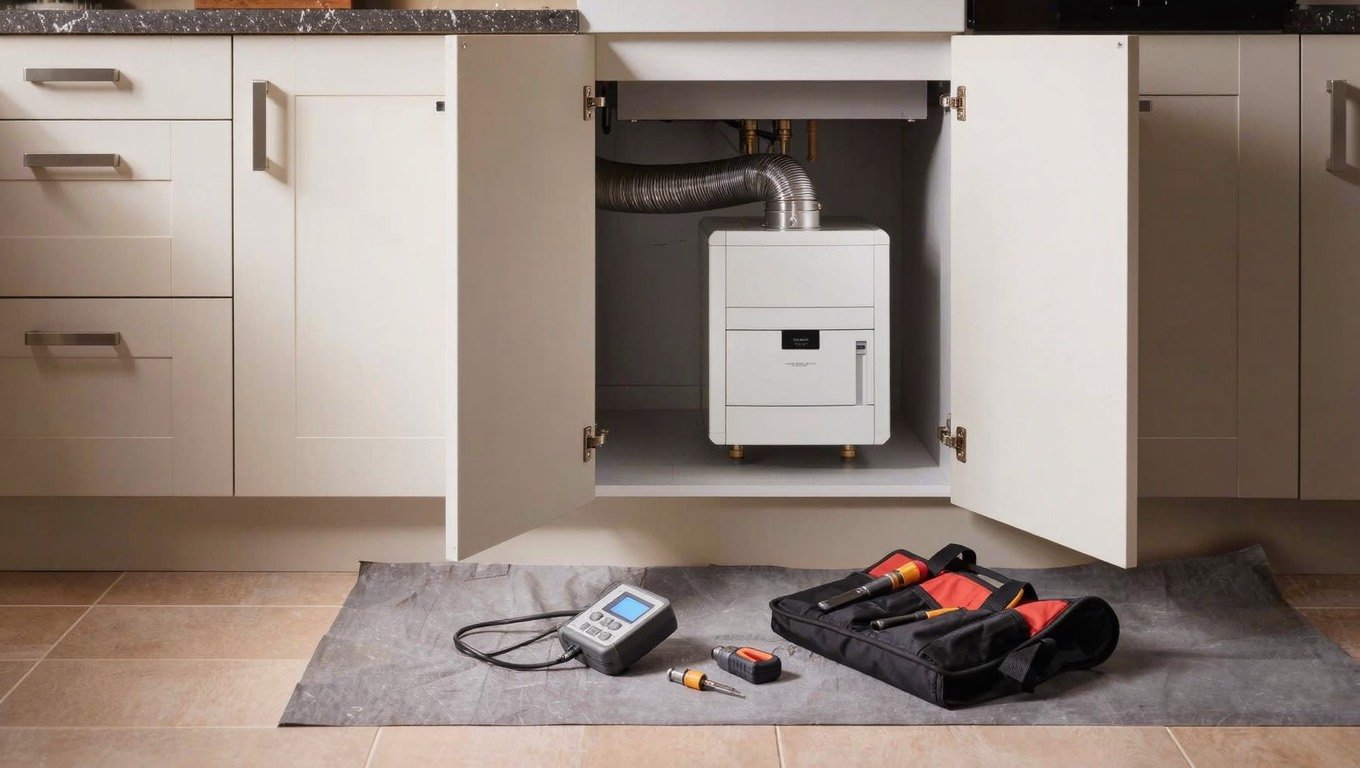
- •System 3 — continuous mechanical extract: a central MEV unit ducted to every wet room, or decentralised dMEV fans running permanently on trickle.
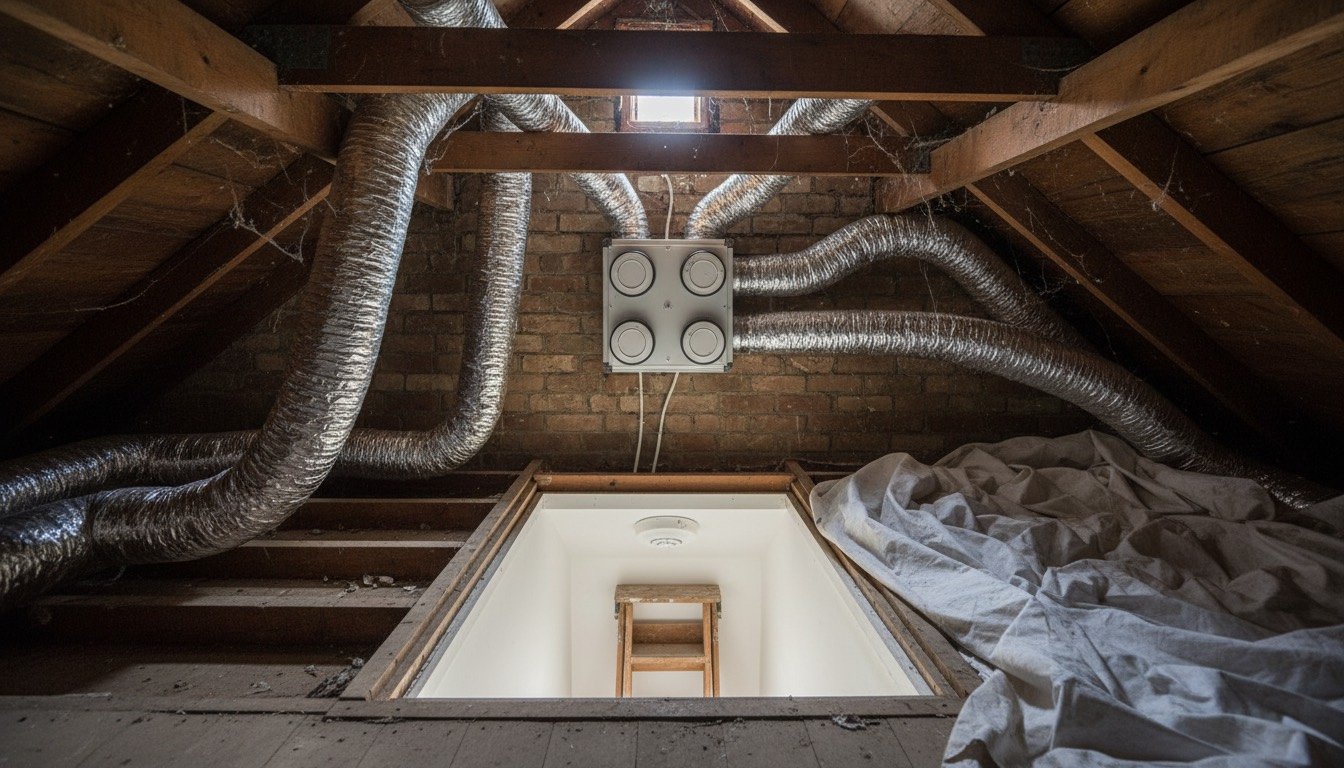
- •System 4 — MVHR. Balanced ducted supply and extract through a heat exchanger recovering 75–90% of outgoing warmth. Only makes sense in an airtight house.
- •Positive input ventilation (PIV) — not one of the four, but the dominant UK retrofit. A loft unit pushes filtered air into the landing, slightly pressurising the house and displacing moist air through existing gaps.
A decision tree for real UK housing stock
Stop at the first line that describes your house. It is the order we use on a survey.
- •Pre-2000 house, accessible loft, streaming windows, mould on cold bedroom walls — PIV at £450–£900 fitted. Very often the whole answer.
- •Flat or bungalow with no usable loft — wall-mounted PIV, or continuous dMEV in bathroom and kitchen.
- •Full refurbishment, floors up and ceilings down, targeting under about 5 m³/h·m² at 50 Pa — MVHR. The only realistic window for retrofitting ducting.
- •New build or large extension — decided at design stage; Part F steers tight dwellings towards System 3 or 4.
- •Listed building or conservation area — passive stack or discreet dMEV. Terminals and cowls need consent; do not assume permitted development covers them.
- •Tide marks and salt staining low on ground-floor walls — not ventilation. Fix the damp and mould cause first; no fan cures a failed damp-proof course.
What it costs in 2026
UK installed prices including labour, VAT and making good. London and the South East run 20–30% above.
- •dMEV continuous fan, one room: unit £60–£160, installed £180–£320 depending on the duct run.
- •PIV loft unit: hardware £250–£450, installed £450–£900. Most draw 2–6 W — roughly £5–£15 a year at 27p per kWh.
- •Central MEV ducted to three or four wet rooms: £1,200–£2,500 retrofit, £900–£1,500 in a new build with joists open.
- •MVHR: unit £900–£2,500; £2,500–£4,500 installed in a three-bed new build, £4,500–£9,000 retrofitted into an occupied house. Ducting is the cost, not the box.
- •Commissioning and airflow testing with a calibrated anemometer, plus certificate: £150–£350.
- •Consumables: MVHR G4 and F7 filter sets £25–£60 every six to twelve months; PIV filter £20–£35 every two to five years.
DIY, Part P, Gas Safe and building control
Ducting, terminals and grilles are fair DIY. Electrics and gas interactions are not. In England, Part P notifiable work covers new circuits, consumer unit changes and special locations, so a fan spurred off an existing lighting circuit usually is not notifiable — but Wales kept the wider pre-2013 scope, where kitchens, bathrooms and outdoor work still are. Bathroom zoning applies either way: IPX4 minimum in zones 1 and 2, SELV inside the shower zone. Our list of electrical jobs you should never DIY applies here too.
The gas point catches almost everyone. Where an open-flued appliance shares a room with an extract fan — a back boiler, gas fire or solid fuel stove — the fan can pull combustion products back down the flue. Kitchen extract is generally capped around 20 l/s there, and a spillage test by a Gas Safe registered engineer is mandatory. That is not paperwork; it is the mechanism behind carbon monoxide incidents.
Building control follows the work, not the fan. Replacement windows must not leave a room worse ventilated than before, which is why compliant installers fit background ventilators of typically 8,000 mm² equivalent area in habitable rooms and kitchens, 4,000 mm² in bathrooms and utilities. Loft conversions and extensions pull the whole strategy into scope. Landlords carry a separate duty: damp and mould is a Category 1 hazard under the HHSRS, and Awaab's Law now imposes fixed investigation timescales on social landlords in England, extending to private renting under the Renters' Rights Act.
Maintenance, and what actually goes wrong
Ventilation fails quietly — nobody notices a blocked filter the way they notice a dead boiler, they just start wiping windows again. Diarise filter changes, clear cobwebs and wasp nests from external terminals each autumn, and vacuum wet-room valves without rotating them, because turning a valve changes its commissioned airflow. The two faults we see most are flexible ducting sagging into a U in the loft and filling with condensate, and MVHR units left on trickle by someone who found them noisy. Both are cheap to fix; both undo the entire installation.
Frequently asked questions
Will a dehumidifier do instead? It manages symptoms. A good unit pulls 10–20 litres a day and suits one problem room, but it recirculates the same stale air — our air purifier vs dehumidifier comparison sets out where each earns its place.
Does ventilation solve radon? Only partly. The UK action level is 200 Bq/m³ against a target of 100, and while positive pressure helps at modest readings, the standard remedy in affected areas such as Cornwall, Devon, Derbyshire and Aberdeenshire is a sub-floor sump — see our radon mitigation costs. Test first.
Does MVHR pay for itself? In a leaky Victorian terrace, no — recovered heat is dwarfed by fabric losses and retrofit ducting is brutal. In an airtight new build it saves real heating energy and delivers filtered air. Judge it on comfort first, savings second; there is more across the Heating & Cooling guides and our guide to improving indoor air quality.
Where to start: put a £15 hygrometer in the worst bedroom for a fortnight. It tells you more than any installer's survey, and turns the conversation from guesswork into numbers.
Found this useful?
There's plenty more — hundreds of guides and honestly-tested product reviews for every corner of your home.
Browse All Guides