DIY & Maintenance · 6 min read · 24 April 2026
Fibreglass vs Steel Exterior Door: Differences, Pros, Cons and UK Costs
Fibreglass composite dominates UK front doors; steel quietly wins the jobs nobody photographs. Here is how they compare on heat, security, ten-year cost and who is allowed to fit them.
By the Nims Casa editorial team — written from professional cleaning experience and checked against our editorial standards.
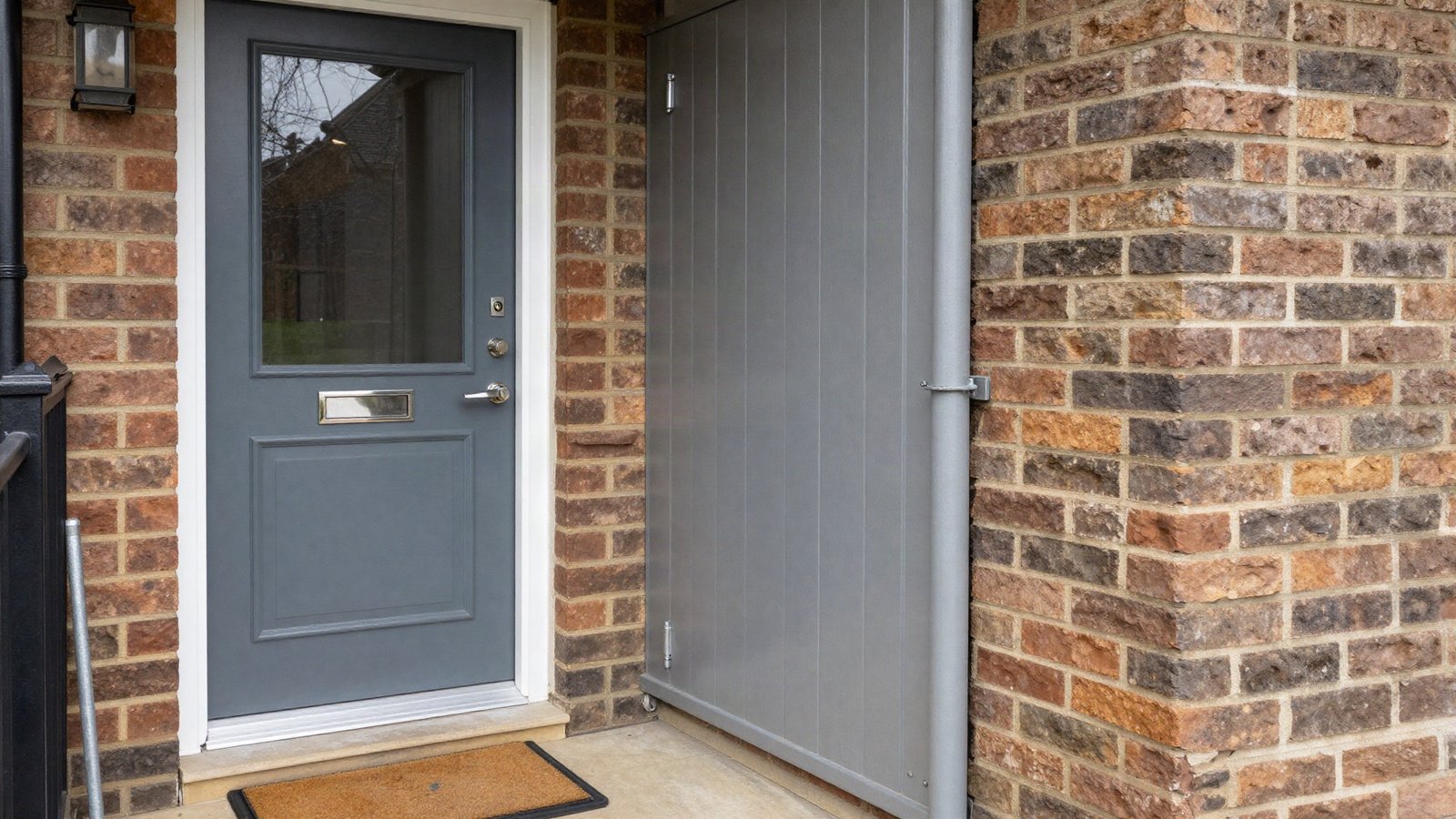
Walk any UK street built since 1990 and most front doors you pass are glass-reinforced plastic — GRP, or fibreglass — moulded around an insulated core and sold as a "composite" door. Steel is the quieter option: standard on communal blocks, rear entrances and HMOs, rarely pushed by high-street door companies.
Both keep the weather out. They behave very differently once a British winter gets hold of them, and they differ completely on who is allowed to fit them. This is the comparison we give on survey.
The short version: side by side
Prices are supplied-and-fitted for a standard 838 x 1981mm opening, spring 2026. Steel looks dearer because the UK domestic steel market is security doorsets, not economy leaves.
- •Fitted price — fibreglass composite £900–£1,800; steel £1,200–£3,500.
- •Whole-door U-value — fibreglass 1.0–1.4 W/m²K as standard; steel 1.0–1.8, and only with a genuine thermal break.
- •Leaf weight — fibreglass 40–48kg; steel 55–90kg, which dictates heavier flag hinges and through-fixings rather than frame screws.
- •Security — both reach PAS 24:2016. Every LPS 1175 SR2 and SR3 doorset on the UK market is steel, not GRP.
- •Impact — fibreglass flexes and recovers; a wheelie bin permanently dimples a steel skin.
- •Corrosion — fibreglass never rusts. Steel rusts wherever the coating is breached, and coastal salt finds those points inside two winters.
- •Service life — fibreglass 25–35 years; steel 30 years plus inland, 12–20 within a mile of the sea.
Performance through a British winter
Both use polyurethane foam cores at similar density, so the difference is the skin. Steel conducts heat roughly a thousand times better than GRP, so without a proper thermal break the inside face sits at 9–11°C on a -2°C night. Warm air condenses on it, runs down and pools at the threshold, and within three winters you have a swollen floor edge and black mould in the corner. A GRP inner face stays within 3–4°C of room temperature and stays dry. If you buy steel, insist on a thermally broken leaf and frame; "it's foam filled" is not the same answer.
GRP is otherwise close to inert: a dark colour fades slightly over 15 years. Steel's weak points are the bottom 100mm behind the weather bar and the hinge knuckles. Security is decided by ironmongery rather than material: most forced entries go through the cylinder, so specify TS007 3-star either way. And a dark composite leaf on a south-facing wall can gain a millimetre in a July heatwave and catch on the keep — thermal movement, not a fault, and hinge-adjustment territory, like squeaky and sticking doors.
Ten-year cost of ownership
Purchase price is only the opening figure. Three worked examples using real job costs:
Note what the energy line does not say. Swapping a draughty timber door (effective U-value near 3.0) for a 1.2 W/m²K doorset over 2m² saves about 170 kWh of gas a year — roughly £12 at 2026 tariffs. The gain comes from the compression seal killing the draught, not the slab, which is why draught-proofing what you already have is usually the better first spend. Our door installation cost guide splits labour from materials.
- •1930s semi, inland, GRP composite: £1,350 fitted + £45 cylinder upgrade + a DIY hinge adjustment = £1,395, or £140 a year.
- •Same house, thermally broken steel: £1,900 fitted + £75 in etch primer and enamel + £220 respray at year seven + £45 cylinder = £2,240, or £224 a year.
- •Coastal terrace 400m from the sea, steel: £1,900 fitted, annual waxing, then a new leaf at year 12 — £3,600 plus. GRP there costs no more than inland.
- •Sanity check: ask for any quote split into doorset, fitting, making good and registration.
Fitting: where DIY ends and a professional starts
Replacing an external door in England and Wales is notifiable under Building Regulations, and the new door must achieve 1.4 W/m²K or better. A FENSA- or CERTASS-registered installer self-certifies the job. Do it yourself and you must notify local authority Building Control first — £200–£400 plus inspection. Skip that and it surfaces during conveyancing, where indemnity costs more than notification would have. In Scotland a like-for-like swap needs no warrant but must still meet Section 6.
The safety boundary here is unusually clear:
- •DIY, if you are competent: measuring brick-to-brick and ordering; swapping a like-for-like GRP leaf into an existing frame where hinge and lock positions match; fitting cylinders, handles and letterplates; adjusting hinges and keeps to cure a stiff multipoint lock; renewing the seal and threshold weather bar.
- •Professional only — full doorset replacement with the frame out: lintel checks, cavity closers and damp-proof course detailing that go wrong invisibly.
- •Professional only — any opening being widened or altered. That is structural and needs Building Control sign-off.
- •Professional only — steel doorsets over about 60kg, needing a two-person lift and M10 through-fixings into masonry, not frame screws into a plasterboard reveal.
- •Professional only — FD30S fire doorsets to integral garages and flat entrances, certified as complete assemblies; a DIY fit voids the certification.
- •Professional only — any leasehold flat entrance or communal escape door, which needs freeholder consent before you order.
- •Stop immediately if you expose damp brickwork, a cracked or missing lintel, or wiring in the reveal.
Maintenance: what each door asks of you
Neglect a composite door and you get a stiff lock. Neglect a steel one and you lose the leaf.
- •Fibreglass: wash twice a year with warm water and non-abrasive detergent; silicone grease on rollers, hinges and keeps every autumn; test the seal by closing on a £5 note — if it slides out freely, the seal is spent. No pressure washer on woodgrain texture.
- •Steel: inspect the bottom 100mm and hinge knuckles every October; touch in chips within a week using etch primer and matched enamel; keep leaf litter off the threshold, where trapped damp starts rust; expect a respray at 7–10 years inland, 4–5 on the coast.
- •Both: keep the frame's outer drainage slots clear — the same logic as weatherstripping a door.
Who each door suits, and the verdict
For a front door on an ordinary UK house, fibreglass composite is right nine times in ten: better thermal behaviour as standard, no corrosion, no repainting, and a supply chain deep enough for three comparable quotes. Steel earns its place when the brief changes — rear and side entrances, HMO and flat entrance doors, workshops holding tools, and anywhere an insurer specifies LPS 1175. On a listed or conservation-area front elevation, expect refusal on both and budget to restore the timber.
Two recurring questions. Can a steel door go into an existing uPVC frame? No — weights and fixing patterns are incompatible, so it is a full doorset job. Do composite doors dent? They bruise, and a spray repairer removes a scuff for about £120; steel cannot be fixed that way. Next action: give three installers one brief — brick-to-brick size, target U-value, PAS 24:2016, TS007 3-star cylinder, colour, and whether FENSA registration and making good are included. If glazing is due too, price it as one visit; our window replacement cost guide shows where the combined saving sits.
Found this useful?
There's plenty more — hundreds of guides and honestly-tested product reviews for every corner of your home.
Browse All Guides