DIY & Maintenance · 6 min read · 27 April 2026
How Much Does Door Installation Cost? UK Prices for 2026
A joiner quoting £140 for one door and £1,800 for another is not being inconsistent. Here is what door installation actually costs in the UK in 2026, broken down line by line.
By the Nims Casa editorial team — written from professional cleaning experience and checked against our editorial standards.
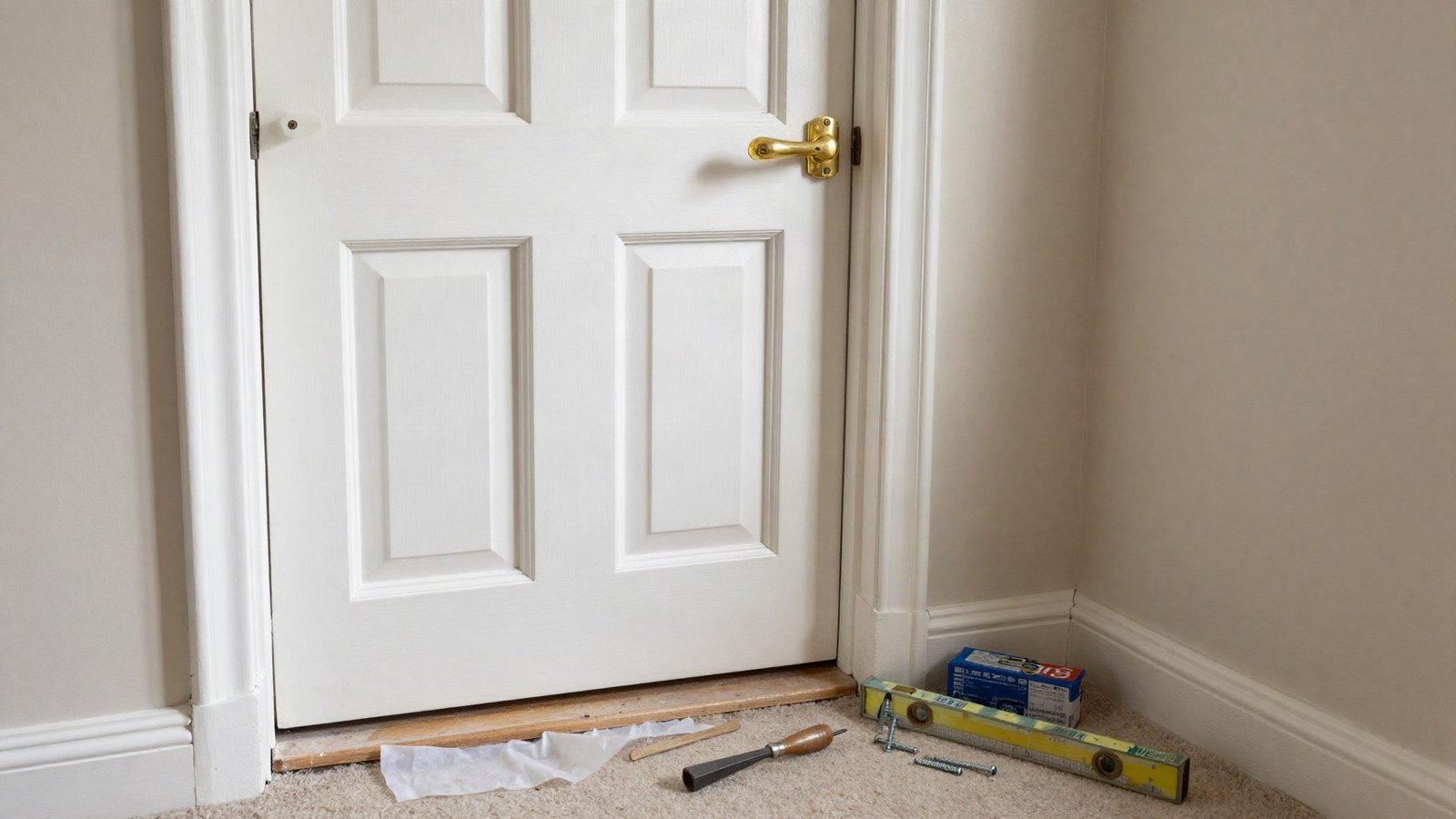
Two jobs share the name "door installation" and almost nothing else. Hanging a moulded internal door into a lining that is already square is two hours of a joiner's day and a £45 door blank. A front door means a made-to-measure doorset, a multipoint lock, Building Regulations compliance and a certificate your conveyancer will ask for. Quotes that look wildly inconsistent usually are not — they price different work.
The figures below come from installer quotes across England, Wales and Scotland, split into materials and labour. There is also a section for tenants, because for renters the answer is rarely "replace the door".
Typical UK Door Installation Costs in 2026
Supplied-and-fitted prices per door, including standard ironmongery, for a straightforward opening. Anything below a band means something is excluded — handles, disposal, or making good.
- •Hanging a basic internal door into a sound existing lining: £120–£220
- •Internal door with a new lining, architrave and ironmongery: £280–£480
- •Solid or engineered oak internal door: £320–£650
- •FD30 fire door with seals and certified hinges: £280–£550
- •uPVC front door £700–£1,300; composite doorset £950–£2,000
- •Hardwood or accoya front door: £1,400–£3,500
- •uPVC French doors, 1.5–1.8m opening: £1,100–£1,900
- •Sliding aluminium patio door, 2.4m: £2,200–£4,500
- •Aluminium bi-fold, three panels across 3m: £2,800–£5,500
Unit Costs: What Each Part Costs on Its Own
Pricing the parts separately is the fastest way to test a quote. If you fancy hanging the internal doors yourself, our walkthrough on installing an internal door covers the trimming and hinge-sinking that eats the day.
- •White primed moulded internal door, 762 x 1981mm: £28–£55
- •Oak veneered internal door £75–£160; solid oak £180–£350
- •FD30 fire door blank £70–£220, plus £9–£16 for intumescent and smoke seals
- •Softwood lining set £22–£40; architrave per opening £12–£28
- •Hinges £6–£18 a pair; tubular latch £4–£9; lever handles £14–£60 a pair
- •Composite doorset, supply only: £550–£1,300 by glazing and colour
- •Joiner day rate £190–£280 across most of the UK, £280–£380 in London, half-day minimum; a handyman is £35–£55 an hour
- •Building control notification without a FENSA or CERTASS installer: £150–£400
Labour vs Materials: Where the Money Goes
The split flips depending on the door. Internal work is labour-led: a £45 door and £38 of ironmongery against £130 of a joiner's time is roughly 40% materials, 60% labour. That is why four doors in one visit costs far less per door than two call-outs: you buy a day, not a door.
External doors reverse it. On a composite front door the doorset is 60–70% of the bill, fitting 15–25%, the rest making good, disposal and certification. On bi-folds the frame can be 80%, so shopping the fitter saves little and shopping the product saves plenty. Our comparison of composite and steel front doors shows where that difference sits.
What Moves the Price
Five things drive most of the variation between quotes.
- •Out-of-square openings. In Victorian and 1930s stock a lining is often 8–15mm out over its height; scribing the door to suit adds 45–90 minutes and £40–£90.
- •Fire doors. FD30 doors are heavier and need three certified hinges, routed-in seals and a 3mm gap tolerance — budget £120–£200 more per opening. Required between an integral garage and the house, and on rooms off the stairwell in three-storey homes.
- •Building Regulations. In England and Wales a replacement external door is controlled work and must hit 1.4 W/m²K or better. A FENSA or CERTASS installer self-certifies for £20–£30, usually inside the price. Part Q security standards apply to new dwellings only, whatever the sales patter claims.
- •VAT. A VAT-registered firm adds 20%; a sole trader under the £90,000 threshold does not. Two honest quotes can differ by a fifth on this alone.
- •The quiet exclusions. Disposal (£30–£60), cill boards, making good, and decorating — allow £45–£90 per internal door for two coats of eggshell.
Three Worked Examples, Line by Line
Real jobs, as invoiced. Notice how much is not the door.
- •Four internal doors, 1930s semi in Leeds, existing linings reused: doors 4 x £45 = £180; ironmongery 4 x £38 = £152; joiner, one and a half days at £220 = £330; sundries and tip run £25. Total £687, no VAT — £172 a door, because it was one visit.
- •Composite front door, semi in Bristol: anthracite doorset with obscure-glazed side panel £780, multipoint lock and 3-star cylinder included; fitting, four hours £220; making good render and plaster £60; disposal £30; certificate £22; VAT £222. Total £1,334.
- •2.4m uPVC French doors, bungalow in Kent: doors £860; removing a rotten timber pair £90; two fitters, five hours £320; cill board and architrave £70; making good £80; certificate £25; VAT £289. Total £1,734.
The Renter-Safe Version: What You Can Do Without Risking the Deposit
If you rent, replacing a door is neither your call nor your cost — doors are the landlord's fixture, and altering one without written consent breaches almost every assured shorthold tenancy. What you can fix reversibly, for under £30, is what actually annoys people: draughts and sticking.
Start with the hinges; a door that catches is usually a loose top hinge, not a swollen door, and our guide to squeaky and sticking doors covers the diagnosis. For cold, draught-proofing is still the cheapest saving open to a tenant. For the rest, see our reversible rental upgrades.
- •Self-adhesive EPDM strip in the rebate, £7–£12 for 10m. At check-out, warm it with a hairdryer on low and lift it with a plastic scraper.
- •Stick-on brush strip for the door bottom, £9–£16, not the screw-fixed type. Screws mean holes, and holes mean deductions.
- •Swap lever handles and keep the originals bagged. Most UK internal doors use 44mm centres, so a new set reuses the existing screw holes.
- •Never plane, drill, paint or cut a fire door. In a flat or three-storey house it is a life-safety component.
- •Never change the locks. Handing the original cylinder back at check-out does not undo the breach.
- •If an external door will not lock, seal or close, report it in writing. Structure and exterior are the landlord's responsibility under Section 11 of the Landlord and Tenant Act 1985.
Sanity-Checking a Quote, and How We Priced This
Get three quotes, discard the outlier in both directions, and ask the middle two the same questions. For two internal doors you rarely need a specialist joiner, so check handyman rates too.
Our figures come from installer quotes gathered January to March 2026 across ten UK postcode areas, cross-checked against merchant list prices and published joinery day rates. Labour rates exclude VAT; supplied-and-fitted bands include it. Prices track timber and aluminium costs, so treat them as a range to argue from. We review them annually.
- •Is this supply-and-fit or fit-only? The difference is often 60% of the total.
- •Are handles, locks and cylinders included? Excluding ironmongery quietly removes £60–£200 a door.
- •Does it cover architrave, making good and disposal — and is decorating in or out?
- •Is FENSA or CERTASS registration included, and the certificate issued in your name?
- •What U-value is stated for an external door? It should read 1.4 W/m²K or better.
- •How much deposit? Over 25% on a small fitting job is a warning sign; 40–50% is normal on a bespoke doorset, which takes 3–6 weeks. Pay to a business account, never cash.
Found this useful?
There's plenty more — hundreds of guides and honestly-tested product reviews for every corner of your home.
Browse All Guides