Heating & Cooling · 5 min read · 12 July 2026
Heat Pump vs Air Conditioner: What Actually Differs in a UK Home
The catalogue separates them. The refrigerant circuit largely doesn't. Here is what genuinely differs between a heat pump and an air conditioner in a British house, and where the DIY line sits.
By the Nims Casa editorial team — written from professional cleaning experience and checked against our editorial standards.
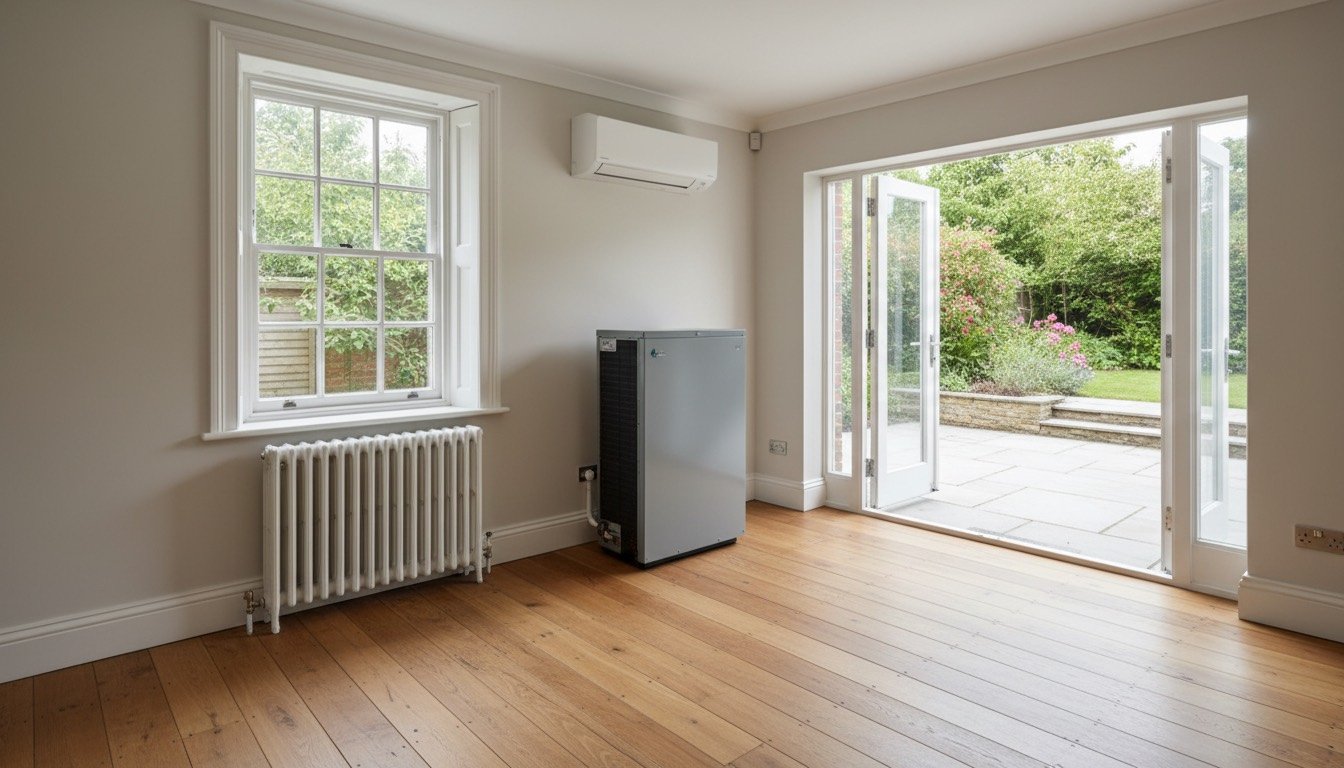
Ask a merchant's counter for a heat pump, then for an air conditioner, and there's a fair chance you'll be shown the same grey box twice. Nearly every split air conditioner sold in Britain this past decade is reverse-cycle: it pulls heat out of the house in August and pushes it back in in February.
What genuinely separates them is where the heat ends up and what the paperwork lets you claim — a distinction that swings the install cost by five figures, decides whether your boiler stays or goes, and sets how much of the work you can honestly do yourself.
Where the Real Difference Sits
An air conditioner, in the British sense, is an air-to-air heat pump: refrigerant collects heat at an outdoor coil and dumps it into room air through wall-mounted indoor units. It heats and cools, responds in minutes, does nothing for your hot water, qualifies for no grant and replaces no boiler.
What the industry means by "heat pump" when grants are discussed is almost always air-to-water. The same outdoor unit heats water to 35-55°C for radiators, underfloor loops and a cylinder, replacing the boiler outright. It cannot usefully cool — push chilled water round standard radiators and you get condensation on the pipework, not comfort.
Side by Side: The Specification That Matters
- •What it does: air-to-air heats and cools room air, no hot water. Air-to-water heats radiators, underfloor and the cylinder, no meaningful cooling.
- •Fitted cost: single-room split £1,800-£3,000; three-room multi-split £4,500-£7,500. Air-to-water £9,000-£15,000 before grant.
- •Grants: air-to-water through an MCS-certified installer attracts £7,500 from the Boiler Upgrade Scheme in England and Wales. Air-to-air attracts nothing.
- •Efficiency: splits reach SEER 6.1-8.5 cooling and SCOP 4.0-5.2 heating. Air-to-water manages SCOP 2.8-3.6 in real installs, because heating water is harder work than heating air.
- •Emitters and space: air-to-air blows 35-50°C air straight at you from an 800 x 550mm outdoor box. Air-to-water needs radiators sized for 45-50°C flow, upsizing a third of them in most 1930s-1980s stock, plus a cupboard for a cylinder.
- •Noise and planning: both must stay under 42 dB at one metre from the nearest neighbouring habitable room window to sit within permitted development.
Performance Through a British Year
In cooling, a fixed split is unbeatable. At SEER 7 it shifts seven units of heat per unit of electricity, and because it dehumidifies as it cools it makes a muggy 27°C bedroom sleepable rather than merely colder. Oversize it and it short-cycles, never running long enough to strip moisture — our kW and BTU sizing method for UK rooms is worth ten minutes before you order.
In heating, both pause to defrost the outdoor coil between roughly +7°C and -2°C, precisely when British air is wettest. Design temperature across most of England is -2°C to -4°C, where a well-specified unit still holds a COP above 2.5. Neither works in a leaky house, so spend a weekend on draught-proofing first.
The Ten-Year Cost, Honestly Calculated
At 25p per kWh for electricity and 6.5p for gas, a useful kilowatt-hour of heat costs about 7.4p from an 88%-efficient gas boiler, 7.8p from air-to-water at SCOP 3.2, and 5.4p from a good split at SCOP 4.6. That ordering is the crux of the comparison.
- •Cooling one bedroom: a 2.5 kW split running six hours a day across 30 hot days uses about 55 kWh — roughly £14 a summer. A portable costs nearer £45.
- •Heating a 3-bed semi with 12,000 kWh demand: gas boiler about £890, air-to-water about £940, air-to-air heating only occupied rooms £780-£850.
- •Ten years, single-room split: £2,200 fitted, £950 servicing, £150 electricity — about £3,300.
- •Ten years, air-to-water: £11,000 fitted less the £7,500 grant, £1,400 servicing, £9,400 running — roughly £14,300, against £12,900 for keeping gas and replacing the boiler once. Every 1p gas rises against electricity moves that £800 in the heat pump's favour.
Installation: The DIY-or-Professional Line, Drawn Plainly
The refrigerant circuit is legally off limits to you in the UK regardless of skill — but plenty of the surrounding work is not, and no installer minds you doing it.
- •Yours: siting and marking the outdoor unit, checking boundary distances and neighbour sightlines, clearing 300mm all round it, laying slabs and fitting anti-vibration mounts.
- •Yours: routing and lagging the condensate drain to a gully or soakaway, making good plaster and decoration once the pipe route is agreed, and every item on the maintenance list below.
- •Professional only: anything touching the refrigerant circuit. Handling F-Gas without City & Guilds 2079 certification is an offence under the retained F-Gas Regulation, and that covers pre-charged "DIY" split kits the moment you break into the circuit.
- •Professional only: brazing, pressure testing above 40 bar and vacuum evacuation below 500 microns. Skip the vacuum and moisture takes out the compressor within three summers.
- •Professional only: the electrical supply. A dedicated circuit from the consumer unit is notifiable under Part P of the Building Regulations in England and Wales. Core drilling a cavity wall near a lintel too.
- •Professional only: MCS-certified design and commissioning if you want Boiler Upgrade Scheme money, and radiator resizing on air-to-water. Undersized emitters are the commonest reason a heat pump disappoints.
Maintenance: Who Does What, and How Often
Both are low-maintenance rather than no-maintenance. A month of neglected filters costs 5-10% of your efficiency and produces the sour smell usually blamed on refrigerant; our guide to cleaning filters, coils and the bit that smells covers the fiddly parts.
- •Monthly in the cooling season: lift the indoor filters, rinse under a warm tap, dry fully before refitting. Ten minutes.
- •Twice a year: clear leaves, cobwebs and drifted gravel from the outdoor coil and straighten bent fins with a £6 fin comb.
- •Every spring: check the condensate drain runs freely. A blockage is the commonest August call-out and shows as water down the wall, not a cooling fault.
- •Annually, professional: pressure check, electrical test, coil deep clean and drain pan sanitising — £90-£140 for a split, £150-£220 for air-to-water.
- •Air-to-water only: confirm system pressure at 1.0-1.5 bar cold, and have glycol strength checked before the first frost.
Who Each Suits, and the Verdict
Choose air conditioning if summer is the problem you actually have — a flat, a loft conversion or a south-facing extension unusable in July — or if you want cheap top-up heat in one or two rooms without touching your existing heating. Our multi-split versus ducted comparison sets out how many indoor units to run.
Choose air-to-water if your boiler is near the end of its life anyway, your loft and walls are already insulated, and you can live with a cylinder and larger radiators. With the grant it is broadly cost-neutral against a new boiler over ten years and better beyond that; the figures sit in our heat pump cost breakdown.
The verdict: for most British houses these are not really competitors. An air conditioner is a comfort purchase that happens to heat well; an air-to-water heat pump is a heating system that happens to be electric. Fix the season that actually bothers you, survey the fabric first, and never break into a refrigerant circuit yourself. Start at the Heating & Cooling hub.
Found this useful?
There's plenty more — hundreds of guides and honestly-tested product reviews for every corner of your home.
Browse All Guides