DIY & Maintenance · 6 min read · 24 July 2026
How to Size an Air Conditioner: The kW and BTU Method for UK Rooms
Most people buy an air conditioner two sizes too big and wonder why the room still feels clammy. Here is the sizing maths in kW and BTU, with UK prices and the point where you hand it to an installer.
By the Nims Casa editorial team — written from professional cleaning experience and checked against our editorial standards.
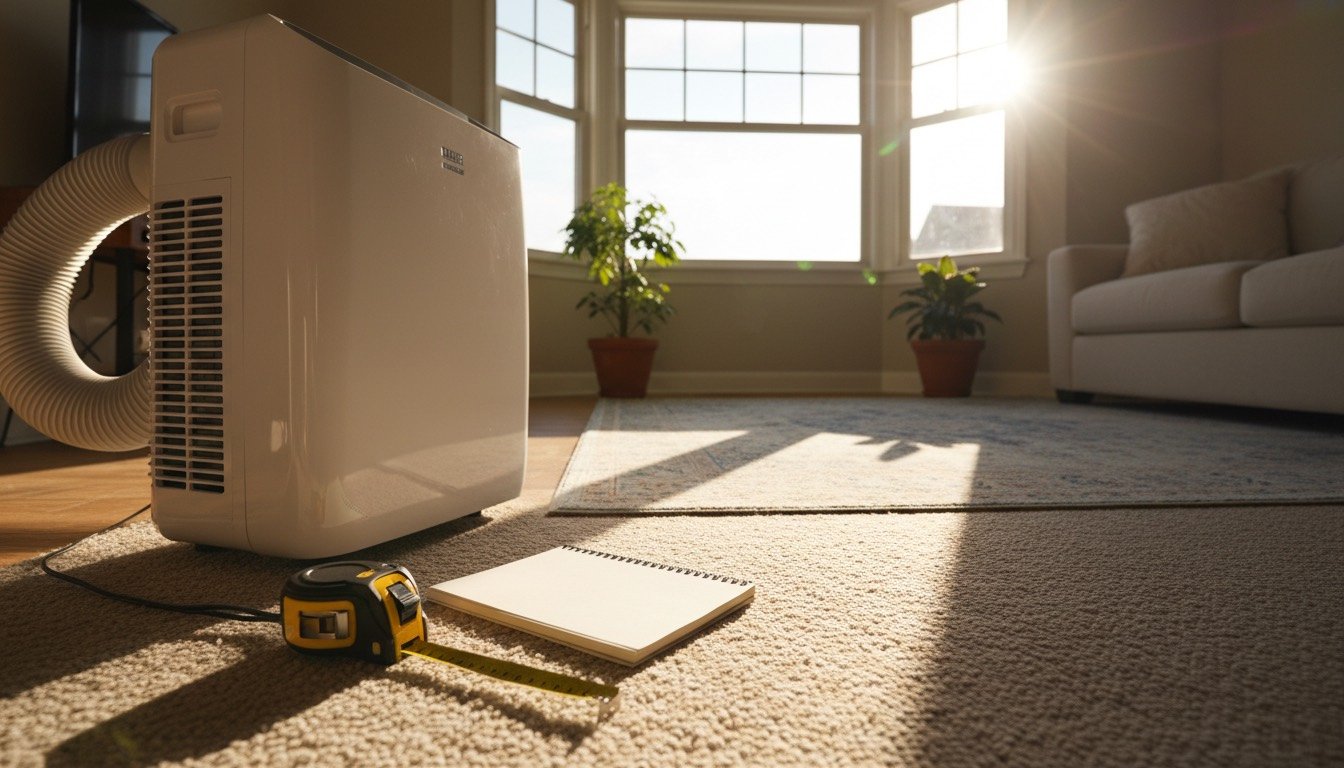
Every July it plays out the same way: two weeks above 30°C, a rush on portable air conditioners, and a lot of money spent on machines that are the wrong size for the room. We are in and out of houses all summer and keep meeting the same unit — an enormous portable roaring in a corner, a room that is cool but still sticky, and an owner convinced they bought a dud.
They usually did not. They bought the wrong capacity. Sizing takes half an hour with a tape measure, costs nothing, and decides more about performance than the badge on the front. Here is the method, converted for UK rooms, glazing and prices.
Tools, Time, Skill Level and Cost
Sizing is a measuring exercise, not a fitting job. The money only appears once you know the number you are shopping for.
- •Tools: tape measure or laser measure (£15–£25), notepad, calculator, and a compass app to check which way the windows face
- •Skill level: easy — if you can measure a room for a carpet, you can do this
- •Time: 30–45 minutes per room, including the adjustments
- •Cost to size: nothing. To buy: £300–£700 for a decent portable, £1,500–£3,000 per room for an installed split system
- •Handy extra: your EPC, which states honestly how the walls and windows perform
kW, BTU and SEER: Reading the Spec Sheet
Capacity is quoted two ways. UK and European sheets use kilowatts of cooling output; anything shaped by the American market uses BTU per hour. The conversion is easy to do in a shop aisle: 1 kW is roughly 3,400 BTU, so 9,000 BTU is about 2.6 kW and 12,000 BTU about 3.5 kW.
Efficiency is the SEER rating — Seasonal Energy Efficiency Ratio — where SEER 7 means seven units of cooling per unit of electricity across a season. Do not buy a fixed unit below SEER 6.1, the A++ threshold; good splits clear 8.5. Portables sit around 2.6–3.0, which is why they cost two or three times as much per hour to run.
Step by Step: The Sizing Calculation
Work through these in order, writing each figure down as you go. The adjustments stack on top of the base number.
- •1. Measure the room: length times width in metres. A 4 m by 3.5 m bedroom is 14 m².
- •2. Apply the base rate of 100 W of cooling per m² for a normal UK room with 2.4 m ceilings. That bedroom starts at 1.4 kW.
- •3. Adjust for ceiling height. Above roughly 2.6 m — high Victorian rooms, vaulted extensions — add 10% per extra half metre.
- •4. Adjust for sun. South- or west-facing with ordinary glazing, add 15%; large patio doors or a room that bakes from 2pm, add 25%. A conservatory can need double and is often not worth cooling at all.
- •5. Adjust for occupants and kit. The base assumes two people: add 0.1 kW per extra person, and 0.3–0.5 kW for a home office of computers or a lounge running a big TV all evening.
- •6. Adjust for the building. Take 10% off for a well-insulated post-2010 build; add 10–20% for solid walls and original single glazing. Sealing gaps first genuinely shifts the number, and cheap draught-proofing pays you back again in January.
- •7. Round up one step, never two. Units come in fixed sizes — typically 2.0, 2.6, 3.5 and 5.0 kW — so take the first at or above your figure and stop. Buying a portable? Add one further step, because the published output assumes conditions your window and hose will not deliver.
A Worked Example, and Why Oversizing Backfires
Take a 20 m² south-facing living room in a 1950s semi. Base 2.0 kW, plus 15% for sun gives 2.3 kW, plus 10% for middling insulation lands at 2.5 kW. The answer is a 2.6 kW (9,000 BTU) unit — not the 12,000 BTU one you will be steered towards.
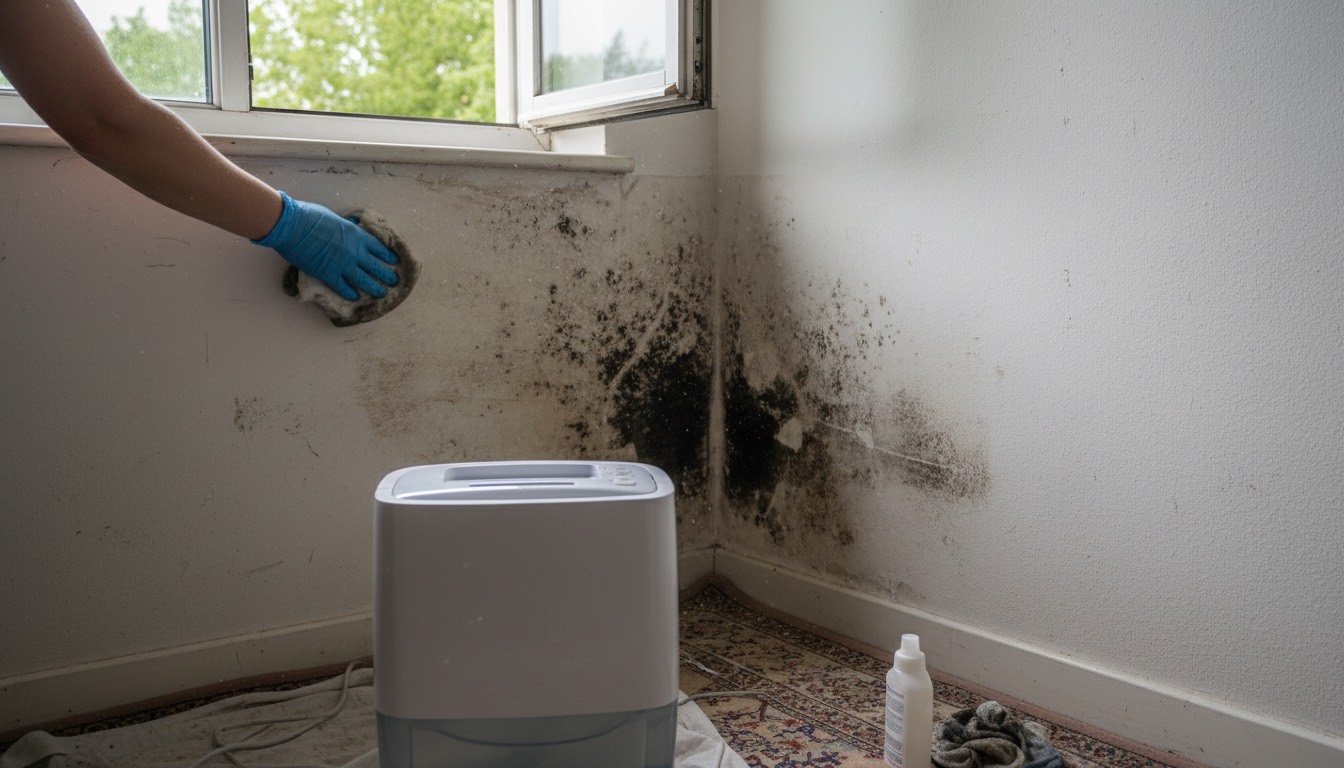
An oversized unit chills the air fast then shuts off — the trade calls it short cycling. It sounds efficient and is not. Moisture only leaves the air while the compressor runs, so a short-cycling machine leaves the humidity behind: a room at 21°C that still feels clammy, condensation returning on cold surfaces, and eventually the conditions behind damp and mould. It is noisier too, never modulating down.
Be honest about the actual complaint. In a muggy British August the misery is often humidity rather than heat, and a good dehumidifier at £150–£250 fixes that for a fraction of the outlay — especially in homes that dry washing indoors, which dumps heat and litres of water into the room.
Portable, Split or Air-to-Air Heat Pump?
Portables are the honest bodge. A single-hose unit blows warm air out of the window, dragging replacement air in through every gap in the house, so real output trails the sticker badly — read the SACC or seasonally adjusted figure, not the headline BTU. They earn their keep for three hot weeks in a bedroom.
A split system costs £1,500–£3,000 fitted per indoor unit, puts the compressor outside, runs far quieter and is roughly twice as efficient. Almost every modern split is also an air-to-air heat pump: in reverse it heats the room for about a third of what a plug-in electric heater costs. Two UK realities before you get quotes — refrigerant work must be done by an F-Gas certified engineer, so this is never a DIY install, and air-to-air units do not qualify for the Boiler Upgrade Scheme, so no grant is coming.
When to Stop and Get a Survey
Size one room yourself with confidence. Hand it over when any of these apply — a reputable installer does a proper heat-load calculation free with the quote.
- •You want more than two rooms cooled, or a multi-split with several indoor heads
- •You are in a flat, listed building or conservation area, where the outdoor unit needs consent (leaseholders need the freeholder's written permission)
- •Your consumer unit is old or full — a 3.5 kW split wants its own circuit, an electrician's job
- •The maths misbehaves: open-plan spaces off a stairwell, loft conversions under a hot roof, or any figure above 5 kW
Sizing Is Only Half the Job
Once it is in, maintenance is not optional. Rinse or vacuum the filters monthly in season — a clogged filter costs a quarter of the capacity while drawing the same electricity. Keep 30 cm clear around an outdoor condenser, brush its fins each spring, and have a split serviced every couple of years (£60–£120).
Two closing points from people who clean for a living. Filters clog fastest in carpeted, pet-owning homes, so the dust load in the room sets your service interval — a proper carpet clean does more for the air than a bigger unit will. And an air conditioner cools and dries but does not filter: if summer means pollen rather than heat, pair it with an air purifier, or you get a beautifully cool room you still cannot breathe in.
Found this useful?
There's plenty more — hundreds of guides and honestly-tested product reviews for every corner of your home.
Browse All Guides