Costs & Hiring · 6 min read · 26 May 2026
Home Maintenance Mistakes to Avoid (Ranked by What They Cost)
Nearly every expensive callout we attend started as a twenty-minute job someone put off. Here are the maintenance mistakes that cost UK households the most, and what to do instead.
By the Nims Casa editorial team — written from professional cleaning experience and checked against our editorial standards.
Very few of the emergency jobs we attend are genuinely unlucky. The soaked chimney breast was a slipped tile spotted eighteen months earlier; the £4,200 kitchen ceiling was a compression joint dripping into a cupboard for a season. The pattern is consistent: a cheap, dull task gets deferred, and the deferral is what costs money.
What follows is ranked the way a surveyor thinks, by consequence rather than effort. A few will save you four figures, a couple could save your life, and since a fifth of UK households rent, there is a renter-safe version below.
The mistakes, ranked by what they end up costing
Ordered by worst realistic outcome, not by likelihood. Prices are 2026 UK averages for a three-bed semi or terrace.
- •1. DIY on gas or fixed wiring. Consequence: carbon monoxide, fire, invalidated insurance and a criminal offence under the Gas Safety Regulations. No saving justifies it.
- •2. Switching the heating off entirely while away in January. Consequence: burst pipe, £3,000-£10,000 of water damage plus a £250-£500 excess. A thermostat left at 12-14C costs pennies.
- •3. Never servicing the boiler. Consequence: mid-winter breakdown at £180-£350 emergency rates, voided warranty, early replacement at £2,200-£3,800. A service is £80-£120.
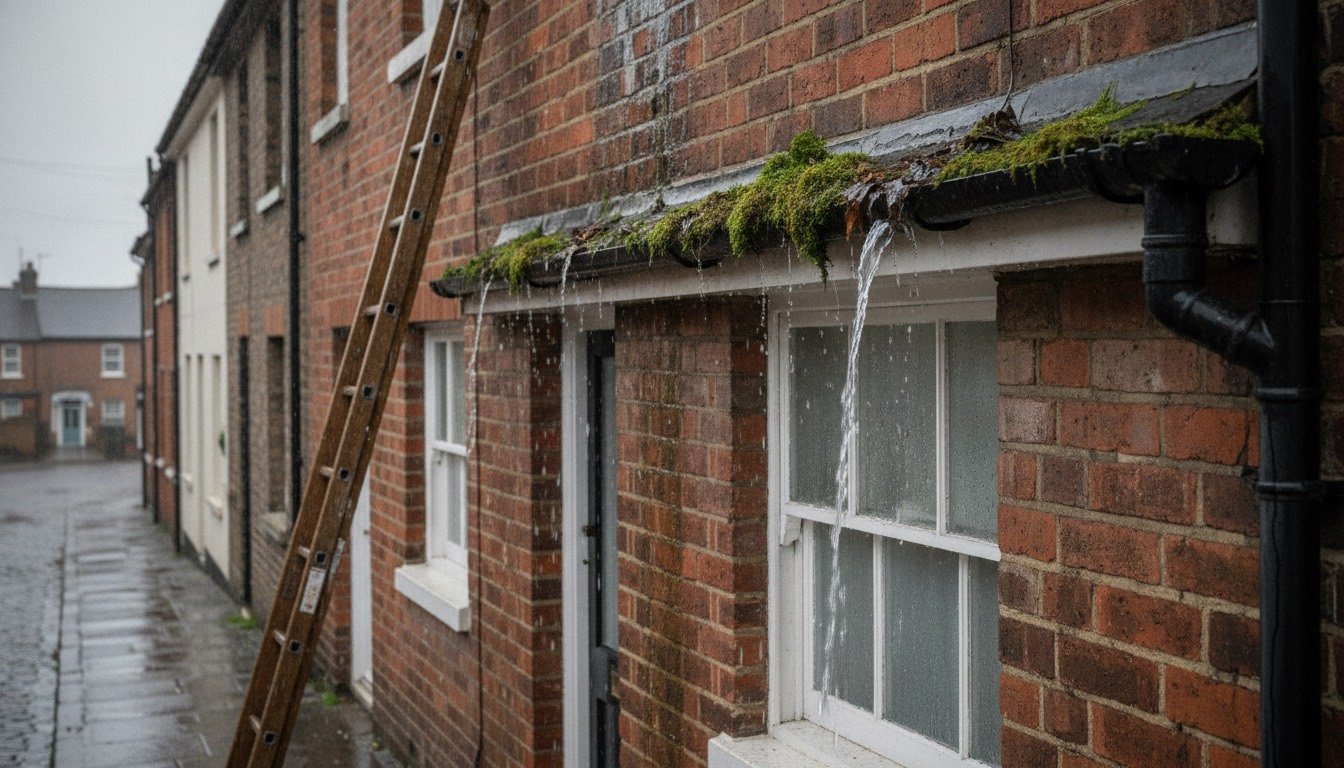
- •4. Letting gutters and gullies block. Consequence: saturated masonry, penetrating damp, blown plaster, £1,500-£6,000 to put right. Clearance is £70-£150.
- •5. Painting over damp patches instead of finding the source. Consequence: timbers stay wet and you buy a survey and a replaster you could have avoided with a £6 tube of mastic.
- •6. Blocking airbricks, trickle vents or extractor grilles to stop draughts. Consequence: condensation, black mould on cold walls, and in older houses wet rot in suspended floors.
- •7. Pressure-washing render, roof tiles and block paving. Consequence: stripped mortar joints, water driven under tiles, paving sand blown out, £600-£2,500 to repair.
- •8. Ignoring a dripping tap or a falling boiler pressure gauge. Consequence: each is a signal, not a nuisance. A drip is a worn washer; a falling gauge is usually a leak.
Why sensible people keep making them
None of this is stupidity. Maintenance fails for structural reasons: the tasks are invisible, seasonal and unrewarding when done right, because nobody admires a cleared gutter. It is also hard to know what a house needs if nobody showed you, which is why the annual home maintenance cost of a UK property blindsides first-time buyers. Three failure patterns recur.
- •Out of sight, out of mind. Roofs, lofts and the first-floor exterior are where damage starts and nobody looks. A phone on a selfie stick fixes most of this.
- •Cosmetic bias. Money goes on what visitors see, while the £45 job on the flat roof waits and becomes a £4,000 one.
- •Wrong-season timing. Gutters cleared in September are useless; British trees drop through to late November. Do them in early December and again in March.
The genuinely dangerous ones
Most maintenance mistakes cost money. This list costs people their homes or their lives; the right response to every item is to stop and phone someone. Carbon monoxide gives no warning: sooty staining around a boiler, a yellow rather than crisp blue flame, or headaches that clear when you leave the house mean ventilate, switch it off and ring 0800 111 999.
- •Working on gas appliances, flues or pipework without being Gas Safe registered. Illegal, and the commonest cause of CO incidents in UK homes.
- •Adding sockets, altering a consumer unit or wiring a bathroom without Part P notification. Uncertified work gets flagged on sale and can void buildings insurance.
- •Ladder work above single-storey height, on soft ground, or alone. Falls are the leading cause of DIY hospital admissions here; a roofer with a tower is £150-£250 a day.
- •Sanding or drilling textured coatings and old insulation board in pre-2000 houses. Assume asbestos until tested; a sample analysis is £40-£60.
- •Taking dead smoke alarm batteries out to stop the chirping. Replace the cell or the unit the same day.
- •Bleach and limescale remover used in the same bathroom session. Acid plus hypochlorite releases chlorine gas within seconds.
The fixes, in the order worth doing them
One Saturday and £100, spent in this order. Each item prevents something far more expensive than itself.
- •Test every smoke and CO alarm, 5 minutes, free. Replace any unit over ten years old, £15-£30 each.
- •Clear gutters, downpipe shoes and the gully at the base, 60-90 minutes, or £70-£150 for a pole-vac visit. See gutter cleaning and maintenance for the safe method.
- •Lag the exterior condensate pipe and loft pipework, 30 minutes, £8-£15 of foam. This one job prevents most January boiler lockouts, as our guide to preventing frozen pipes explains.
- •Book the boiler service for August or September, when engineers charge less and have slots.
- •Bleed radiators and check the gauge sits between 1.0 and 1.5 bar cold, 20 minutes, free. A gauge that keeps dropping means a leak, not a habit.
- •Run extractors 15 minutes after every bath, and stop drying washing on radiators. Condensation causes most of what gets misdiagnosed as rising damp, and damp and mould is cheaper to prevent than treat.
- •Rake out and replace failed silicone around baths, shower trays and door thresholds, 45 minutes, £6 a tube.
The renter-safe version: everything you can do without risking your deposit
Tenants are told to leave maintenance alone, which is only half right. Under Section 11 of the Landlord and Tenant Act 1985 and the Homes (Fitness for Human Habitation) Act 2018, structure, exterior, heating, hot water and electrics are the landlord's responsibility, and you cannot be charged for reporting them. Your job is everything reversible, plus a paper trail.
Report in writing even after a phone call: email beats text and dated photographs beat description. If condensation mould appears, photograph it early and note the ventilation you already provide, because deposit disputes over mould turn on whether it was reported. For the decorative side, rental-friendly decor covers what comes off cleanly.
- •Safe and reversible: bleeding radiators, replacing alarm batteries, clearing hair from shower wastes, running extractors, using a dehumidifier, resetting a tripped RCD once.
- •Safe with a photo first: adjusting radiator valves, moving furniture 5cm off external walls, fitting peel-away draught excluders and self-adhesive foam strips.
- •Never as a tenant: any gas or fixed wiring work, ladder access to gutters or roofs, drilling tiles, or hacking off blown plaster to help.
- •Deposit protection: date-stamped photos on day one and exit day, every maintenance email in one folder, and no repainting without written consent.
When to stop and call someone
The honest boundary is not skill, it is consequence and certification. Stop if the job touches gas, fixed wiring, structure or a working height above one storey, or if you cannot find the source of water within twenty minutes.
Typical 2026 UK rates: handyman £30-£50 an hour or £180-£280 a day, plumber £45-£85 an hour with a £90-£150 minimum callout, electrician £45-£75 an hour, roofer £150-£250 a day plus access. Set against the four-figure repairs above, the maths is rarely close. For the routine rather than the emergency, work from the DIY and maintenance hub and put four dates in the calendar now: March, June, September, December. That habit prevents most of this list.
Found this useful?
There's plenty more — hundreds of guides and honestly-tested product reviews for every corner of your home.
Browse All Guides