Costs & Hiring · 6 min read · 28 July 2026
How Much Does It Cost to Remodel a House? UK Renovation Prices for 2026
Ask three builders what a whole-house renovation costs and you get three very different numbers. Here is what the work really costs per square metre in 2026, and how to tell which of three jobs you face.
By the Nims Casa editorial team — written from professional cleaning experience and checked against our editorial standards.
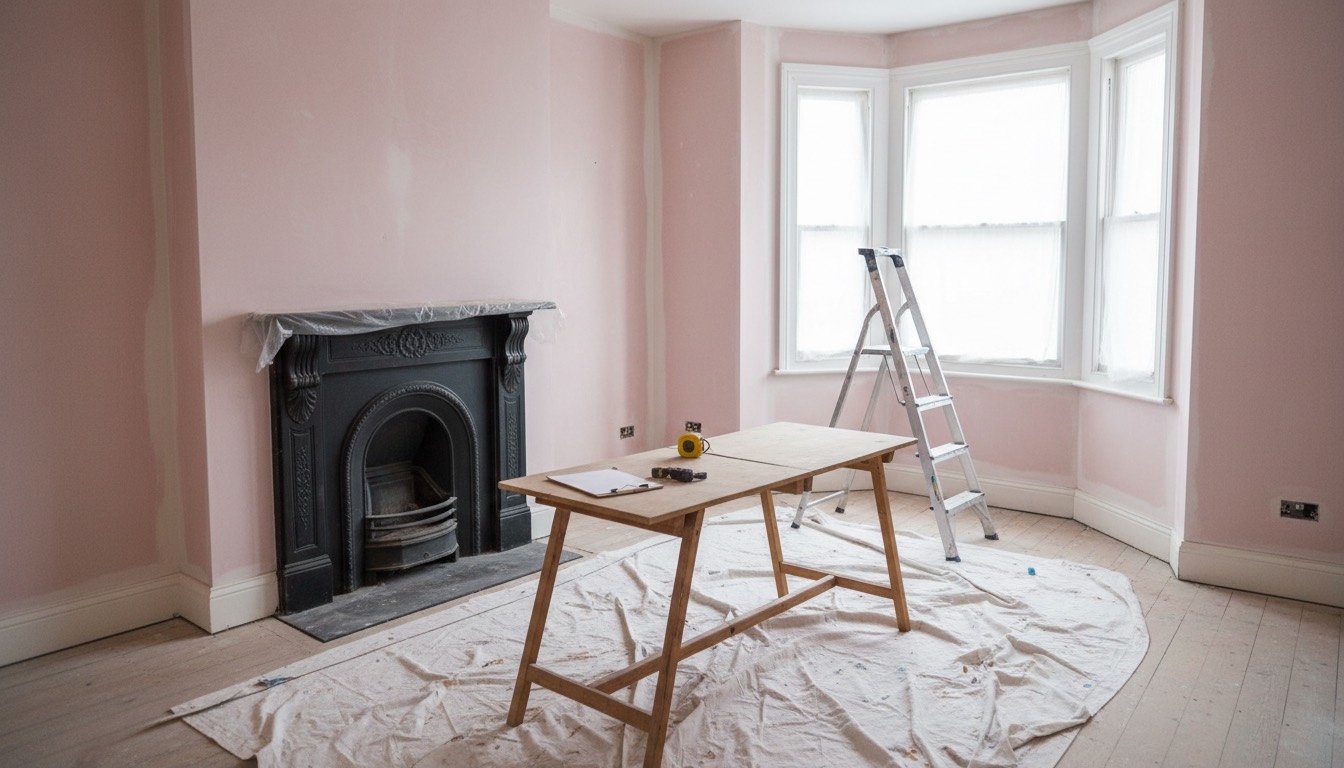
Ask three builders what a house renovation costs and you get three numbers a long way apart. That is rarely dishonesty: "renovation" covers everything from a fortnight of painting to eight months with the roof off. The figure that makes quotes comparable is cost per square metre of internal floor area — in 2026, anywhere from £250/m² to well past £2,500/m².
Below are the UK ranges, the unit costs beneath them and three costed examples. First, though, work out which of three renovations you are facing — most overruns start with someone pricing a refresh on a house that needed a refurbishment. Our guide to budgeting a home renovation covers the order to do things in.
Start Here: Which of the Three Renovations Do You Need?
Walk the house with a torch and a screwdriver before you ring anybody. Each yes below pushes you up a tier, and one is enough — you cannot skim over a failed damp course because the rest looks tidy.
- •Pull a socket faceplate off with the power isolated. Rubber or cloth insulation, or a fuse board with rewireable ceramic carriers, means a full rewire — that alone lifts you out of Tier 1.
- •Knuckle-tap the walls. Hollow, drummy patches across more than a third of a wall mean the plaster has blown off the brick and needs hacking off, not filling.
- •A tide mark or salt bloom a metre up ground-floor walls is damp, and the replastering behind it usually costs three times the treatment itself.
- •Any crack wider than a 20p edge, or running diagonally through a corner, needs pricing before anything else — see settling cracks versus structural cracks.
- •Be honest about whether you want to move a wall, kitchen, bathroom or soil stack. Moving services and load-bearing walls turns a refurbishment into a building project.
The Three Tiers and What They Cost
Rates cover labour, materials and waste, excluding VAT, fees and furniture. London and the South East run 20–35% above; the North East, Yorkshire, Wales and Northern Ireland 10–20% below.
- •Tier 1 — cosmetic refresh, £250–£600/m². Layout, wiring, heating and sanitaryware stay: decorating, floors, internal doors, kitchen doors and worktops, bathroom refitted in place.
- •Tier 2 — full refurbishment, £900–£1,700/m². Back to plaster: new wiring, heating and plumbing, replastering throughout, new kitchen and bathrooms. Walls stay put.
- •Tier 3 — structural renovation, £1,800–£3,000/m² and up. Walls moved, roof recovered, plus a loft or extension; fees and building control become real line items.
- •By house type across those tiers: a 65–75 m² terrace runs £18k–£40k, £65k–£120k or £130k–£220k; an 85–95 m² semi £24k–£52k, £85k–£155k or £165k–£280k; a 130–160 m² detached £38k–£85k, £130k–£250k or £250k–£450k.
Unit Costs and the Labour/Materials Split
Per-square-metre rates set a budget; unit costs check a quote. All 2026 figures, insured firm, excluding VAT.
Labour is 55–65% of a full refurbishment. Plastering, rewiring and decorating run 65–75% labour; kitchens and bathrooms invert, with 55–65% of the spend in units, worktops and sanitaryware. Day rates run £220–£320 for a general builder, £260–£360 an electrician, £260–£400 a plumber and £180–£260 a decorator, plus 25–40% inside the M25.
- •Full rewire of a 3-bed semi: £4,200–£7,500 before making good the plaster.
- •Combi boiler swapped in the same position £2,200–£3,400; a full system with nine radiators £5,500–£8,500.
- •Skim over sound plaster £350–£600 a room; hack off, re-board and skim £1,100–£1,800 a room.
- •Mid-range fitted kitchen supplied and installed £12,000–£22,000; doors and worktop only £3,000–£6,000 (spec-by-spec costs).
- •Bathroom refit in the existing layout £5,500–£9,500; add £1,500–£3,000 if the bath, WC or basin moves.
- •uPVC windows across ten openings £6,500–£10,000; timber sash replacements £1,400–£2,600 each.
- •Recovering a pitched roof on a semi £7,000–£13,000, plus £900–£1,800 for scaffolding.
- •Structural opening with steel, engineer's calculations and building control sign-off: £2,200–£4,000 each.
- •Fitted flooring: carpet and underlay £28–£55/m², LVT £45–£85/m², engineered oak £70–£120/m². An 8-yard skip is £250–£420, and a back-to-brick semi eats four to seven.
What Moves the Price
Two identical houses on one street can differ 30% on the same spec. These are the levers, in rough order of impact.
- •VAT. Standard is 20%, but a property empty two years or more qualifies for 5%, as does any conversion changing the number of dwellings — £12,000 on an £80,000 job. Get the rate in writing before anyone starts.
- •Access. A mid-terrace with no side gate means every skip load goes through the hall: add 5–10% labour.
- •Age. Pre-1919 houses bring lath and plaster, lime mortar, solid walls and made-to-order joinery, typically 15–25% above a 1970s equivalent.
- •Consents. Rewires, new bathrooms, window replacements and structural work all touch building regulations even where planning permission is not needed (where the lines fall).
Three Worked Examples
Mid-market rates outside London, excluding VAT.
- •1930s semi, 88 m², cosmetic refresh. Patch plaster and redecorate £7,500; carpets and LVT £4,200; kitchen doors and worktop £3,800; bathroom refit in situ £6,500; internal doors and skirting £2,600; consumer unit and remedials £1,400; skips £900. Subtotal £26,900, plus 10% contingency = £29,600, or £336/m².
- •Victorian mid-terrace, 95 m², full refurbishment. Strip-out £2,800; rewire £6,200; replumb, combi and nine radiators £7,400; replaster £8,500; kitchen £14,000; two bathrooms £13,000; flooring £6,500; joinery £5,200; decoration £6,500; damp and timber treatment £3,200; windows £8,000; building control £900. Subtotal £82,200, plus 15% contingency = £94,500, or £995/m².
- •1900s detached, 140 m² plus a 25 m² loft, structural. Scaffolding and skips £5,500; three steels with calcs and building control £11,000; roof recover £13,500; rewire £9,000; heating £9,500; sash-style windows £22,000; replaster and insulation £16,000; kitchen £26,000; three bathrooms £21,000; joinery, flooring and decoration £24,000; dormer loft £48,000. Subtotal £205,500, plus 20% contingency = £246,600, or £1,494/m².
How to Sanity-Check a Quote
Write the specification yourself as a numbered document and send the identical one to three firms. Quotes priced on different assumptions cannot be compared — our guide to comparing contractor estimates has a scoring method.
- •Demand a breakdown by trade with day counts, not one "labour" line. Divide labour by the day rate: if the maths implies fourteen weeks and the builder promises six, a number is wrong.
- •Confirm whether VAT is in or out. A 20% surprise at invoice stage has ended more renovations than any structural problem.
- •Check who pays for skips, scaffolding, welfare, building control fees and making good, and interrogate every provisional or prime cost sum — those placeholders get revised upward later.
- •Verify Gas Safe, NICEIC, NAPIT or FENSA registration on the registers themselves, treat any quote 25% below the rest as a warning rather than a bargain, and pay no more than 20–25% up front.
Methodology
These figures come from UK merchant pricing, published trade day rates and jobs quoted across the Midlands, North West and South East in the first half of 2026. All exclude VAT unless stated, and assume an insured firm using scheme-registered subcontractors.
Materials pricing has been volatile since 2022, so treat any cost guide older than eighteen months as a shape, not a budget. Re-price the big items with live quotes, and hold contingency at 10% for cosmetic work, 15% for a refurbishment and 20% for anything pre-1919 or structural. A full refurbishment rarely returns pound for pound, so read which improvements add value if resale is the driver.
Found this useful?
There's plenty more — hundreds of guides and honestly-tested product reviews for every corner of your home.
Browse All Guides