DIY & Maintenance · 5 min read · 15 March 2026
How to Install a Ceiling Fan (Even Where No Light Fitting Exists)
A decent ceiling fan cools a room for about 2p an hour. Here's how to fit one safely in a UK home — including where no light fitting exists — and when to hand the job to an electrician.
By the Nims Casa editorial team — written from professional cleaning experience and checked against our editorial standards.
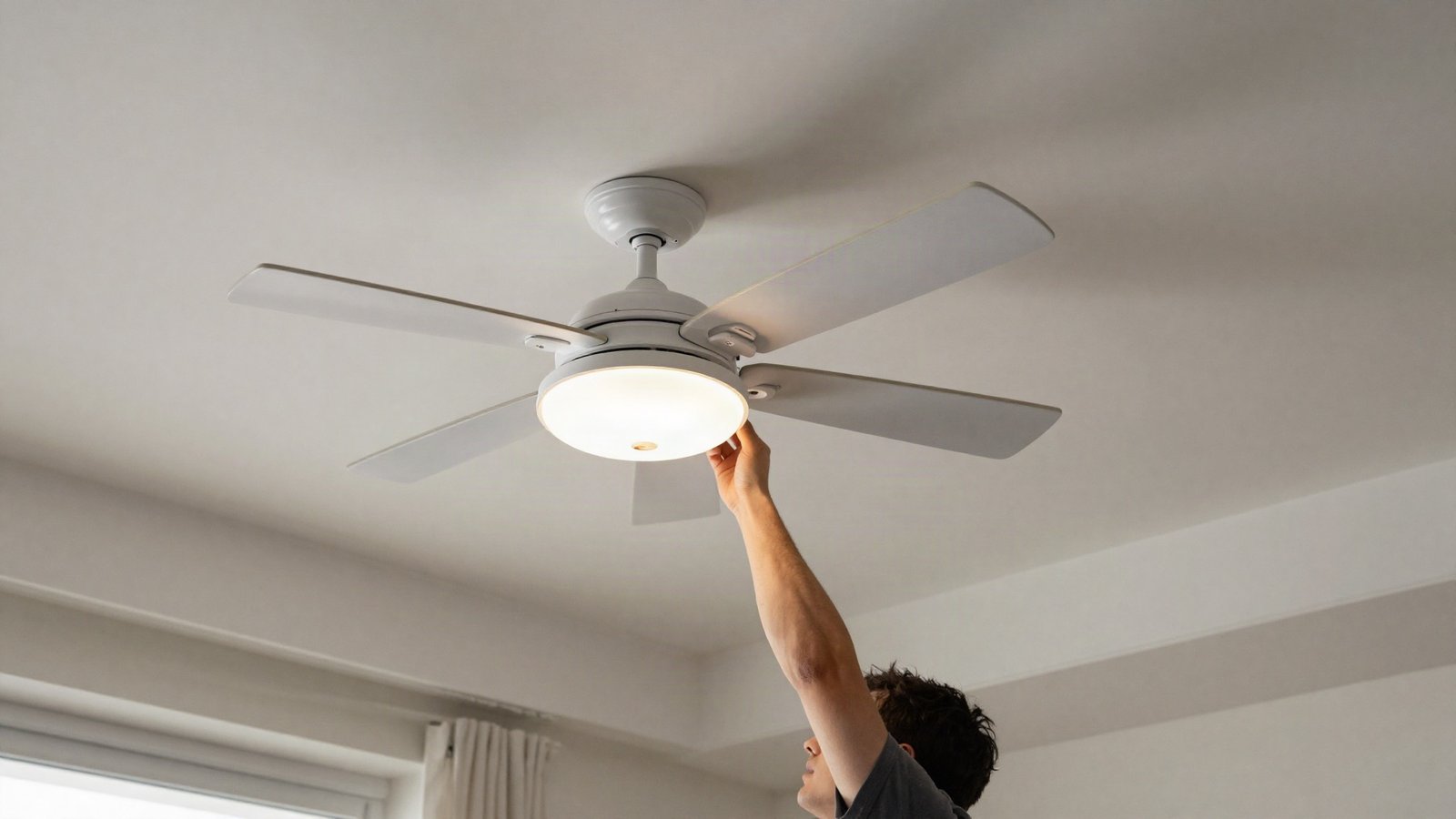
Three hot summers in a row have turned ceiling fans from an American curiosity into something we get asked about on almost every June visit. The maths is persuasive: a good fan draws 30–70 watts — roughly 2p an hour at current rates — while a portable air-con unit pulls 1,000–2,600 watts and costs 60p to £1 an hour to run. A fan won't lower the room temperature, but moving air across your skin feels 3–4°C cooler, which is usually enough for a UK bedroom in July.
We maintain homes for a living, but we're not electricians, and we'll be straight with you: parts of this job sit right on the line where sensible DIY ends. This guide covers what the regulations actually say, how to swap a fan onto an existing light point safely, your options where no fitting exists at all, and the moments where the only correct move is to put the screwdriver down and phone a professional.
Before you touch anything: Part P and when this stops being DIY
Domestic electrical work in England and Wales is covered by Part P of the Building Regulations. In England, replacing a light fitting like-for-like, or adding a new lighting point to an existing circuit, is generally non-notifiable — you may do it yourself if you're competent. Installing a new circuit, or doing any electrical work in a bathroom zone, is notifiable and must either go through building control or be done by an electrician registered with a competent person scheme such as NICEIC or NAPIT. Wales kept the stricter pre-2013 rules, so more work is notifiable there, and Scotland runs its own Building Standards system entirely. When in doubt, a registered electrician self-certifies the work and hands you a certificate — which matters when you sell the house.
Regulations aside, stop and call a professional the moment you meet any of the following:
- •No earth wire at the ceiling point, or old rubber- or fabric-insulated cable (common pre-1970)
- •Wiring colours you can't identify — old installs use red/black, modern ones brown/blue, and mixed circuits exist
- •A bathroom, or anywhere within 600mm of a shower or bath — fan installs here are notifiable and zone-restricted
- •Any tingle, scorch mark, or warm switch plate — those are faults, not quirks
- •A concrete ceiling with no obvious fixing route
Tools and parts, with honest prices
Screwfix, Toolstation and B&Q all stock everything below. Budget £60–£120 for a basic fan and £150–£300 for a quiet DC-motor model with remote — worth it in bedrooms, as cheap AC motors hum. UK ceilings are typically 2.4m, and blades must sit at least 2.1m above the floor, so most rooms need a low-profile (flush-mount) fan rather than one on a drop rod.
- •Two-pole voltage tester (GS38 compliant), £15–£30 — a neon screwdriver is not a safe substitute
- •Joist and cable detector, £15–£25
- •Insulated screwdrivers, wire strippers and side cutters
- •Brown PVC sleeving and maintenance-free connectors (Wago-type), about £8
- •65mm wood screws for joist fixing — never rely on the plasterboard fixings in the box
- •A stable step platform, not a wobbly chair
Swapping an existing ceiling light for a fan
This is the achievable version of the job, but UK ceiling roses hide a trap. Most are wired loop-in, meaning three cables meet at the rose: permanent lives feeding the next light, neutrals, and one switched live returning from the wall switch. Disconnect everything blindly and you'll never work out what goes where. Work through it in this order:
- •Turn the lighting circuit off at the consumer unit — not just the wall switch — and tape over the breaker so nobody flips it back
- •Prove the circuit dead at the rose terminals with your two-pole tester, and test the tester on a known live socket first
- •Photograph the wiring from two angles before loosening a single terminal
- •Identify the switched live: it should wear brown (or red) sleeving, but older installs often skip it — if unsure, this is an electrician moment
- •Check the fixing. Fans weigh 4–9kg and vibrate; the bracket must screw into a joist or a solid noggin, never plasterboard alone. Joists sit at roughly 400mm centres — find one with your detector
- •Fit the fan's mounting bracket with 65mm wood screws, connect switched live to L, neutral to N, earth to earth, and park the permanent loop lives safely in a maintenance-free connector inside the canopy
- •Hang the motor, fit the blades, restore power and run it on high for ten minutes checking for wobble
No light fitting at all? Your three realistic options
Where no fixture exists, someone has to get power to the middle of the ceiling, and this is where we'd hire in. An electrician will usually spur off the existing lighting circuit from the loft or by lifting a bedroom floorboard above — in England that's typically non-notifiable, and you should expect £150–£350 including making good, or more if the ceiling is under a tiled bathroom floor.
If lifting floors is impossible, surface-mounted mini-trunking down from the loft hatch or along the coving is the honest budget route — about £20 in materials, and paintable, though you'll always know it's there. The third option softens the wiring problem: a remote-controlled fan needs only a permanent live feed, no switch drop down the wall, which roughly halves the cable run. Whichever route you choose, the mechanical fixing rule doesn't change — if the fan lands between joists, screw a 47mm timber noggin between them from above before anything hangs from the ceiling.
Ceiling fan with a light: the switching question
A single switched live gives you one circuit, so the fan and light come on together — fine in a garden room, maddening in a bedroom. Separate wall control needs 3-core-and-earth cable between switch and fan, which means chasing plaster and repainting. The cheaper answers are pull cords (most fans with lights include two — one for speed, one for the lamp) or a remote handset, which controls both independently through a receiver hidden in the canopy. If you're planning the room's lighting properly, treat the fan light as your ambient layer and add bedside or wall lights around it — our lighting layers guide covers how to build a scheme that doesn't rely on one central glare.
Making good and keeping it clean
Every fan install leaves scars: old screw holes, a rose-sized bare patch, pencil marks. Fill and sand them properly — our guide to filling cracks and holes in walls works exactly the same on ceilings — then touch up with the method in how to paint a room, cutting in around the new canopy while the blades are still off. Drilling into a lath-and-plaster or plasterboard ceiling also drops a surprising amount of fine dust into carpet pile, and it walks through the whole house within a day. Vacuum slowly the same afternoon; if the room was due a proper refresh anyway, a professional deep clean after the dusty work is done is the right order to do things in.
Once running, dust the blade tops monthly — they collect a felt-like layer that unbalances the fan and then gets flung across the room the first time you switch it on in May. A £3 balancing kit cures most wobbles in ten minutes.
The winter trick most owners never use
Nearly every fan has a reverse switch on the motor housing (or a button on the remote). Anticlockwise in summer pushes air down at you; clockwise on low in winter pulls cool air up and pushes the warm layer trapped at ceiling height back down the walls. In a room with 2.4m-plus ceilings this can let you drop the thermostat a degree — roughly £80–£100 a year off a typical gas bill. Gentle year-round air movement also keeps condensation from settling on cold external walls, which is half the battle against black mould; if you're already seeing spots, our guide to getting rid of damp and mould covers the causes a fan alone won't fix. Two seasons in, a £150 fan is one of the few gadgets we'd call genuinely good value — provided it went up on a joist, on a dead circuit, with the paperwork done where the rules require it.
Found this useful?
There's plenty more — hundreds of guides and honestly-tested product reviews for every corner of your home.
Browse All Guides