Cleaning Guides · 6 min read · 3 April 2026
How to Organise a Small Closet: The UK Wardrobe Fit-Out That Actually Holds
Small wardrobes rarely run out of room — they run out of geometry. Here is the order a fitter works in, from what is hidden behind the wall to the rail heights that double your hanging space.
By the Nims Casa editorial team — written from professional cleaning experience and checked against our editorial standards.
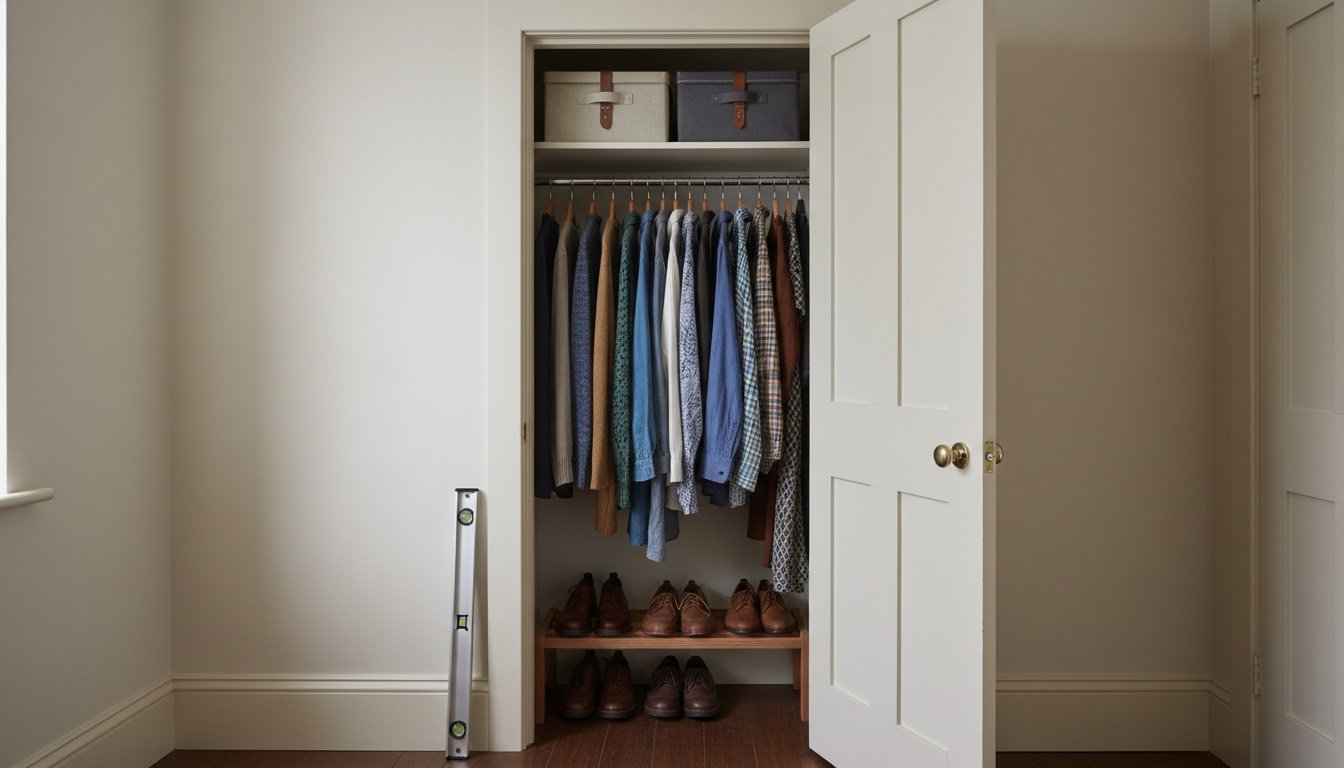
A small wardrobe seldom fails for lack of space. It fails because one rail sits at 1.8m with a single shelf above it, leaving nearly a metre of dead air underneath, and because a third of what hangs there hasn't been worn in years. Fix the geometry and contents together and a 900mm cupboard in a 1930s semi holds a full year's clothing.
This is the order a fitter works in: empty it, understand the wall, then rebuild around measured drops rather than guesswork. Do the room-by-room declutter first — organising clothes you're about to bag for the charity shop wastes an afternoon.
Safety first: know what's behind the door before you drill
In British housing stock a small closet is often not just a clothes cupboard. Airing cupboards hold cylinders and combi boilers; understairs cupboards form part of a protected escape route; anything pre-2000 can hide surprises in the lining board.
Permission matters too: most tenancies and leases require written consent before you fix anything to a wall, and unfilled holes are a classic deposit deduction. Our guide to rental-friendly decor covers the no-trace version of this job.
- •Gas appliance inside? Never box in or restrict ventilation to a boiler or meter — access and air supply are Gas Safe territory, and an engineer can log the appliance At Risk and cap it.
- •Understairs cupboard in a flat or HMO: the staircase is a protected escape route. Aerosols, paint and strimmer fuel don't belong there, and HMO licensing usually requires 30 minutes' fire lining.
- •Cables and pipes: under BS 7671 buried cables run within 150mm of a ceiling or corner, or straight up and down from a switch or socket. Sweep with a multi-mode detector first.
- •Pre-2000 property: old cupboard linings and textured coatings can contain asbestos. Don't drill or sand — have a sample tested.
- •Listed building? Original cupboards and panelled doors can be protected fabric — altering them may need listed building consent.
Tools and materials
Skill level is basic DIY. Only one step wants two people: holding the rail while you mark the sockets.
- •Combi drill, 6mm and 8mm masonry bits, 3mm pilot bit, PZ2 driver
- •Multi-mode detector for studs, metal and live cables — £25–£40, and non-negotiable
- •600mm spirit level, tape, pencil, junior hacksaw or pipe cutter
- •25mm chrome rail (£8–£12 per 1.2m), two end sockets, plus a centre bracket for spans over 900mm
- •Fixings matched to the wall: 5.0 x 70mm woodscrews into studs at 400 or 600mm centres; 8 x 100mm frame fixings through dot-and-dabbed plasterboard into block; geared anchors only where nothing sits behind the board
- •18mm MDF or melamine-faced board for shelves, cut to size at the timber merchant
- •Flocked hangers, two lidded boxes, sugar soap, filler, matt white emulsion
Realistic time and cost
For one 900mm–1.2m built-in, allow five to six hours plus paint drying. Buying boxes before measuring is what inflates the bill.
- •Empty, sort and bag up: 90 minutes, £0
- •Clean, fill and repaint the interior: 90 minutes plus 4 hours' drying, £12–£20 for 2.5L
- •Rail, sockets and centre bracket: 45 minutes, £15–£30
- •Two shelves cut to size and fitted: 60 minutes, £25–£45
- •Hangers, boxes and a low shoe rack: £30–£70
- •Total DIY £85–£165. A modular wall-track system £120–£250, joiner-built alcove internals £450–£900, a fitted wardrobe £900–£1,600 per linear metre.
The step-by-step fit-out
Work in this order — jumping straight to the rails is why wardrobes get rebuilt twice.
- •1. Empty it completely onto the bed — everything, including the shoebox of cables at the back. A half-emptied cupboard can't be judged.
- •2. Measure internal width, depth and floor-to-soffit height. Front-facing hanging needs 560mm of clear depth (450mm hanger plus bulk and door clearance). Under 500mm, use a side-facing pull-out rail or hooks.
- •3. Sort into keep, repair, rehome and recycle. Textiles too worn for the charity shop go to a textile bank.
- •4. Vacuum the base, corners and shelf undersides, then wash the walls with sugar soap, checking the bare back wall for cold spots and dark spotting.
- •5. Fill old fixing holes and repaint the interior matt white — you can then see the back without a torch.
- •6. Set your drops before your rails: 950–1000mm for shirts, 800mm for trousers over a bar, 1400–1600mm for coats. In a 2.4m room that puts a top rail at 2000–2050mm and a lower rail at 1000–1050mm — double the hanging capacity, same footprint.
- •7. Mark the height with the level, find the studs or solid backing, then fix the end sockets. Add a centre bracket over 900mm — an unsupported 1.2m 19mm rail bows under 20kg of coats.
- •8. Fit a shelf at 2100mm or above for lidded boxes: off-season bedding, spare pillows. Label box ends, not lids.
- •9. Treat the floor as a zone, not a dumping ground. A 150mm shoe rack lifts footwear off the base and keeps air moving.
- •10. Restock in reverse order of frequency: daily at hand height, weekly low, seasonal up top. Swapping wooden hangers for 6mm flocked ones reclaims 500mm of rail across 40 garments.
Troubleshooting: problems that surface two weeks later
Musty smells and dark spotting on the back wall almost always mean the cupboard sits against a cold external wall with no air movement. Leave a 25–40mm gap behind the contents, stop cramming the rail solid, and treat the cause — our guide to damp and mould explains why a cupboard on a north-facing gable behaves nothing like the rest of the room.
Small irregular holes in wool and cashmere aren't wear. That's clothes moth larvae, and the treatment overlaps with dealing with carpet moths.
- •Rail bows or rotates: span too long, or sockets not seated. Add a centre bracket and check the tube is 25mm, not thin-wall 19mm.
- •Doors catch on clothing: internal depth is under 560mm. Move to a side-facing rail, or hang only shirts and jackets on the front bar.
- •Shelf sags: 18mm board unsupported over 800mm. Add a back batten or a mid-span bracket.
- •Vacuum bags creasing knitwear: only compress cotton and synthetics. Wool and down need to breathe.
- •Chaos returns within three weeks: the system is fighting your routine. A seasonal rotation, covered in our wardrobe organisation guide, lasts far better than a one-off tidy.
When to stop and call a professional
Lighting is where these projects stray. A rechargeable LED strip under the top shelf costs £15–£30 and needs no electrical work. Wiring a mains fitting is different: an addition to an existing lighting circuit must comply with BS 7671 and be certified, and a new circuit from the consumer unit is notifiable under Part P in England and Wales — a registered electrician or a building control application. See our breakdown of what an electrician costs.
Hand the job over when the cupboard houses a gas appliance you want altered, when suspected asbestos board is involved, when nothing in the opening sits plumb, or when the cupboard forms part of a fire-separating structure. A joiner will refit a small alcove for £450–£900 — money well spent in a Victorian house where every shelf must be scribed.
Found this useful?
There's plenty more — hundreds of guides and honestly-tested product reviews for every corner of your home.
Browse All Guides