Home Decor · 6 min read · 16 July 2026
Maximalism vs Minimalism Interior Design: Costs, Upkeep and Which Suits UK Homes
Two households can spend the same £4,500 on a living room and end up with opposite results. Here is what each style really costs to install, run and clean in a British house.
By the Nims Casa editorial team — written from professional cleaning experience and checked against our editorial standards.
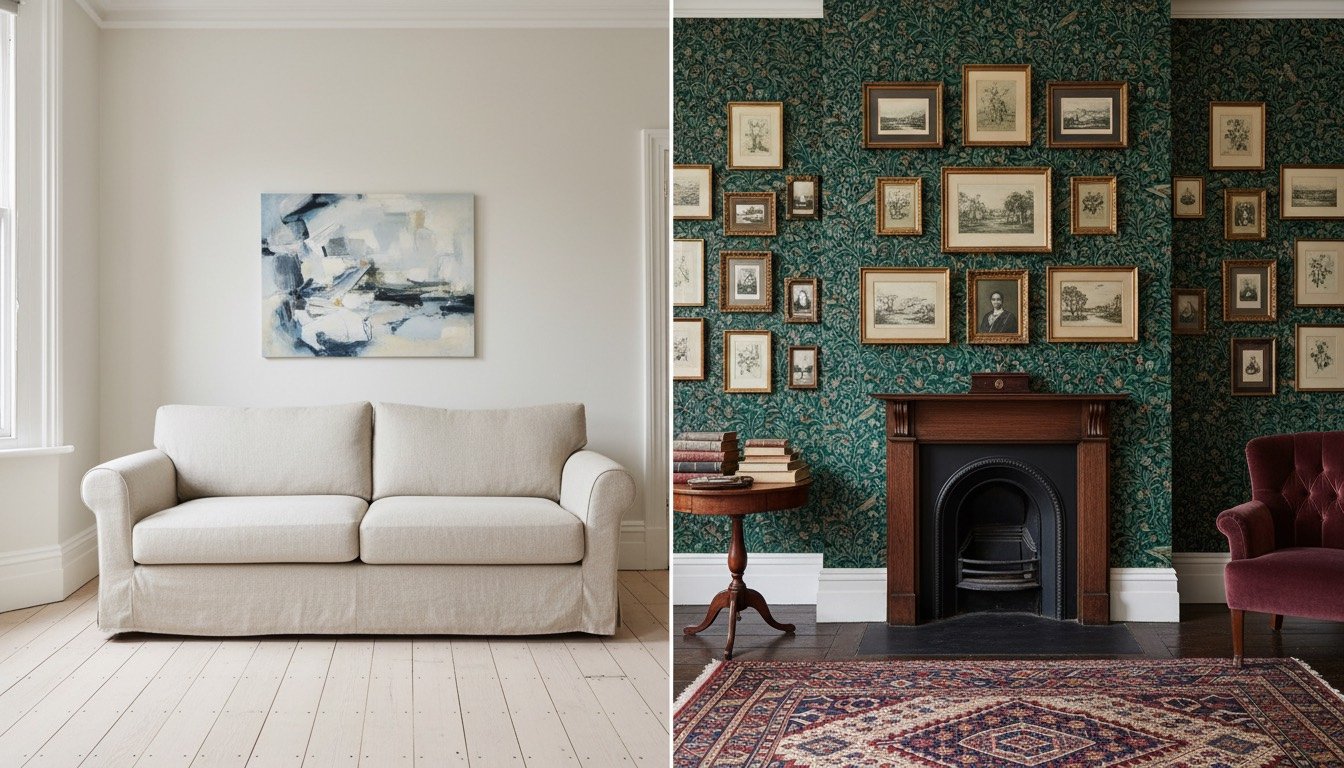
Two households can spend an identical £4,500 on the same 4m x 4.5m living room and end up with opposites. One has three pieces of furniture, a single large canvas and a lot of visible floor. The other has a papered chimney breast, thirty framed prints and a wool rug layered over sisal. Neither is more correct — they make different demands on the building, the budget and whoever holds the duster.
We have decorated both, cleaned both weekly and inventoried both at end of tenancy. Here is the comparison with the moodboard language stripped out, including how a tenant does either without losing a deposit.
The Side-by-Side, Without the Moodboard Language
Both are systems for handling visual weight. Minimalism removes competing elements so the few that remain carry the room; maximalism overloads the eye so no single flaw registers.
- •Palette — Minimalism: two or three tones. Maximalism: five to eight, anchored by one saturated hue repeated at least three times around the room.
- •Layout — Minimalism: fewer, larger pieces, 900mm+ circulation, visible floor at the edges. Maximalism: layered zones, mismatched seating, floor deliberately covered.
- •Walls — Minimalism: flat and unforgiving; every skim ripple shows in raking light. Maximalism: paper, panelling and hung objects, which hide plaster sins.
- •Storage — Minimalism: concealed, usually built in. Maximalism: open, displayed, part of the scheme.
- •Failure mode — Minimalism: one abandoned mug and the room looks neglected. Maximalism: two purchases too far and it reads as a jumble sale.
- •Housing stock — Minimalism: new-builds and post-war semis with square rooms. Maximalism: Victorian and Edwardian terraces with picture rails and 2.6m+ ceilings.
Performance in a Real UK Home
Britain gets roughly 1,400 hours of sunshine a year, and many back rooms face north. Pale minimalist schemes turn grey-lilac by three in November, because off-whites with blue or green in the base read cold under low northern light. Deep maximalist colours stop pretending, which is why oxblood and forest green work in a Victorian back reception where soft white never will.
Acoustics are the second difference. A flat with LVT flooring and plasterboard partitions echoes; rugs, lined curtains and full bookshelves knock that down noticeably, while minimalism needs compensation or it sounds like a waiting room. In small rooms both camps follow the rule from our guide to small living rooms that actually work: go large or go hidden, never medium. Get the lighting layers right either way.
Installation and Fit-Out: What Each Job Costs
Minimalism is a substrate job: with bare walls every defect shows, so most schemes start with a skim coat at £350-£600 per room. Then the quality tax: with four objects on show, all four must be good — £1,200-£2,500 for a sofa that holds its shape, £250-£900 for one large artwork, £1,300-£3,200 for built-ins. Realistic fit-out: £4,200-£8,000, nearly all of it in the first fortnight.
Maximalism is an assembly job, payable in instalments. Papering a 4m x 4.5m room with 2.4m ceilings takes seven to eight rolls — £315-£720 in materials, plus a decorator at £200-£320 a day. Twenty frames cost £160-£500; furniture can come secondhand at a third of retail. Realistic fit-out: £2,500-£6,000, spread over a year. If you are painting instead, check the UK interior painting cost breakdown first. One warning: on plasterboard a spring toggle holds 15-20kg reliably, while the plastic plugs in the frame packet hold about 2kg and pull out within a year.
The 10-Year Cost Compared
Over a decade the totals converge, but the shape of the spending differs completely. Minimalism front-loads, then bleeds through redecoration: plain pale walls in a family room need a full repaint every three to four years, at £420-£650 with a decorator or £70-£110 in materials yourself. Call it £5,500 fit-out plus £1,400 of repainting and £400 of replacements — around £7,300.
Maximalism starts cheaper and drips. Good wallpaper lasts 10-15 years, so redecoration is little more than repainting woodwork once at £200-£280. But the style has an appetite: households add three to six objects a year at £30-£90 each, which is £1,200-£3,500 over ten years, plus rug cleaning at £70-£160 every two to three years. Call it £6,800-£9,500. Crucially, maximalism's spend is optional in any given year and minimalism's is not.
Maintenance: The Weekly Hours, Honestly
Timed on the same living room, minimalism takes 25-35 minutes a week to keep looking right and maximalism 50-75. Thirty displayed objects each need dusting, open shelving films over within ten days, and layered rugs want lifting monthly rather than quarterly. If anyone has a dust allergy, that is the deciding factor.
Minimalism's hidden labour never shows in that tally: continuous editing. The room only works while it is empty, so post, keys and school letters must be dealt with daily. Households that find this hard get more from the room-by-room decluttering method than from any purchase.
The Renter-Safe Version of Both
Almost every style guide assumes you can drill. Both schemes work reversibly if you move them into a different layer. Photograph every room date-stamped on day one and report anything the inventory missed inside your agent's window, usually seven to fourteen days — deductions must account for fair wear and tear, and that evidence settles most disputes. More in our guide to decorating a rented home without losing the deposit.
- •Picture rails first. In a Victorian or Edwardian property the rail at roughly 2m is load-bearing — brass hooks and chain carry a full gallery wall with zero holes.
- •Adhesive strips for the rest. Large picture-hanging strips hold about 3.2kg per pair; remove by stretching the tab straight down the wall, slowly. Pulling outwards takes the paint with it.
- •Test peel-and-stick paper: a 15cm square behind a door for 72 hours, then remove it. On year-old emulsion it often lifts the paint film.
- •Go freestanding, not fitted. Modular shelving, a tall bookcase and a rolling rail give maximalist display or minimalist concealment, and they leave with you.
- •Change the soft layers: rugs over landlord LVT, lined curtains on a tension rod inside the reveal, replacement lampshades. Keep the originals bagged and labelled.
- •Paint only with written permission, by email, and budget £120-£180 plus a weekend to reinstate the original colour before check-out. Alter nothing else: no adhesive splashback tiles, no stick-on skirting.
Who Each Suits — and the Verdict
Minimalism suits square modern rooms with good light, households of one or two, people who enjoy tidying, and anyone selling or letting within two years. Maximalism suits period properties with height and mouldings, homes with children or pets, north-facing rooms, echoey flats, and people who acquire things and would rather display them.
The verdict: for most UK housing stock a maximalist-leaning scheme is the more forgiving and cheaper choice, because our rooms are small, our light is poor, our walls are rarely flat and our lives are cluttered. Minimalism is the better outcome when it lands, but it needs flat plaster, good light, real storage and daily discipline.
Test it cheaply first: strip the room to four objects for a fortnight, layer it back hard, and notice which fortnight you preferred. The specific jobs are in our home decor guides.
Found this useful?
There's plenty more — hundreds of guides and honestly-tested product reviews for every corner of your home.
Browse All Guides