Home Decor · 6 min read · 7 July 2026
Small Living Room Ideas That Actually Work (UK Edition)
British living rooms average under 17m² — small is the national condition. The designer moves that make modest rooms feel generous, no wall removal required.
By the Nims Casa editorial team — written from professional cleaning experience and checked against our editorial standards.
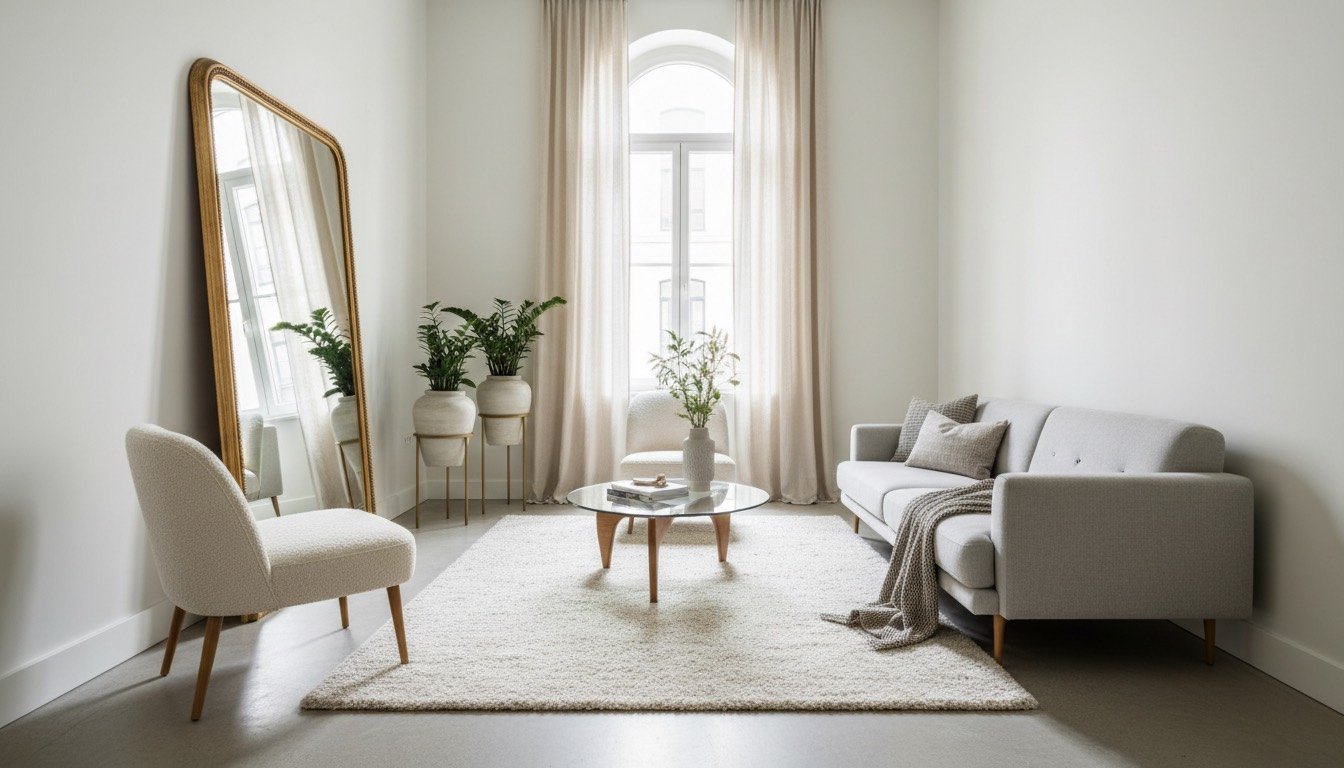
The average UK living room has been shrinking for decades, and most of us are now decorating spaces under 17 square metres — smaller than many single garages. That's not a design failure; it's the national condition, and small rooms done well feel intimate rather than cramped.
This guide covers the moves that genuinely change how a compact room reads: furniture scale, layout decisions that keep the space walkable, the two colour strategies that actually work (the muddled middle does neither), and storage habits that stop a room filling with visual noise. Every idea carries a realistic UK price, because knowing what a fix costs matters as much as knowing what it does.
None of it requires knocking through a wall or moving a radiator — though if you're weighing that option too, our guide to open-plan versus closed-plan layouts covers the trade-offs separately.
Furniture: fewer, leggier, right-sized
- •One properly sized sofa beats a sofa-plus-armchairs squeeze. A three-seater with slim arms often fits a small room better than a chunky 'compact' two-seater, because generous seating reads as intentional rather than cramped. Budget roughly £500–£1,200 for a well-proportioned three-seater from a mid-range retailer.
- •Legs are magic: sofas, sideboards and TV units raised on visible legs of 10cm or more let light and floor run underneath, and visible floor reads as spare capacity. Choosing a legged frame over a skirted one costs nothing extra at purchase but changes the whole room.
- •Scale up, count down: one large piece of art, one generous rug with the front legs of every seat sitting on it, and one statement lamp beats a confetti of small ornaments every time. See our guide to choosing a living room rug — an undersized rug is the single most common small-room mistake.
- •Go vertical: full-height shelving and floor-to-ceiling curtains, hung close to the ceiling and wider than the window frame, pull the eye upward and make ceilings feel taller for free. A decent curtain pole runs £15–£40; the trick is entirely in the hanging height, not the spend.
- •Everything storage: ottoman footstools (£60–£150), console tables with baskets underneath, and TV units with doors rather than open shelving. Small rooms can't absorb clutter the way large ones can, and clutter shrinks a room faster than any wrong colour choice.
Layout and sightlines: getting the traffic flow right
Before any styling move, the furniture has to be arranged so the room works as a room. Walk in from the doorway and note what you see first: if the sightline lands on the back or arm of the sofa, the space reads as an obstacle course before you've even sat down. Turning that same sofa to face the window, or floating it just 15cm off the wall, usually opens the geometry more than any amount of decluttering. For the full method — including two doors, a radiator and a fireplace all competing for wall space — see our step-by-step guide to arranging furniture in a small living room.
Keep a clear walking path of at least 60–90cm between the two busiest points, usually doorway to sofa or sofa to TV, and resist pushing every piece flush against a wall. Furniture floated a hand's width off the skirting board, anchored by a rug, almost always looks more considered than pieces lined up around the edges like a waiting room.
Colour and light: the two strategies that actually work
Small rooms want either honest light or confident enclosure — the timid middle ground of pale, indecisive greys does neither. The light route means warm whites that bounce daylight, with walls and woodwork painted in a single tone to blur the edges between them; a 2.5-litre tin of decent emulsion covers roughly 25 square metres per coat and costs £25–£45. The enclosing route means one deep, confident colour across walls, woodwork and sometimes the ceiling, which dissolves the corners and reads as a cocoon rather than a box — see our guide to colour drenching for how to do it without it looking like a mistake.
Whichever route you choose, light does the rest of the work. Place one oversized mirror to reflect the window rather than the sofa, and layer at least three light sources at different heights — floor lamp, table lamp, wall light — rather than one central pendant that flattens the room into a flat wash. Our guide to layering lighting properly sets out room-by-room targets. Keep curtains pulled fully clear of the glass during the day; even 10cm of fabric overlapping the pane blocks daylight a small room can't spare.
Storage that earns its keep without shrinking the room
Storage is where small living rooms tend to go wrong in one of two directions: either there isn't enough, so surfaces fill with clutter, or there's too much visible storage, so the walls start closing in. The fix is capacity that's generous but low in footprint.
- •Wall-mounted media units and floating shelves keep the floor clear underneath. A basic floating TV unit costs £80–£180 and reads far lighter than a freestanding cabinet of the same capacity.
- •A window seat or bench with a lift-up lid turns dead space under a window into seating and storage — a flat-pack version costs £120–£250, a bespoke fitted one £400–£900.
- •Nested or stacking side tables (£40–£120 for a set) give you surface area on demand without permanently occupying floor space.
- •If the room doubles as a home office or playroom, our guide to small-space storage ideas covers concealment tricks for kit that has no business being on show.
Common small living room mistakes
- •Buying a rug that only fits under the coffee table. It should extend under the front legs of every seat, or it will shrink the floor rather than expand it.
- •Hanging curtains tight to the window frame instead of 10–15cm below the ceiling — this quietly cancels out the vertical trick that makes ceilings feel taller.
- •Choosing rug, sofa and paint colour on separate shopping trips with no sample in hand. Undertones clash more obviously when everything sits closer together.
- •Relying on overhead lighting only. A single pendant with no lamps creates hard shadows that make a room feel flatter and smaller after dark, not bigger.
- •Styling before decluttering. No layout trick survives a room buried in post and laundry — our room-by-room declutter guide is worth doing first.
Frequently asked questions
**Will a lighter colour always make a small room feel bigger?** Not automatically. Pale colours only help if the room gets reasonable natural light; in a north-facing room, pale walls can look flat and grey, and a confident dark colour that dissolves the corners often reads as more spacious instead.
**What's the single most cost-effective change I can make?** Fixing curtain height and rug size. Both are typically under £150 combined, need no structural work, and correct the two mistakes that most reliably shrink a small room.
**Should I remove a wall to make the room feel bigger?** Sometimes, but it's a five-figure decision with structural and planning implications a layout fix doesn't have. If a wall looks load-bearing, get advice first — our guide on when to call a structural engineer explains what that involves and costs.
**Does furniture size matter more than colour?** Generally yes. A room with the wrong-sized sofa feels cramped in any colour, while a well-scaled room with an imperfect colour choice still reads as considered. Sort scale and legs first, then treat colour as the finishing layer.
**How do I stop the room feeling cluttered again within weeks?** Give every category of object — remotes, chargers, throws, post — a specific home with a lid or door, not just a surface. Clutter creeps back when storage has no obvious slot for daily items.
**Is it worth hiring an interior designer for one room?** Most homeowners get similar results from a few hours of paid consultation (£75–£150) rather than a full package, since the core moves — scale, legs, sightlines, one confident colour — are what any service recommends anyway.
Found this useful?
There's plenty more — hundreds of guides and honestly-tested product reviews for every corner of your home.
Browse All Guides