Garden & Outdoor · 6 min read · 5 June 2026
Pavers vs Concrete Patio: UK Costs, Drainage and the Old-House Verdict
Two quotes for the same 20m² patio often land within £300 of each other. The difference shows up ten winters later, in what you can lift, patch and get back underneath.
By the Nims Casa editorial team — written from professional cleaning experience and checked against our editorial standards.
Quotes for the same 20m² back patio routinely arrive within £300 of one another, poured or laid. Price is rarely the deciding factor. What decides it is what you can get back to afterwards — the clay drain, the wall base, the corner that has settled 15mm — and how the surface survives ten British winters.
Most UK homeowners are choosing for a terrace or semi built before 1940: a solid nine-inch wall with a slate damp proof course at best, and a salt-glazed drain of unknown vintage somewhere underneath. That changes the answer, so it is dealt with head-on.
Side by side, in plain terms
"Pavers" here means block paving, concrete flags, riven Indian sandstone or porcelain; "concrete" means plain broom-finished slab or pattern-imprinted. Rates are 2026 supplied-and-laid figures for a rear garden with reasonable access.
- •Cost laid: plain concrete £65–£100/m²; flags £70–£110/m²; block paving £80–£125/m²; imprinted concrete £90–£140/m²; sandstone £95–£145/m²; porcelain £125–£185/m².
- •Build-up: both want 100–150mm of compacted MOT Type 1. Concrete adds 100mm of C25/ST3 over A142 mesh; pavers a 30–40mm wet mortar bed, or 40mm of sharp sand for blocks.
- •Time to use: blocks walkable same day, mortar-bedded flags in 24–48 hours. Concrete needs three days before boots, seven before furniture.
- •Failure and repair: concrete cracks in lines, and the fix is a visible patch or a breaker. Pavers dip, and a dozen sunken blocks are re-laid in an afternoon.
- •Drainage and access: permeable block paving takes rain through the joints and lifts for repairs. Concrete sheds every drop to one edge and never comes back up — which decides more old-house jobs than looks ever do.
How each performs in a British climate
Our freeze-thaw is shallow but relentless — a Midlands winter crosses 0°C forty or fifty times, usually with the surface already saturated. Cheap Indian sandstone under 22mm delaminates by year six; calibrated 20–22mm grades hold up. Porcelain absorbs under 0.5% water and is effectively immune.
Concrete's weakness is movement, not frost. A monolithic 20m² slab has nowhere to go when shrinkable clay swells in January and shrinks in August. Skip control joints every 3–4m and you get a crack off a corner within three years.
In shade both go green by year two, though concrete's open pores hold algae harder. Removing it without wrecking joints is covered in our patio cleaning guide; machine choice matters more than raw pressure, as our pressure washer picks explain.
Installation: what actually happens on site
Concrete is one committed day. Ready-mix runs £120–£155/m³ plus a £40–£70 part-load charge, because 20m² at 100mm is only 2m³. If the mixer cannot reach the back garden you are barrowing through the house or hiring a line pump at £350–£500. Once discharged you have about 90 minutes to level, tamp and finish — no second attempt.
Pavers are incremental and forgiving. Lay 6m² on a Saturday, tarpaulin the screed, carry on next weekend — which is why it stays the realistic DIY route. Base depths and jointing are in our step-by-step paver patio guide.
Both need a fall of at least 1:80 (1:60 is better) away from the house, and neither should discharge onto a neighbour or into a foul gully. If the ground already sits wet, improve the garden drainage first. And in England, a new impermeable surface over 5m² in a front garden needs permeable construction or drainage to a permeable area within your boundary.
The old-house case: DPC, air bricks and Victorian drains
Solid walls have no cavity to interrupt rising or splashing water, and lime plaster inside shows the mistake before the brickwork does. The finished patio must sit at least 150mm — two brick courses — below the damp proof course, and where the DPC is slate, felt or absent, treat that as a floor rather than a target. A slab poured tight to the wall bridges it; the tell-tale is a tide mark 400–600mm up the internal wall in the second winter.
The remedy is the same whatever the surface: leave a 100–150mm margin of 10mm pea shingle along the wall foot, draining to a perforated pipe, and never seal paving into lime-pointed brickwork with cement mortar.
- •Survey the drains first. Victorian salt-glazed clay sits in short jointed lengths, often only 300–450mm down, and habitually crosses the strip you want to pave. A CCTV survey is £80–£180; a failure under concrete means a breaker and a re-pour.
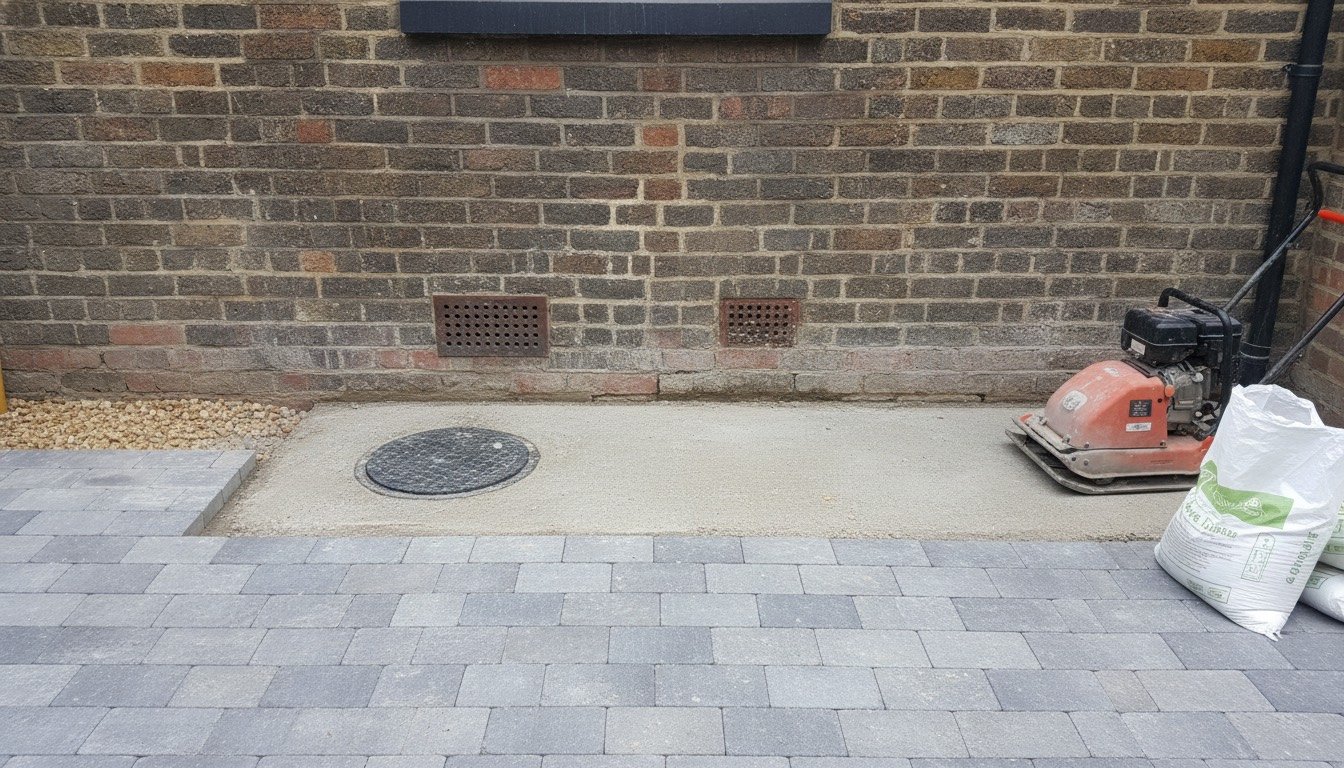
- •Keep gullies, rodding eyes and inspection chambers reachable. A recessed manhole tray (£60–£120) lets block paving cross a chamber; a slab entombs it.
- •Never bury an air brick. Suspended timber floors rely on that cross-flow, and blocked vents rot joist ends within a decade. If levels force it, fit periscope vents at £25–£40 each.
- •Check for coal vaults, light wells and cellar drops before ordering — paving over a vault crown is a genuine collapse risk, and old footings are too shallow to excavate hard against.
Ten-year cost, honestly totted up
A 20m² rear patio over ten years with realistic upkeep. All exclude £280–£400 of skip hire, the line most quotes bury.
- •Plain concrete: £1,650 install, three reseals at ~£10/m² (£600), one crack repair £150–£300. Total £2,450–£2,550.
- •Imprinted concrete: £2,300 install, four reseals at £12/m² (£960). Total ~£3,260 — and a faded, patchily sealed imprinted patio is hard to rescue.
- •Block paving: £2,050 install, sand top-ups £60, one lift-and-relay £200. Total ~£2,310, and genuinely renewable at year 15.
- •Porcelain on a full mortar bed: £3,100 install, occasional jointing repair £80. Total ~£3,180, with the lowest annual effort here.
Maintenance, year by year
Neither is maintenance-free. Concrete wants a big effort every few years; pavers a small one every spring.
- •Spring, pavers: brush the joints, top up kiln-dried sand or brush-in compound, and let a patio-safe biocide work rather than blasting moss out.
- •Spring, concrete: rake out and reseal opened control joints; check the wall junction for a standing puddle line.
- •Autumn, both: clear the gully grating and check the fall still throws water clear of the wall.
- •Every 2–3 years, imprinted concrete: clean and reseal in a dry spell above 10°C — realistically late May or September.
- •Every 5–8 years, block paving: re-lay any settled bay — usually an edge sub-base fault.
Who each suits, and the verdict
Concrete earns its place on stable ground with easy access, over a large plain area with nothing important beneath: a modern estate house, a side return with no services, a utility area where flatness beats looks. It is the honest low-budget pick.
Pavers earn theirs wherever the ground is uncertain or the house is old — most Victorian and Edwardian stock, most London clay. Lifting twenty blocks, fixing a pipe and relaying them beats any spec sheet.
The verdict: for a pre-1970s house, lay pavers. Permeable block paving where budget rules and drainage is awkward, porcelain where you want minimal upkeep, calibrated 22mm sandstone where the house wants a softer material. Reserve poured concrete for post-war properties on firm ground with nothing beneath. Weighing it against timber instead? Our ten-year decking comparison is the next read. Before accepting any quote, get the drain surveyed and chalk the finished level against your DPC.
Found this useful?
There's plenty more — hundreds of guides and honestly-tested product reviews for every corner of your home.
Browse All Guides