DIY & Maintenance · 6 min read · 10 July 2026
Pet-Friendly Home Ideas for Older UK Homes and Real Budgets
A retriever can do more damage to a 1900s terrace in a fortnight than a family does in a year. Here is how to make an older UK house genuinely pet-friendly without wrecking its fabric.
By the Nims Casa editorial team — written from professional cleaning experience and checked against our editorial standards.
Most pet-friendly advice assumes a post-1990 house: plasterboard, a concrete slab, a modern consumer unit. Roughly a fifth of British homes went up before 1919, and those behave completely differently. Solid brick walls with no cavity, lime plaster on timber lath, floorboards suspended over a ventilated void, salt-glazed clay drains and, in plenty of houses, wiring nobody has touched since decimalisation.
So half the standard advice either does not work or actively damages the building. What follows is the version we give clients with Victorian, Edwardian and inter-war houses: ideas that survive claws, mud and accidents without trapping moisture in a wall that needs to breathe. Most of it quietly future-proofs the house for people too, which is why the same measures turn up in ageing-in-place work.
Floors first, because that is where the money and the smell go
In an older house the ground floor is usually timber boards on joists over an open, air-bricked void. Gaps between boards run 2-5mm, and that is where urine, hair and grit disappear. Closing them is the highest-value job in a pet household, and it cuts draughts noticeably too.
Sanding and refinishing original boards costs roughly £25-£45 per m2 through a contractor. Insist on a two-pack polyurethane or a hardwax oil rated for commercial traffic, not a domestic satin varnish, which a large dog will haze inside eighteen months. If the boards are past saving, a 6mm plywood overlay screwed at 150mm centres before click-fit LVT gives a flat, quiet, waterproof floor for around £45-£70 per m2 fitted. Skip the ply and every board joint telegraphs through within a season.
- •Best all-round: engineered oak, 4mm wear layer, brushed and oiled. Scratches blend rather than glare, and it spot-repairs.
- •Avoid high-gloss laminate. It shows every claw mark and becomes a skating rink for older dogs on the turn.
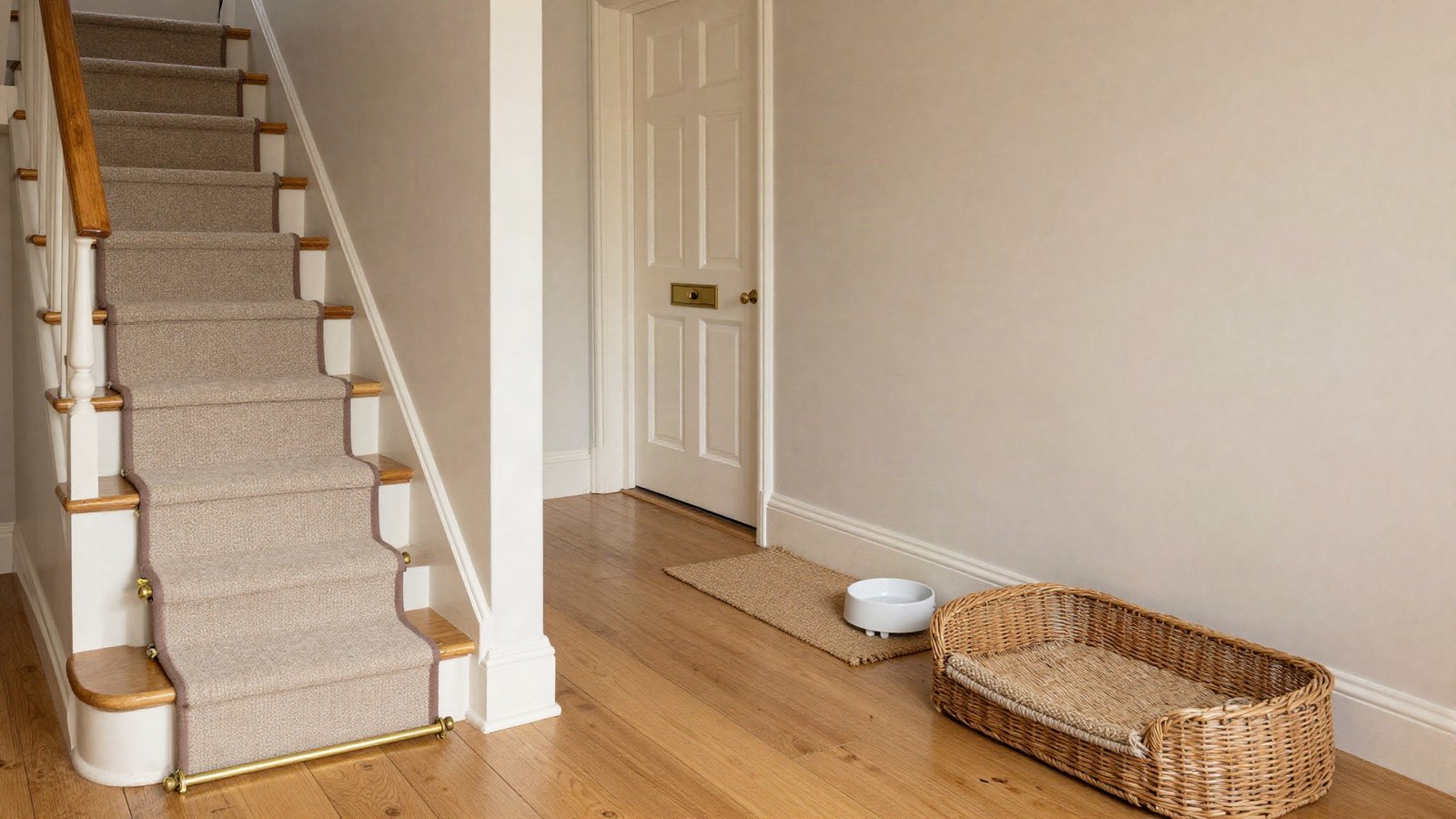
- •Stairs: a wool-rich runner on brass rods beats fitted carpet. You can lift and wash a runner; you cannot wash a staircase.
- •Never seal a suspended timber floor with impermeable sheet vinyl unless the underfloor airbricks are clear. Trapped moisture rots joist ends.
Lime plaster, solid walls and the dog that leans
Lime plaster on lath is soft, porous and designed to let a solid wall dry inwards. A wet dog leaning on it leaves a mark you cannot scrub out, and the instinctive fix, coating it in wipeable vinyl silk, is the wrong one: vinyl and modern masonry paints trap moisture behind the surface and blow the plaster off the lath in sheets. Use a breathable mineral or clay paint in matt or eggshell instead. The same logic applies outdoors, where lime mortar rather than modern cement keeps the brickwork drying.
Better still, add a sacrificial layer. Tongue-and-groove panelling to 900mm along the hallway and stair wall costs about £30-£55 per linear metre in MDF, takes shoulder-height mud, and repaints in an afternoon.
- •Leave a 15mm ventilation gap behind panelling on a solid external wall so the wall can still dry.
- •Cats scratch corners, not flat walls. A sisal post within a metre of the sofa arm redirects it; a corner protector fitted afterwards does not.
- •Repaint deep Victorian skirtings in water-based satinwood, not oil gloss, so touch-ups do not yellow.
Doors, gates and sash windows
Cut a cat flap through an original four-panel door's lower panel only, never through a stile or rail, which is the door's structure. Through a solid wall you are dealing with 225-330mm of brick, so budget for a tunnel extender kit rather than a standard 60mm collar.
Sash windows are the quiet hazard: a cat can shift a counterbalanced sash several inches, which matters on a first floor. Sash stops cost £6-£12 a pair and fit in fifteen minutes. For stair gates, never screw into turned newel posts or cast-iron balusters. A banister fitting kit with Y-spindles and webbing straps, £12-£20, clamps without leaving a hole in original joinery.
Wet dogs, Victorian drainage and where the smell really lives
Older houses often still run into salt-glazed clay drains with an open back gully. Hair, shampoo and grease bind into a mat that clay pipework, with its rougher bore and shallow falls, clears far less willingly than modern plastic. Fit a stainless gully grate, and trap the hair before it goes down.
Indoors, odour is nearly always sub-floor rather than surface. Urine wicks into underlay, gripper rod and the timber beneath, then reactivates whenever humidity climbs, which in a solid-walled house is most of autumn. Treat the substrate, not the stain, and read our method for getting pet urine smell out of carpet before buying another bottle of anything. A drying-off zone by the back door with washable coir matting, a hook rail and a lidded towel bin does more than any air freshener.
Wiring, heating and the hazards you cannot see
Pre-1970s installations used rubber or lead-sheathed cable that perishes into a crumbling sleeve, and often have no RCD protection at all. A puppy chewing a trailing flex on that kind of circuit is a genuine danger, not a caution. If your consumer unit is a wooden or Bakelite box with rewireable fuses, replacement runs roughly £450-£800, is notifiable under Part P, and is the best money in this article.
Cast-iron column radiators reach 60-70C at the surface on a standard flow, so keep beds a hand's width clear and cover the hallway radiator a dog sleeps against. Route flexes in D-line trunking clipped to the skirting rather than looping them across a floor a cat treats as a racetrack.
Budget tiers and small-room reality
Terraced hallways are commonly 900-1,050mm wide and a back bedroom in a two-up two-down can be under 7m2, so nothing bulky survives. Wall-mounted feeding stations, an under-stairs crate with the door reused as a gate, and a bench with hidden lead storage all buy floor area back. Outside, gravel beats lawn where a dog patrols the same line daily, and artificial grass with dogs only works with the right sub-base and a rinse routine. Choose planting deliberately as well, starting with our list of pet-safe houseplants.
- •Under £400: sash stops, banister-fit stair gate, cable trunking, washable coir matting, a hardwax oil top-up, a sisal scratching post.
- •£1,200-£2,500: sand and refinish the ground floor, wool runner and rods on the stairs, panelling in the hall, gully grate and outside tap.
- •£5,000-£9,000: LVT over ply throughout the ground floor, consumer unit upgrade and partial rewire, a boot room in the rear return with a shallow tray for rinsing.
- •Where the money goes: roughly 60% labour on flooring and electrics, 40% materials. Anything involving lifting floorboards overruns, because old boards break on lifting.
Quick answers, and what to do first
Does carpet ever make sense with pets? On stairs and in bedrooms, yes, in a solution-dyed polypropylene that survives a diluted bleach clean. Cut pile shows every drag mark. Will retrofitted underfloor heating dry out old boards? It can, so have their moisture content checked first. And if the house is listed or in a conservation area, altering original doors or windows may need consent.
Start with the floor and the sash stops: those two remove the problems that cost most later. Then browse our carpets and flooring guides to specify materials.
Found this useful?
There's plenty more — hundreds of guides and honestly-tested product reviews for every corner of your home.
Browse All Guides