Kitchens & Bathrooms · 6 min read · 25 May 2026
Quartz vs Granite Worktops: The Honest UK Cost Comparison
The price gap between quartz and granite is usually smaller than the gap between two colours of the same material. Here is what genuinely separates them in a UK kitchen — and what a fair quote looks like.
By the Nims Casa editorial team — written from professional cleaning experience and checked against our editorial standards.
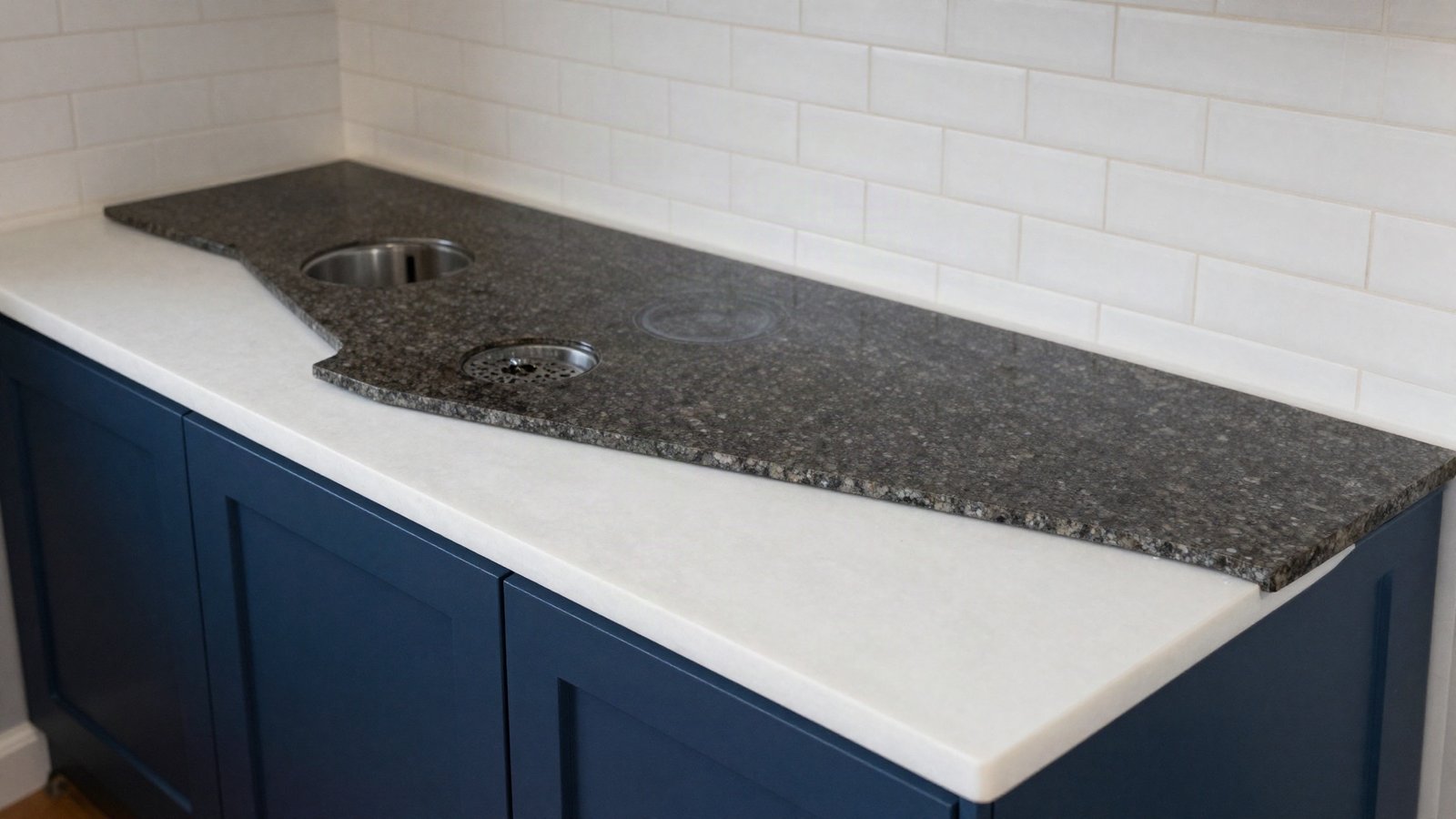
Two slabs, both heavy, both sold from the same showroom by the same fabricator — and the price gap between them is usually smaller than the gap between two colours of the same material.
We template and fit both. What genuinely separates them in a British kitchen: behaviour under a hot pan, what happens in a south-facing extension, what belongs on the quote, and the rules around a 150kg slab.
Quartz vs granite: the side-by-side
Strip out the showroom language and six things decide it.
- •Composition: granite is quarried stone, no two slabs identical. Quartz is engineered — typically 90–93% crushed quartz mineral bound with 7–10% polyester resin.
- •Heat: granite takes a pan straight off a gas ring. Quartz resin scorches and yellows above roughly 150°C, and thermal-shock cracking beside a hob cut-out is the commonest quartz claim we see.
- •Sealing: quartz is non-porous and never needs it. Granite varies wildly by colour — Black Galaxy barely drinks, pale Kashmir White is thirsty — and wants a penetrating sealer on fitting, then every 12–24 months.
- •Sunlight: quartz pigment fades and the resin yellows under sustained UV, so manufacturers exclude conservatory and outdoor use from the warranty. Granite is UV-stable — worth knowing in a bifold-door extension.
- •Looks and repair: quartz gives repeatable pattern and the only convincing white Calacatta look, but chips show. Granite has movement you cannot fake and takes colour-matched epoxy invisibly — approve the actual slab, not a sample.
- •Warranty: quartz brands give 10–25 years on the material if you register it. Granite carries 12–24 months on workmanship only. Nobody warrants geology.
What quartz and granite cost in the UK
Fabricators quote supply-and-fit per square metre of finished worktop, and the 2026 bands overlap heavily. A typical UK kitchen carries 4.5–8m², so most quotes land between £1,700 and £4,500 either way.
There is no clean labour-versus-materials split on stone, which is why "how much is the granite?" is the wrong question. The raw slab is roughly 30–40% of a supply-and-fit price, workshop fabrication 35–45%, templating and fitting the rest. VAT is 20% in an occupied home; the 5% rate only reaches properties empty two years or more. Our kitchen remodel costs guide puts that in proportion.
- •Granite, stock colours (Steel Grey, Star Galaxy, Black Galaxy) at 20–30mm: £250–£450 per m² fitted; exotic or heavily veined slabs £450–£800.
- •Quartz, mainstream ranges: £280–£500 per m² fitted; premium book-matched marble-look £500–£750.
- •Undermount sink cut-out £100–£180; drop-in £50–£90; hob cut-out £50–£100; drainer grooves £80–£150.
- •100mm upstands £40–£70 per linear metre; full-height stone splashback £180–£300 per m².
- •Mitred waterfall island end £250–£450 each; removing and tipping old worktops £100–£250.
Three worked UK examples
Per-square-metre figures only mean something once the extras attach. Three real jobs, itemised as a quote should be.
- •Small galley, 4.2m² of 20mm mid-grey quartz: material and fabrication £1,302 (£310/m²), undermount cut-out £140, hob cut-out £70, 5.5m of upstand £300, template and fit £330, laminate removal £120. Total £2,262.
- •L-shape with island, 7.8m² of 30mm Steel Grey granite: material and fabrication £2,574 (£330/m²), two mitred waterfall ends £700, undermount cut-out with drainer grooves £260, hob cut-out £70, template, delivery and two fitters £520, old oak removal £150. Total £4,274.
- •Budget like-for-like swap, 5.0m² of stock Black Galaxy granite: material and fabrication £1,250 (£250/m²), drop-in sink cut-out £60, hob cut-out £60, template and fit £350. Total £1,720.
- •All three land between £340 and £550 per m² all-in — the band to hold in your head. Under £250 per m² usually means a 12mm slab on a substrate, an unmentioned joint, or a number that grows after templating.
How to sanity-check the quote
Stone quotes hide their variables, because the real cost driver — how much slab your shape consumes — stays invisible until fabrication. Four questions flush it out before you compare estimates properly. Worktops also belong late, after layout, sink position and hob type are fixed, which is where they sit in planning a kitchen remodel.
- •Are the quoted square metres net (finished worktop) or gross (slab consumed)? Wastage on an awkward L-shape runs 20–30% and you pay for it either way.
- •Get slab name, brand, thickness and finish in writing — "grey quartz" is not a specification — and check VAT is stated.
- •Agree where the joints fall before you sign, not on template day. A seam across an island is a design decision, not an accident.
- •On granite, ask which sealer is used and whether the first coat is included; on quartz, register the warranty or cover drops to two years.
Heat, hard water and the ten-year cost
Both wipe down with warm water and washing-up liquid, and both are wrecked by bleach, oven cleaner, abrasive cream cleansers and anything strongly alkaline left to sit. On quartz those dull the resin permanently; on granite they strip the sealer.
Across southern and eastern England the real enemy is limescale round the tap base. Avoid strong acidic descalers — repeated use etches polished granite and degrades quartz resin — and borrow the gentler method from our limescale guide. Over ten years the running-cost gap stays small: quartz costs nothing beyond cleaner, granite about £120–£150 in impregnating sealer. Test annually by leaving a water droplet five minutes; if the stone darkens underneath, reseal.
Silica dust and the UK rules that genuinely apply
Replacing a worktop needs no planning permission or building control approval in its own right. Two exceptions: a listed building needs listed building consent for internal alterations, which catches kitchens more often than owners expect, and in a rental a water-damaged worktop can be an HHSRS hazard under the landlord's fitness-for-habitation duty.
The connected services are where the rules bite. A gas hob must be disconnected and reconnected by a Gas Safe registered engineer, not the worktop fitter. Electrically, a like-for-like swap in England is not notifiable under Part P — kitchens stopped being a special location in 2013 — but a new induction hob circuit or consumer unit work is. Wales kept the broader older rules.
Then there is dust. Engineered quartz is over 90% crystalline silica, granite roughly 25–40%, and dry-cutting either releases respirable silica against an HSE limit of 0.1mg/m³ over eight hours. Competent fabricators wet-cut with extraction under COSHH. If a fitter starts trimming a cut-out with a dry angle grinder in your kitchen, stop the job — Australia banned engineered stone fabrication in 2024 over silicosis. It is the honest reason DIY is off the table: unlike a tiled splashback, stone is not a weekend job.
So which should you buy?
Choose quartz for a pale, consistent, marble-look surface, for hard-water homes where sealing will never actually happen, or where you may need matching material later. Choose granite if you cook hard and put pans down without thinking, if the run sits in strong direct sun, or if money is tight — stock colours routinely undercut mainstream quartz by £50–£80 per m².
The dishonest version of this comparison declares a winner. In a typical UK kitchen the two perform closely enough that your hob habits, your window orientation and which slab you like looking at decide it. For the wider field, see our worktop round-up.
Found this useful?
There's plenty more — hundreds of guides and honestly-tested product reviews for every corner of your home.
Browse All Guides