DIY & Maintenance · 6 min read · 7 April 2026
Why Do Drywall Cracks Keep Coming Back (and How to Fix Plasterboard for Good)
Filler doesn't fail on its own. If the same crack reappears every winter, the wall is moving — and until you work out why, you are only repainting the problem.
By the Nims Casa editorial team — written from professional cleaning experience and checked against our editorial standards.
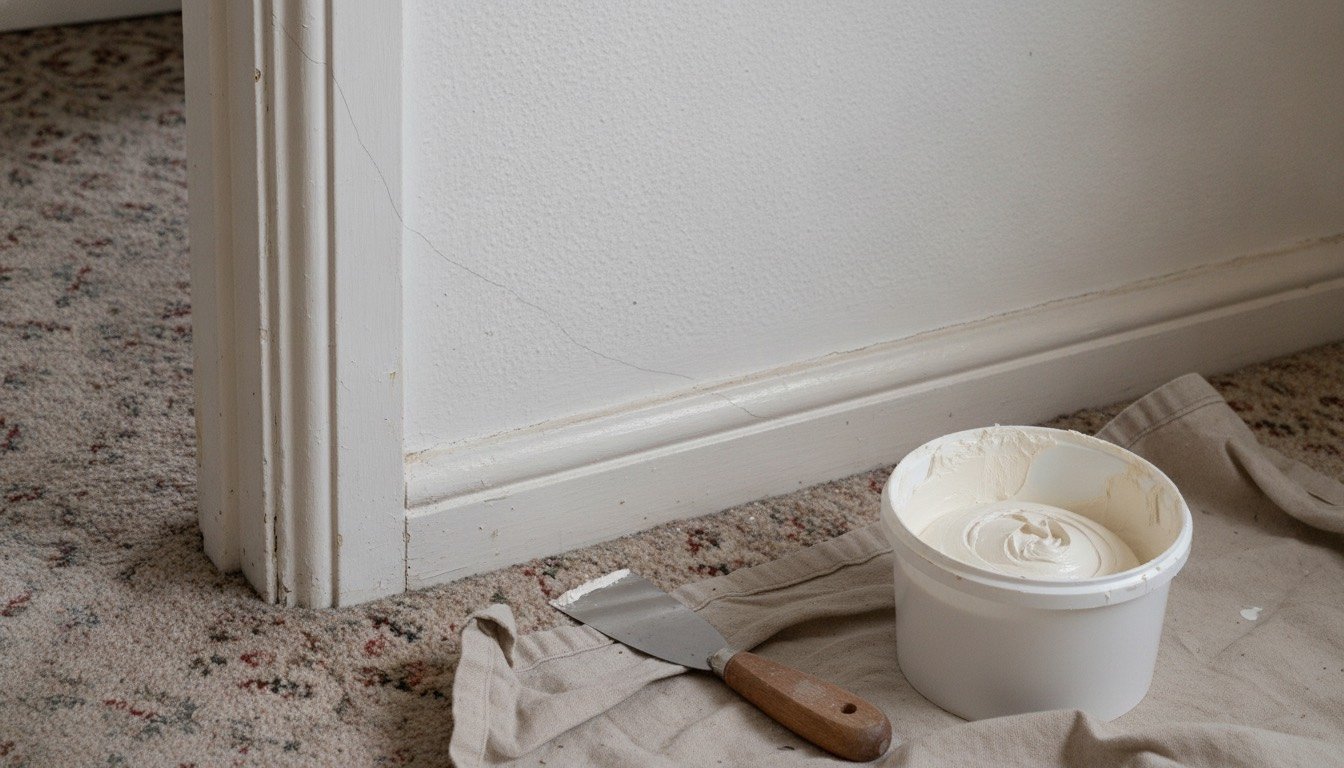
There is a particular frustration in filling the same hairline three times. You rake it out, fill it, sand it back, touch in the paint, and by February it has walked back across the wall on the same line. That is not a filling failure: ready-mixed filler cannot bridge a joint that is still moving.
The useful question is never what to fill it with. It is what is moving, how much, and how often. Answer that in ten minutes with a torch and a steel rule and everything else follows — including whether this is a £4 tube of caulk or a £600 engineer's report.
The ten-minute diagnosis
Do this before you buy anything: where the crack sits, how wide it is, whether it is growing, and whether it shows outside too.
- •Measure the widest point with a steel rule. Under 1mm is cosmetic in almost every case; over 5mm changes the conversation entirely.
- •Note the line. Vertical, or horizontal at 1.2m or 2.4m, is a board joint. Diagonal from a door or window corner is a load path.
- •Tap either side with a knuckle. A dull thud means bonded plaster; a hollow rattle means it has parted from what is behind.
- •Pencil a tick at each end, date it, photograph it. Growth within three months means live movement, not a one-off.
- •Check the outside brickwork at the same spot, whether doors still close cleanly, and what surrounds the room: a loft, a bay, an extension junction.
Symptom to cause: what the crack is telling you
Nine out of ten repeat cracks in UK homes fall into one of these patterns, and each has a different correct answer.
- •Vertical line roughly every 1.2m, opening in winter: an untaped or badly taped plasterboard joint moving with humidity.
- •Crack right around an upstairs ceiling perimeter, worse after a cold snap: thermal movement in the roof trusses, common where loft insulation was topped up to 270mm.
- •Small circular pops in rows, sometimes rust-ringed: nail pops as timber studs dried from around 18% to 10% moisture content.
- •Diagonal crack from a door or window corner, wider at the top, visible outside too: structural movement. Stop filling.
The causes, in the order we actually find them
Seasonal humidity swing comes first by a distance: a UK house sits at 60-65% relative humidity in November and 40-45% in a heated January, and both timber and plasterboard move with it. Second is a joint that was never reinforced — filler alone in a board seam has no tensile strength, which is the commonest reason a repair fails. Third is fixing failure: nail pops, screws that missed the stud, dot-and-dab boards flexing on their adhesive. Fourth is thermal movement at ceiling perimeters and flues. Fifth, and only fifth, is genuine building movement, which is what most homeowners assume and almost never what it is. Our guide on settling cracks versus structural cracks shows how each behaves over a year.
Fixes, ordered from lowest risk to highest
Work down this list. Width and behaviour matter far more than length.
- •Moving junction (wall to ceiling, wall to skirting): rake to a 4-6mm gap, prime, run flexible decorator's acrylic caulk and tool it with a wet finger. Redo every five to eight years, or fit coving instead.
- •Crack up to 3mm: open it to a square section 4-5mm wide, vacuum, dampen, then fill with a 45-minute setting compound. Bed paper tape into the wet first coat, second-coat it, feather 250-300mm each side. Self-adhesive scrim telegraphs through paint within a year.
- •Nail pops: drive a 38mm drywall screw 40mm above and below into the stud, punch the old nail under the surface, fill all three in two thin passes.
- •Hollow dot-and-dab: refix through the board into the blockwork with 100mm drylining screws and washers at 400mm centres, then patch. Cheaper than reboarding, and it stops the flex.
- •Crazing across a whole room: stop patching and re-skim. Past roughly eight patches per wall, patching costs more in time than skimming.
- •Failed lath and plaster ceiling: overboard with 9.5mm plasterboard screwed to the joists, then skim. Patching one that has lost its keys buys a single winter.
What this actually costs in the UK
Materials are the small number, and that is the whole trick to reading a quote. A 10kg bag of setting joint filler is about £12, a 75m roll of paper tape £5, a tube of decent caulk £4, a taping knife £15, a sanding sponge £4 — everything needed to fix every crack in a three-bed house for £45-£80.
Labour is where the money goes. Plasterer day rates in 2026 run £200-£280 across most of the UK and £280-£380 in London and the South East, with a half-day minimum of £130-£180. Making good a handful of cracks in one room is a half-day: £150-£250 ready for paint. Re-skimming a 12m² ceiling is £250-£400; a full room, walls and ceiling, £500-£850 outside London.
Now look at the split. On a £250 half-day repair, materials are typically £15-£30 — under 12% of the bill. Even on a £600 re-skim, plaster, beads and boards total £70-£120, so you are still paying 80-85% labour. Our drywall repair cost guide covers regional variation, and the ratio holds when repairing old plaster walls.
Reading a quote: fair versus suspect
Because labour dominates, any quote with a fat materials line deserves a question, as does any quote that fixes the crack without once mentioning why it appeared.
- •Fair: a written scope naming the products, saying whether a mist coat and waste removal are included, and admitting the crack may return if the cause is seasonal.
- •Fair: a total within about 20% of the day rate multiplied by days quoted, plus £30-£120 of materials.
- •Suspect: £200 or more itemised as materials for a filling and taping job.
- •Suspect: a price well under the local half-day minimum. Someone will fill and leave, and it will be back by spring.
- •Suspect: a firm that arrives uninvited, diagnoses subsidence on the doorstep and offers underpinning with finance attached. Nobody prices underpinning without an engineer's report and months of monitoring.
- •Worth paying for: an engineer's visit and written report at £400-£800, or tell-tale crack monitoring at £300-£600.
Where DIY has to stop
Everything above is homeowner work with a filling knife and a Saturday. The hard line sits here: instruct a structural engineer, not a builder and not a damp firm, if the crack is over 5mm, wider at one end than the other, diagonal from a door or window opening, mirrored in the outside brickwork, or if doors have begun binding. Same again on South East clay with a mature willow, poplar or oak within 15 metres.
Ceilings get their own rule. If one flexes underfoot from the room above, sags, or drops dust when a door slams, keep people out and have it looked at rather than propping and filling. If the plaster around a crack is damp or soft, fix the water first — start with damp and mould causes and cures. Below that line technique beats product, and our step-by-step on filling cracks and holes in walls covers raking, taping and feathering properly.
Found this useful?
There's plenty more — hundreds of guides and honestly-tested product reviews for every corner of your home.
Browse All Guides