Heating & Cooling · 6 min read · 18 April 2026
The Ideal Indoor Humidity Level for UK Homes (And How to Actually Hit It)
Two houses on the same street can both read 62% humidity. In one it means nothing; in the other, black mould by February. The number only matters once you know how cold your walls are.
By the Nims Casa editorial team — written from professional cleaning experience and checked against our editorial standards.
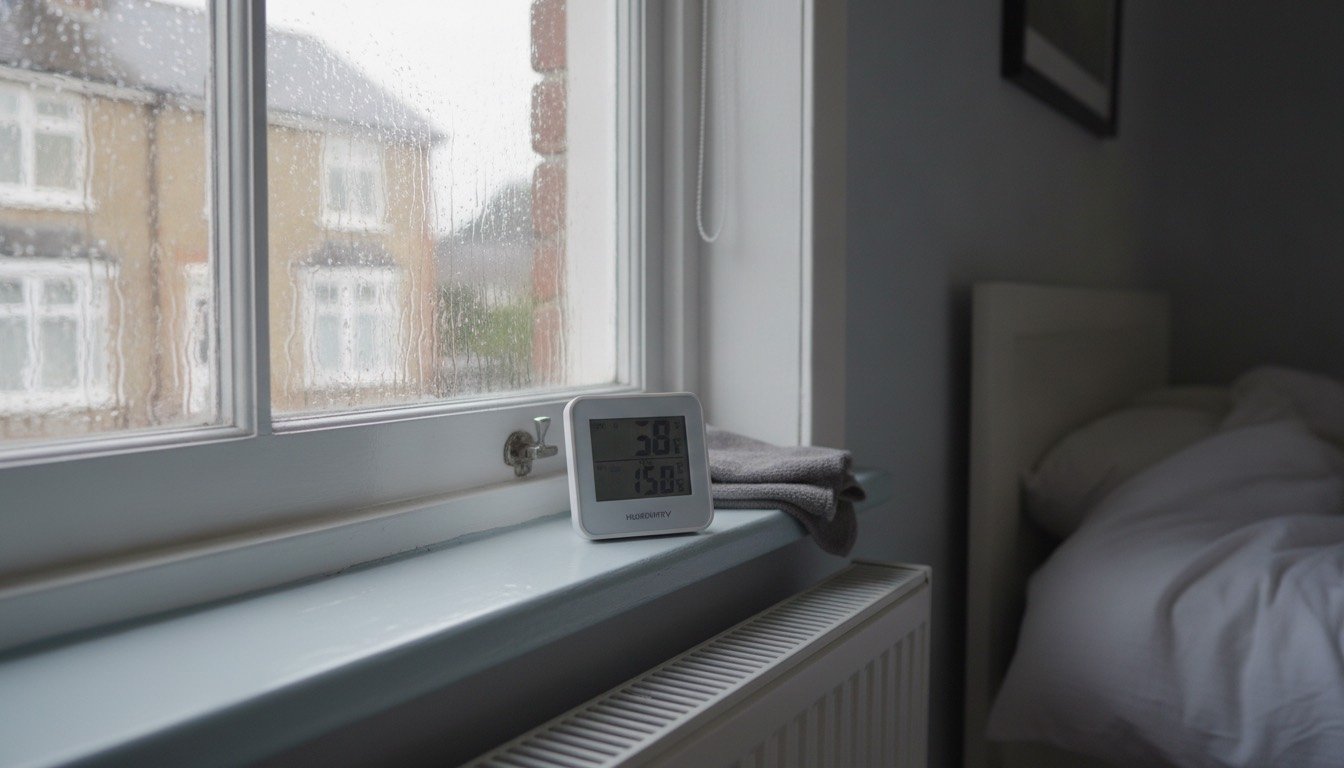
Two houses on the same street can both read 62% on a hygrometer. In one that is harmless. In the other, the north-facing bedroom wall grows black mould every February. The reading means little until you know how cold the coldest surface in that room gets — the part most advice skips.
Damp specialists spend most of their week on jobs where the homeowner already bought a dehumidifier, opened the windows, and still has the problem, because the fix was aimed at the wrong cause. Here are the target numbers, then a way to work out which problem you actually have.
What the ideal indoor humidity level actually is
Relative humidity (RH) is the percentage of moisture air holds against the maximum it could hold at that temperature — a ratio, not a quantity, which is why the same air reads 55% in a warm living room and 90% behind a wardrobe on an outside wall. Aim for 40-60% RH, and 40-55% from November to March.
- •Below 30%: sore throats, static off door handles, wood floors and joints shrinking. Rare in the UK; 30-40% is harmless short term in freezing weather.
- •40-55%: the target. Comfortable, stable for plaster and timber, hostile to dust mites.
- •55-65%: dust mite numbers climb sharply. Fine in a warm, well-insulated house; risky in an older solid-wall property.
- •Above 65%: condensation on cold surfaces, musty smells within days, visible growth within weeks. Start with how to get rid of damp and mould.
Why dew point matters more than the RH number
A household of four generates 10-15 litres of water vapour a day doing nothing unusual: 1.5-2 litres per person from breathing, 1-2 litres cooking, up to a litre per shower, and around 2 litres for one load on an indoor airer. That last is the biggest avoidable source in most British homes, so read how to dry clothes indoors without causing damp first.
What decides whether condensation forms is dew point. At 20C and 50% RH it is roughly 9C; at 60%, 12C; at 70%, 14.4C. Measure your coldest surface: a single-glazed sash or uninsulated reveal can sit at 8-11C on a January morning. Below dew point, water condenses whatever the room reading says. A £15 infrared thermometer beats a second hygrometer here.
Diagnose first: which humidity problem do you actually have
Buy two or three hygrometers (£8-15 each): one in the worst room, one in the living room, one in the cellar. Read them at 7am and 10pm for a week and write it down. To check accuracy, seal one in a food bag with an eggcup of table salt dampened to a slush; after eight hours it should read 75%.
Then match the week to a pattern. Each points at a different fix, and getting this right saves most people a few hundred pounds.
- •Whole house at 65-75%, worst first thing, dropping when windows open: a ventilation and moisture-load problem. Fix airflow and sources, not the wall.
- •One room 15-20 points above the rest: a localised source — a tumble dryer venting indoors, an airer, a fish tank, or a slow leak under a bath.
- •A healthy 45-55% but one wall still streams and grows mould: not humidity, a cold surface. Usually a cold bridge at a reveal or lintel, a wardrobe against an outside wall, or a gap in cavity insulation.
- •High readings only in a cellar or on the ground floor, with a tide mark a metre up and salting on the plaster: rising or penetrating damp. A dehumidifier only masks it.
- •A patch the same size in July and January, or worse after rain: a leak. Check gutters, a slipped tile, failed pointing or a heating pipe.
- •Below 35% in winter in a warm house: over-ventilation plus high heating. Draught-proof and drop the thermostat a degree rather than buying a humidifier.
The four families of fix, and when each applies
Source control is free and always first: lids on pans, extractor running 15 minutes after a shower with the door shut, washing dried outside or in a vented machine. That alone often moves a house from 68% to the high fifties.
Ventilation is next. Part F sets intermittent extract rates of 15 l/s for a bathroom, 30 l/s for a kitchen fan over the hob and 6 l/s for a WC, and plenty of nineties fans no longer come close — if yours cannot hold a square of loo roll to the grille, it is decorative. Work through the extractor fan and trickle vent check before you assume the fan is the whole story. Our whole-house ventilation guide covers continuous extract and positive input units, and the signs of poor home ventilation are worth checking first.
Dehumidification suits a damp cellar, a utility room, or a house drying washing indoors all winter. Compressors are cheaper to run above about 15C; desiccants keep working in an unheated garage, as our dehumidifier round-up explains. An air purifier removes particles, not water, so it will not shift RH at all — see our air purifier versus dehumidifier comparison.
Fabric work is last and dearest: insulating a cold reveal or treating a cold bridge. It is the only fix that raises surface temperature, so the only one that works when RH is already normal.
What it costs in 2026
- •Digital hygrometer £8-15 each; infrared surface thermometer £15-25.
- •Bathroom extractor swapped into an existing duct £120-250; a new duct through the wall £250-450.
- •12-litre compressor dehumidifier £160-230. At 180W and 26p/kWh that is 4.7p an hour, so six hours a day costs £8-9 a month.
- •8-litre desiccant unit for a cold cellar or garage £130-200, but 300-650W means 8-17p an hour.
- •Loft positive input unit £700-1,100 fitted, running at 5-8W for £12-18 a year; continuous dMEV fan £250-400 per room.
- •Independent damp survey from a chartered surveyor £300-500; whole-house MVHR retrofit £4,000-8,000.
DIY versus calling someone in
Measuring, logging, source control, pulling a wardrobe 50mm off an outside wall and running a dehumidifier are all homeowner jobs. Swapping a bathroom extractor is usually notifiable electrical work, so that goes to a registered electrician.
Call someone when the pattern points at rising damp, a persistent leak, or a wall cold enough to condense at normal humidity. One warning: a free damp survey from a firm selling injected damp-proof courses is a sales visit, not a diagnosis. Genuine rising damp is far rarer than the trade implies.
Common questions
Why is humidity highest at 7am? The house cooled overnight while two adults exhaled roughly a litre of water into the bedroom. Same moisture, colder air, higher RH — exactly when condensation forms.
What about a baby's room? Same 40-55% band, and skip the humidifier unless a hygrometer genuinely reads below 35%.
Should I tape up trickle vents? No. They cost pennies in lost heat and are often the room's only background ventilation. Blocking them is the commonest self-inflicted damp problem we see.
Does humidity affect radon? Not directly, but they share a solution. Radon is mapped by UKHSA, tested with a three-month kit at £50-60, action level 200 Bq per cubic metre; better underfloor ventilation helps both, though a confirmed result needs a dedicated sump.
Next step: put a hygrometer in the worst room tonight, log a week, then pick your pattern.
Found this useful?
There's plenty more — hundreds of guides and honestly-tested product reviews for every corner of your home.
Browse All Guides