Plumbing · 6 min read · 3 April 2026
Signs of a Clogged Main Sewer Line: Reading the Warnings Before It Floods
One slow basin is a trap problem. A gurgling downstairs loo, a shower tray filling with water you did not put there and a smell in the garden are a different conversation entirely.
By the Nims Casa editorial team — written from professional cleaning experience and checked against our editorial standards.
A single slow basin is a local problem: hair in the trap, ten minutes with a plunger. When the ground-floor toilet gurgles as the washing machine empties, the shower tray fills with water you did not put there, and the bath is sluggish the same morning, the fault has moved past your pipework into the drain carrying everything to the sewer. One fixture or several — that is most of the diagnosis.
It matters more in older housing than most guides admit. A 1900 terrace or a 1930s semi drains through short lengths of salt-glazed clay with rigid mortar joints, usually on a combined system, often via an intercepting trap at the boundary. Those drains fail in predictable ways, and knowing which ones saves a wasted Saturday and a £600 invoice.
The 60-Second Diagnosis
Run this before you buy anything or ring anyone. It tells you where the water has stopped moving.
- •Flush the ground-floor WC. If the level surges, hesitates, then falls away slowly, the restriction is downstream of the pan, not in it.
- •Count affected fixtures. One is a trap or branch. Two or more on different branches, especially different floors, points at the main run.
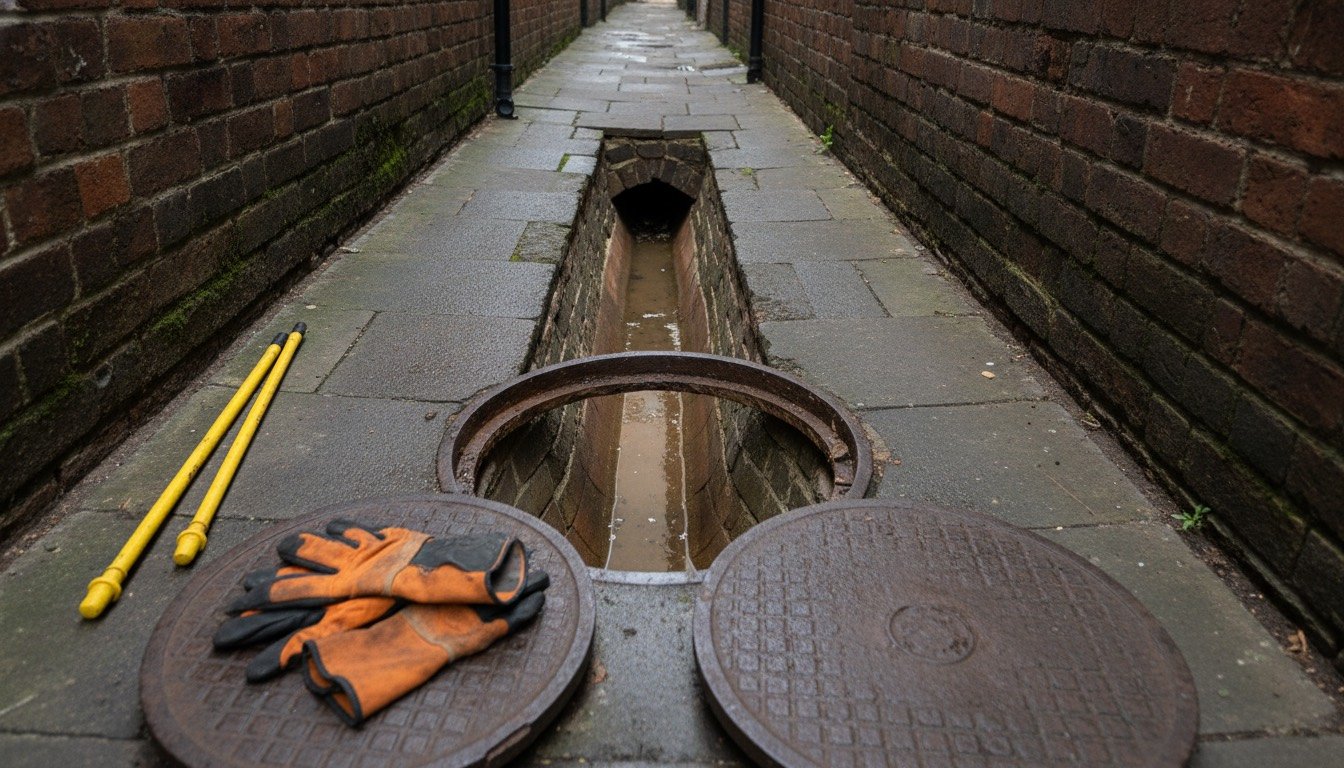
- •Lift the covers outside, starting nearest the boundary. Use proper lifting keys (£10) — a cast-iron cover weighs 25–45kg.
- •Note which chambers hold standing water. The blockage sits between the last full chamber and the first clear one. That fact decides everything else.
Symptom to Cause: What Each Warning Means
A main drain warns you for weeks before it floods anything.
- •Gurgling from a bath or basin when a WC flushes — air displaced back through the traps because the drain below is running part-full. The earliest reliable sign.
- •WC water sitting higher than normal, or dropping to almost nothing: the run downstream is backing up or siphoning traps dry.
- •Sewage at the lowest fixture in the house, usually a ground-floor shower tray: the drain has surcharged and found its lowest open point.
- •A heavy drain smell in the garden or cellar that worsens after rain: a cracked pipe venting below ground, quite unlike a dried-out trap indoors.
- •A dead-straight stripe of lush dark grass in a dry August, or a dip in a path along the drain line: water is escaping below ground.
- •Rats inside a terrace with no obvious external route: a fractured drain is the commonest entry point by a wide margin.
Causes, Ordered by How Often They Turn Up
Engineers pull the same things out in the same proportions year after year.
- •Wipes, sanitary items and cooking fat: over half of everything rodded out. Fat cools within two or three metres in a cold clay run and catches every wipe behind it.
- •Root ingress at mortar joints, thickening into a mat that traps solids — the classic recurring blockage where a mature tree sits nearby.
- •A dropped or displaced joint, leaving a step in the invert that solids catch on.
- •A silted intercepting trap at the boundary chamber, often because the rodding-arm stopper has fallen into the trap itself.
- •Delaminated pitch fibre pipe in 1950s–70s estates, deforming into an oval before it collapses.
- •A surcharged public sewer in heavy rain, where the problem is not yours at all.
Why Victorian and Pre-War Drainage Behaves Differently
Modern plastic drainage is flexible and laid to a consistent fall. Victorian salt-glazed clay came in 600–900mm lengths bedded in rigid cement mortar, with no tolerance for movement. A century of clay shrinkage, roots and traffic loading leaves a drain full of small steps and open joints: fine for decades, then blocking every eighteen months once roots find it.
Two period features catch people out. The intercepting trap is a U-bend in the boundary chamber that keeps sewer gas out of the house drain — a deliberate obstruction that silts, and rods pushed at it from upstream stop dead. Second is combined drainage: rainwater downpipes share the foul pipe, which is why a part-blocked Victorian drain floods the garden in a downpour and behaves all week, and why keeping gutters and gullies clear cuts blockage risk.
Terraces add shared drainage: one run often serves six or eight houses, so a blockage at number 14 surcharges the chamber at number 8. Complaining neighbours are diagnostic. And if you have already poured caustic drain cleaner down there, say so — it is a splash hazard for whoever rods it and useless against roots. It all belongs with the wider problems of century-old housing stock.
Fixes, Ordered from Lowest Risk to Highest
Work down this order. Skipping to the bottom is how a £120 problem becomes a £3,000 one.
- •Stop using water — no washing machine, no baths, no dishwasher. Every litre reappears at the lowest fixture.
- •Rod from the downstream chamber back towards the house, never the other way. A 10-rod set is £25–£40 at Screwfix. Turn clockwise throughout — anti-clockwise unscrews the joints and strands rods in the drain.
- •Plunger head for soft blockages, double-worm screw only to pull back a root mass. Nitrile gloves under gauntlets and eye protection: sewage carries leptospirosis, E. coli and hepatitis A, and cuts need covering first.
- •With an intercepting trap, unscrew the rodding-arm stopper and rod through the arm rather than fighting the U-bend; scoop the trap if the stopper has dropped in.
- •If rodding fails, book a firm carrying CCTV as well as a jetter. In-hours clearance runs £80–£180, out of hours £150–£300; a survey is £120–£250.
- •On pre-1900 clay or pitch fibre, ask for reduced pressure and a camera first — 3,000–4,000 psi will blow a tired mortar joint. Our comparison of rodding and jetting covers where each earns its keep.
- •Repairs, if damage shows: a patch liner over one failed joint £400–£900, relining a full run £2,000–£4,500, digging out and replacing £3,000–£8,000 depending on depth.
Where DIY Stops, and Who Actually Pays
Never climb into an inspection chamber. Hydrogen sulphide collects in deep Victorian chambers, deadens your sense of smell within seconds, and confined-space entry kills professionals every year. Stop too if sewage rises faster than you can rod, if a chamber is surcharged to cover level, if the invert has dropped, or if rods will not pass. And keep electricity away from standing water: on pre-1970s wiring with no RCD protection, an extension lead trailing to a wet cellar floor is a real hazard.
The money question is the one most people get wrong. Since October 2011 in England and Wales, the lateral drain beyond your boundary and any shared drain serving more than one property belong to the water company. So if your boundary chamber is surcharged and the upstream ones are clear, the blockage is probably theirs — ring Thames Water, Severn Trent or whoever serves you and they attend free. Scottish Water and NI Water work the same way. That call beats a private visit at current drainage rates.
Then keep it clear: no fat, no wipes, a strainer on the kitchen sink, and an annual lift of every cover to check benching and flow. The habits in our guide to preventing blocked drains take twenty minutes a year.
Found this useful?
There's plenty more — hundreds of guides and honestly-tested product reviews for every corner of your home.
Browse All Guides