Tools & Workshop · 6 min read · 23 June 2026
Basic Woodworking Joints Guide: Which Joint to Use, and When
The joints worth knowing, how to choose one in under a minute, what each costs in tools and time, and a renter-safe route that leaves the walls untouched.
By the Nims Casa editorial team — written from professional cleaning experience and checked against our editorial standards.
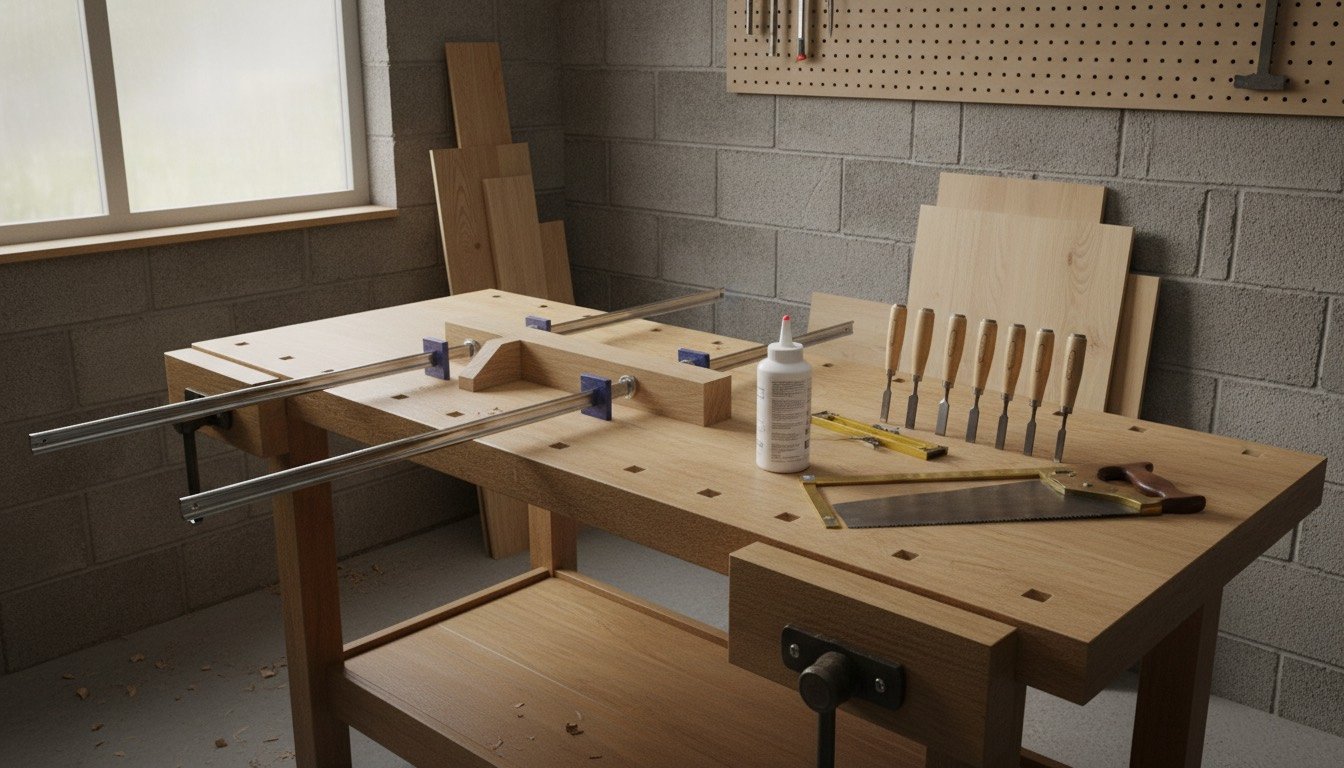
Most furniture that fails in a British home doesn't fail because the timber was weak. It fails at the connections: a screwed butt joint that racked, a shelf that pulled out of its support, a chair rail worked loose by three winters of central heating.
Below: the joints worth learning, a decision tree that gets you to one in under a minute, what each costs in tools and time, where DIY stops, and a renter-safe route for flats nobody owns.
What a joint actually has to do
A joint is the mechanical and adhesive connection between two pieces of timber, and each does three things: locates the parts, resists racking (the parallelogram sag that turns a square bookcase into a diamond), and transfers load without splitting the wood. Judge any joint on those three.
PVA on long grain to long grain is stronger than the timber itself, so a cramped edge joint breaks in the wood, not the glue line. End grain drinks glue like a straw, which is why a butt joint between shelf and upright is worthless without a screw, dowel or trench behind it. Sizing end grain with thinned glue first roughly doubles the bond; our notes on wood glue cover D3 versus D4.
Solid timber also moves across the grain with humidity: a UK house runs 45-60% RH in summer and 30-35% with the heating on, shrinking a 900mm oak top by 3-5mm come January. Sticker new boards indoors for a fortnight, and never glue a solid top rigidly to its frame. Sheet goods dodge all this, which is why first projects go better in plywood or MDF.
The 30-second decision tree
Work down this list and stop at the first line that matches.
- •Hidden joint, sheet material, normal shelf loads? Pocket-hole screws or dowels.
- •Shelf must resist sagging and pull-out? A housing — a 6-9mm trench across the upright.
- •Frame that gets pushed sideways, like a table or gate? Mortise and tenon, or a half-lap.
- •Joint on show? Through dovetails, or a mitre with a contrasting spline.
- •Back or base needs to sit flush? A rebate, which squares the carcass for you.
- •Repairing old furniture? Match the original, usually a dowel or loose tenon, after scraping off the old glue.
- •Still unsure? Half-lap: forgiving, hand-cuttable, ten times the glue area of a butt joint.
Carcass joints: boxes, cabinets and shelves
Panels meeting at right angles, quickest first.
- •Butt joint plus screws: 60 seconds, weak alone. Screws into MDF edges hold about 40% of what they do in plywood.
- •Pocket-hole screws: jig from £30, 90 seconds a joint, hidden in use, genuinely strong in 18mm ply.
- •Dowels: 8mm at 100mm centres, jig £25-40. No visible fixings, and they locate the parts when you glue up alone.
- •Housing (the American 'dado'): a 12mm straight cutter in a router against a clamped straightedge, or two saw cuts and a chisel. The best joint for a fixed shelf.
- •Rebate: an L-shaped step for backs and bases — big racking resistance for almost no extra work.
- •Biscuits or loose tenons: a jointer at £70-110 aligns panels beautifully; a Festool Domino does it better at £950.
- •Through dovetail: strongest and slowest. Budget 45-90 minutes for your first, in softwood off-cuts.
Frame joints: anything with legs
Once a piece has legs, racking rather than downward load destroys it. Accuracy beats ambition: 1mm out at a tenon shoulder is a visible gap, and one degree out on a mitre becomes 4mm by the fourth corner.
- •Half-lap: half the thickness off each part. Huge glue area, easy to mark, standard for gates and benches.
- •Bridle joint: an open mortise — nearly tenon-strong, cut with a saw and chisel, and visibly right before glue.
- •Mortise and tenon: tenon one third the rail thickness, 1mm short of the mortise bottom. Draw-bore with a 6mm dowel offset 1mm and it pulls tight without cramps.
- •Mitre with a spline: 45 degrees glues badly, being end grain. A plywood spline in a saw kerf fixes it.
What it costs, in tools and in time
Every joint above can be cut by hand for less than one mid-range power tool. Rough UK prices:
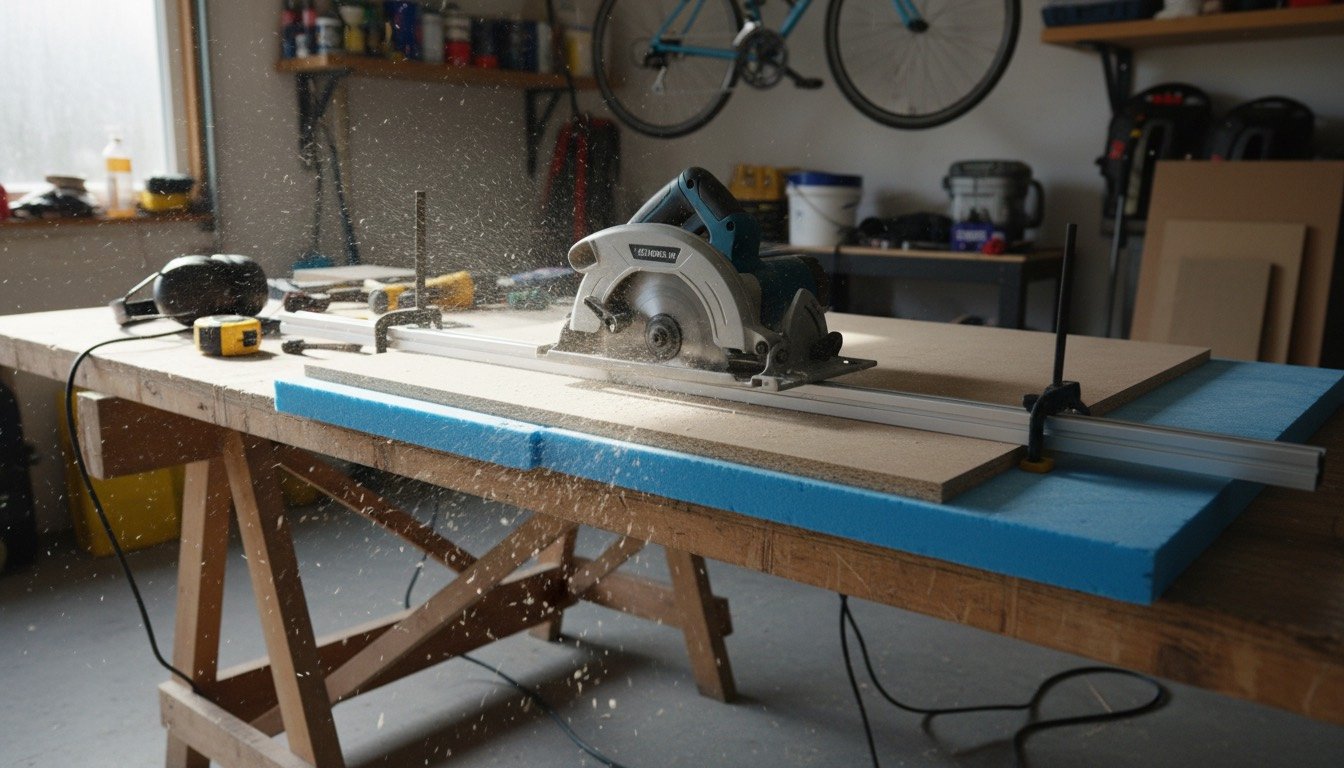
Time is the real cost. A four-shelf ply bookcase is 90 minutes with pocket screws, three hours with housings and a weekend with dovetails — the dovetailed one holds no more books. A circular saw with a clamped straightedge does 90% of what a table saw does.
- •Hand-tool route, £120-160: tenon saw £20-35, four bevel-edge chisels £35-55, marking gauge £15, mallet £12, two 600mm bar cramps £30.
- •Pocket-hole jig £30 own-brand to £65 for a Kreg, plus £10 per 500 coarse screws.
- •Quarter-inch router £70-160 plus a 12mm straight cutter £10-18 — unlocks housings, rebates and grooves.
- •Timber: PAR redwood 44 x 44mm about £4 a metre, 18mm MDF sheet £32-40, 18mm birch ply £75-95, PAR oak 20 x 150mm £12-20 a metre.
The renter-safe version: joints that don't cost you the deposit
Standard tenancies bar alterations without written consent, and deposit schemes routinely allow £15-40 a hole for making good plasterboard. Build things that stand on their own and come apart when you move. Even floating shelves need real fixings into masonry or a stud, so in a rental they are a landlord conversation first.
- •Knock-down joinery: M6 cross-dowel barrel nuts (£8 for 20) or threaded inserts in 18mm ply undo with an Allen key and rebuild in the next flat.
- •Freestanding beats fixed: a half-lapped ladder shelf leaning at 10 degrees, or a ply panel carrying its own French cleat.
- •Get sheets cut at the merchant's panel saw — about £1 a cut at B&Q or Wickes, squarer than a jigsaw in a hallway.
- •Wipe glue squeeze-out within ten minutes; cured PVA scraped off laminate takes the finish with it.
- •Finish outdoors or by an open window. Solvent varnish smells for three days, and a run on a rented worktop is a deduction.
- •Anti-tip strap on a tall unit? Ask in writing; two 5mm holes usually gets agreed, and filling them takes ten minutes.
DIY or call a joiner
Freestanding furniture, boxes, benches, shelving and most furniture repairs are firmly DIY. Scribing units into a Victorian alcove that bows 20mm over two metres, mitring a laminate worktop, hanging fire doors and anything involving a staircase are not — staircases fall under Building Regulations Part K.
Joiner day rates run £180-280 outside London and £250-350 inside it, with worktop mitres £80-150 as a standalone visit. Weigh that against the cost of custom built-in shelving before you commit a weekend.
Common questions
- •Which joint is strongest? Draw-bored mortise and tenon for frames, through dovetail for drawers — though 'strong enough' usually wins.
- •Do I need a table saw? No. A circular saw with a straightedge plus a router cuts everything here.
- •How long do I cramp? PVA D3: 30-45 minutes at 18°C, 24 hours before stressing it. Below 10°C it chalks and never reaches full strength.
- •Can I skip glue and just screw it? For knock-down builds yes; otherwise no — screws slowly enlarge their own holes.
- •Do joints work in MDF? Housings and dowels yes, screws into edges no — use threaded inserts.
Found this useful?
There's plenty more — hundreds of guides and honestly-tested product reviews for every corner of your home.
Browse All Guides