Product Reviews · 6 min read · 17 May 2026
The Best Wood Glue UK (2026): Diagnose the Joint, Then Buy
Most failed joints are a chemistry problem, not a quality problem. Diagnose the joint first, then choose between D3 PVA, D4, urea resin and polyurethane — with four UK picks and the numbers that actually matter.
By the Nims Casa editorial team — written from professional cleaning experience and checked against our editorial standards.
Affiliate disclosure: if you buy through links in this article we may earn a small commission at no extra cost to you. Our recommendations come from professional cleaning experience and are never influenced by retailers or brands.
A joint that opens up eighteen months after glue-up almost never failed because the adhesive was cheap. It failed because the wrong class of glue went onto the wrong surface, or because it came out of clamps at twelve minutes when it needed forty, or because the garage was 4°C the night it cured.
Wood glue is not one product with good and bad versions — it is four chemistries doing four different jobs. Buying the strongest one for everything wastes money indoors and still fails on oily timber, so this guide diagnoses before it shops.
Our top picks at a glance
Titebond III Ultimate Wood Glue
~£13–17 (473ml)The one bottle to own if you only want one: a D4 cross-linking PVA that handles interior furniture, kitchens and outdoor joinery without a second thought. It sands cleanly, takes stain better than most PVAs, and works down to about 8°C, which matters in a British garage.
Pros
- ✓ D4 rated — genuinely fine for garden gates, planters and shed doors
- ✓ 8–10 minutes of open time, enough for a four-joint frame
- ✓ Sands without clogging abrasive and machines cleanly at 24 hours
- ✓ Lowest minimum application temperature of the mainstream PVAs
Cons
- ✗ Two to three times the price per litre of a trade D3 PVA
- ✗ Dark tan glue line shows on pale timbers like maple, ash and sycamore
Everbuild 502 All Purpose Weatherproof Wood Adhesive
~£7–10 (1 litre)The trade PVA that lives on most joiners' vans, and the sensible default for interior cabinetry, doors, architrave and shelving. D3 rated and strong enough that a well-fitted joint fails through the timber rather than the glue line.
Pros
- ✓ A litre for roughly the price of a small premium bottle
- ✓ D3 rating covers kitchens, bathrooms and sheltered exterior work
- ✓ Widely stocked in UK merchants and DIY sheds
- ✓ Pale glue line that disappears on softwood and oak
Cons
- ✗ Not suitable for fully exposed exterior joinery
- ✗ A litre is more than a light hobby user will get through in 12 months
Polyvine Extramite Powdered Urea Resin Wood Adhesive
~£15–20 (1.5kg)A powder you mix with water in the quantity you need, giving over 20 minutes of open time and virtually no shrinkage as it cures. It is the honest answer for a slack mortise, a large carcass going together in one go, or anything being stained afterwards.
Pros
- ✓ Genuine gap-filling with almost no shrinkage
- ✓ 20–30 minutes of working time for complex glue-ups
- ✓ Sands back cleanly and does not reject stain or oil
- ✓ Mix only what you need, so a tub lasts for years
Cons
- ✗ Mixing and measuring is a nuisance for a single small repair
- ✗ Contains formaldehyde — mix outdoors or with good extraction, and wear gloves
Gorilla Glue Original (Polyurethane)
~£7–9 (115ml)A moisture-cured polyurethane that bonds where PVA simply cannot: teak, iroko, oily reclaimed timber, and wood to metal, stone or rigid plastic. Buy it for those jobs specifically, not as a general-purpose furniture glue.
Pros
- ✓ Bonds oily and resinous species that defeat PVA
- ✓ Works across dissimilar materials including metal and stone
- ✓ Fully waterproof once cured
Cons
- ✗ Foams aggressively out of the joint and needs scraping back
- ✗ The foam has little strength, so it fills gaps without really bridging them
- ✗ Stains skin badly — nitrile gloves are not optional
Who This Is For, and Which Glue Problem You Actually Have
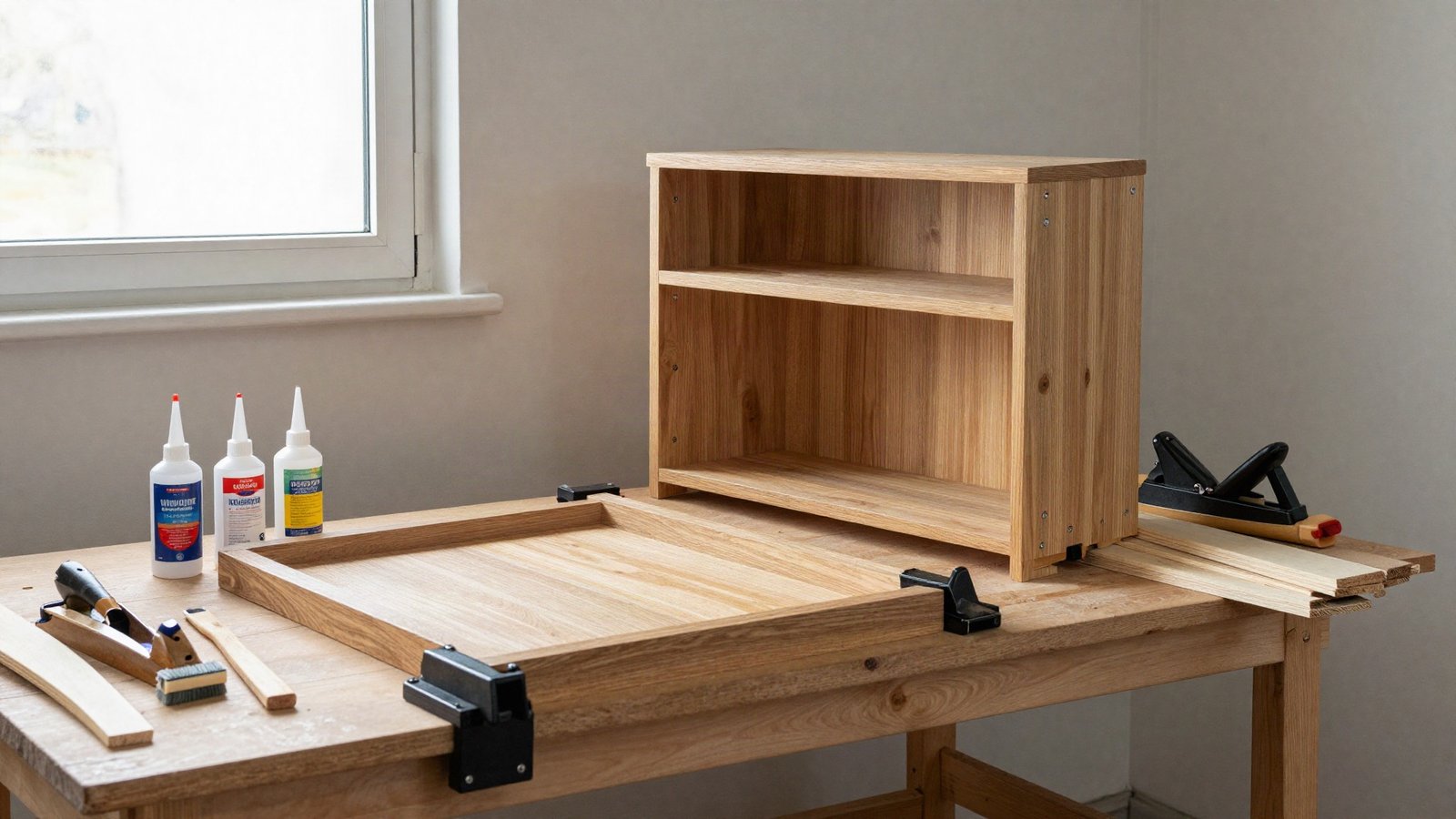
This is for people building and repairing furniture, shelving, doors and garden joinery in a UK home workshop: joints cut rather than screwed, in a piece that has to survive British humidity swings. Everything from floating shelves to a workbench build. It is not for boatbuilders or load-bearing timber, which need epoxy or certified structural adhesives.
Run through the list below before you buy anything. Each answer points at a chemistry, not a brand.
- •Interior furniture, well-fitted joints, never damp — a D2 or D3 PVA is all you need.
- •Kitchen, bathroom or utility room — D3 minimum. A D2 line softens in a room hitting 90% humidity every morning and eventually lets go.
- •Outdoors, unheated garage, garden furniture, shed doors — D4: Titebond III, a cross-linking PVA or a urea resin.
- •A gap you could slide a business card into — PVA shrinks and the gap comes back. Use a powdered urea resin or epoxy.
- •Oily species such as teak, iroko or reclaimed pitch pine — PVA cannot wet the surface. Wipe with acetone, then use polyurethane or epoxy.
- •Six or more joints closing at once — you need 20-plus minutes of open time, not the four to six a fast PVA allows.
- •An antique, or anything that may come apart again — hide glue, the only common adhesive that reverses with heat and moisture.
How We Judge Wood Glue
We are not running a certified test lab and will not pretend otherwise. These conclusions come from workshop use across cabinet, door and garden work, cross-checked against published EN 204 classifications and manufacturers' data sheets, plus glue-ups on beech and redwood offcuts broken over a bench dog.
That last test is the one that matters. A cured PVA joint in dry softwood should tear wood fibre out, not release along the line — any glue failing at the glue line on a well-fitted joint is out. Our basic woodworking joints guide covers the fits that make glue almost incidental.
- •Failure mode on a well-fitted long-grain joint: wood failure, not glue-line failure.
- •EN 204 rating from the data sheet, not the marketing on the front label.
- •Open time at a realistic 15–18°C workshop temperature, plus shrinkage, cost per 100ml and shelf life.
The Picks, and What Each One Is Actually For
Titebond III is the default if you want one bottle on the shelf: D4, sands without gumming abrasive, takes stain tolerably, and its 8–10 minute open time suits a four-joint frame.
Everbuild 502 is the trade bottle on joiners' vans — D3, a litre for the price of a small Titebond, fine for interior cabinetry and internal door and architrave work. Extramite is the specialist you buy once and keep: a powder mixed with water, 20-plus minutes of working time, near-zero shrinkage, and it genuinely fills a slack mortise.
Gorilla polyurethane earns its place only for oily species and wood-to-metal joints. On ordinary furniture it just foams out and adds no strength a £6 PVA would not.
What to Look For: D-Ratings, Open Time and Temperature
Four numbers on the back of the bottle decide whether a glue-up succeeds.
- •D-rating (EN 204) — D1 dry interior; D2 occasional condensation; D3 frequent short-term wetting or sheltered exterior; D4 fully exposed. UK kitchens and bathrooms are D3 as a floor, not a luxury.
- •Open time — the window between spreading and the glue skinning over: 4–6 minutes on a fast PVA, 8–10 on Titebond III, 20–30 on a urea resin. Halve it on a warm July afternoon.
- •Clamp time versus cure time — clamp time (30–60 minutes) is when you release pressure; cure time (24 hours) is when you can machine or load the joint. Confusing the two is why assemblies creep out of square.
- •Minimum application temperature — 8°C for Titebond III, 10°C for most PVAs. Below that the emulsion cannot coalesce and you get a chalky line with almost no strength, and an unheated UK garage sits under 10°C for five months a year.
The Technique That Makes Cheap Glue Beat Expensive Glue
Technique beats product choice at this level. The commonest failure in domestic joinery is not weak adhesive but a starved joint, squeezed so hard under clamps that almost nothing is left in the line.
Spread thinly on both faces with a brush or a scrap of card, not one thick bead on one face. End grain drinks adhesive, so size a stile end or a mitre first with glue thinned about 10% with water, let it soak two minutes, then apply full strength — an unsized mitre is a dry joint in disguise. More of these sit in our guide to the woodworking mistakes beginners make.
- •Clamp only hard enough to close the joint and show a fine, even bead of squeeze-out — on softwood, hand-tight is plenty.
- •Thirty minutes in clamps at 18–20°C, doubled below 12°C, then 24 hours before planing, sanding or routing.
- •Scrape squeeze-out at the rubbery stage, 15–20 minutes in, with a chisel held flat. A damp cloth pushes wet glue into the pores and shows as pale patches under finish.
- •Dry-assemble with clamps on anything over three joints — the only way to find you are two clamps short before the glue is open.
Common Buying Mistakes
These account for most of the money wasted and most of the joints that quietly fail a year later.
- •Buying five litres for the price per litre. Opened PVA lasts about 12 months, and a hobby workshop bins three-quarters of the tub.
- •Paying D4 prices for interior bookcases. D3 is the correct specification at roughly a third the cost.
- •Reading 'waterproof' as 'submersible'. D4 survives weather and repeated wetting, not immersion — anything living in water wants epoxy.
- •Treating polyurethane foam as strength. The foam has almost none; it fills voids cosmetically and encourages sloppy joints.
- •Ignoring the date code, or storing PVA in an unheated garage. A bottle that has frozen and thawed comes out stringy — bin it.
Where Adhesive Stops Being the Fix
A chair re-glued twice does not have a glue problem. The mortises have worn oval, and until they are shimmed, wedged or re-dowelled nothing will hold — a sequence covered in our guide to repairing wood furniture.
Glue is never a structural repair either. Split joists, cracked rafters and staircase strings need mechanical repair specified by a joiner or structural engineer. If the piece is a genuine antique, stop: modern PVA is effectively irreversible, and a restorer working in hide glue at £45–£70 an hour is cheap against what an unpickable joint costs at resale.
Found this useful?
There's plenty more — hundreds of guides and honestly-tested product reviews for every corner of your home.
Browse All Guides