Home Decor · 5 min read · 10 June 2026
Solid Stain vs Semi-Transparent Stain: Differences, Pros, Cons and UK Costs
Two near-identical tins, and a decision that dictates your maintenance for a decade. How each finish behaves on British timber, and how to tell which yours needs.
By the Nims Casa editorial team — written from professional cleaning experience and checked against our editorial standards.
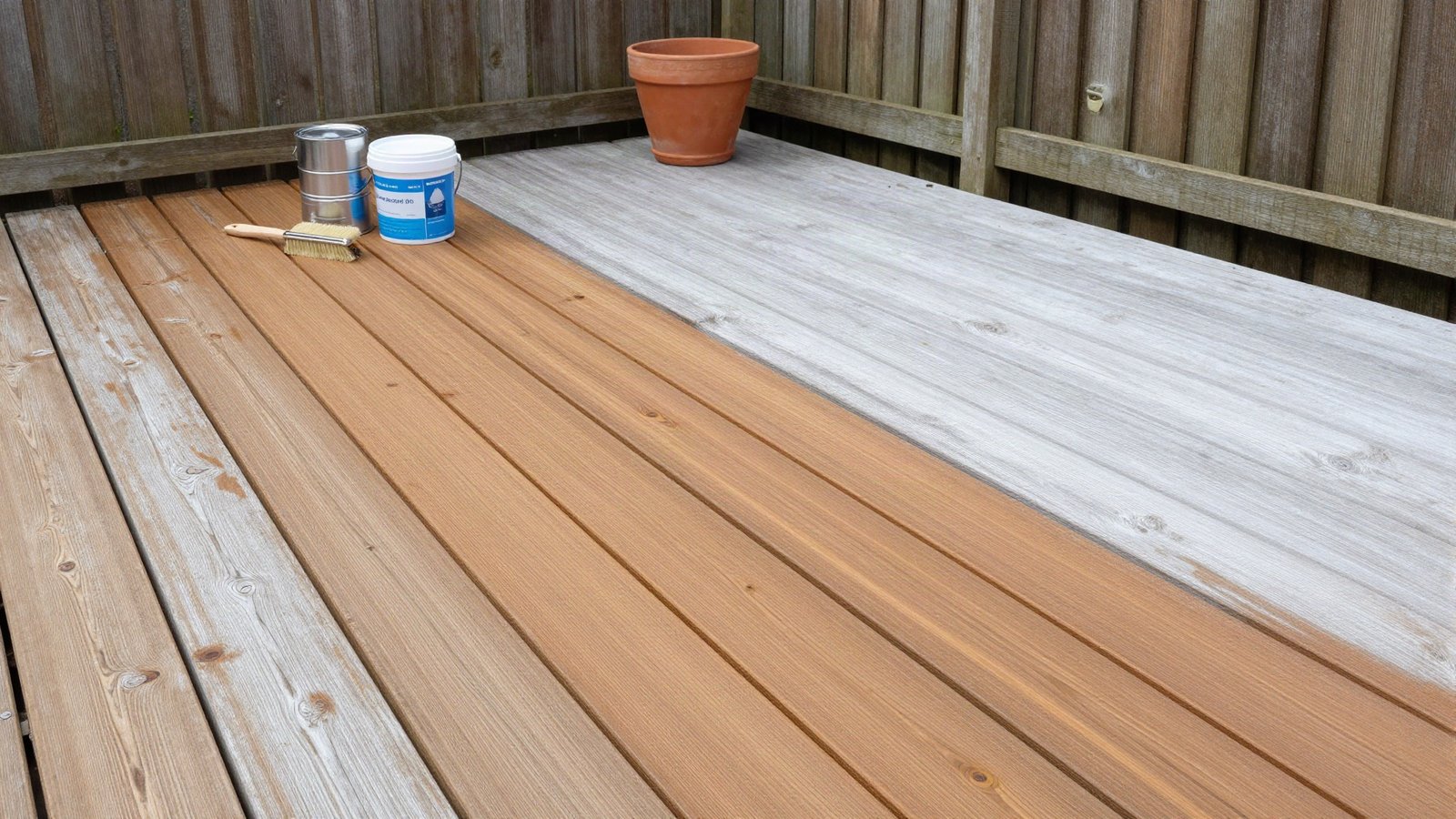
The tins sit side by side in every builders' merchant, the labels differ by one word, and the price gap is about £10. Yet one can be refreshed with a wash and a brush every other summer, and the other commits you to scraping flakes off your decking on a Saturday in 2031. That distinction has almost nothing to do with colour.
Nearly every failed exterior stain we get asked to rescue failed the same way: the wrong category of product went onto timber whose condition nobody checked. So start with the problem, not the tin.
Diagnose the timber before you choose the tin
Fifteen minutes of checks tells you whether you need a stain at all, and if so, which type the wood will hold.
- •Water bead test: flick water across three areas. Beads sitting 30 seconds mean the finish still works and recoating wastes money; grain darkening within five seconds means bare or spent timber.
- •Scrape test: if the finish lifts in brittle flakes it is film-forming (solid stain, varnish or paint) and must come off first. If it powders away as fine pigment, it is penetrating - clean and recoat.
- •Probe test: push a screwdriver into joist end grain, fence post bases and the board nearest the downpipe. More than 5mm under light pressure is rot, and no finish fixes rot.
- •Growth check: green film or black spotting is algae and mould, not colour loss. Treat it, or you seal a living layer under the new finish.
- •Movement check: splits over 2mm and heavy surface checking rule out film-forming finishes - the film bridges the crack, then splits along it next winter.
- •Moisture check: after two dry days, timber should read under 18% on a cheap pin meter (£20-30). Wetter than that and any coating blisters.
Solid vs semi-transparent: the side-by-side
Pigment loading drives every other difference. Semi-transparent carries roughly 1-3% pigment and sits inside the wood; solid (sold in the UK as opaque or solid-colour woodstain) carries far more and behaves like a thin, flexible exterior paint.
- •Appearance: semi-transparent shows grain, knots and colour variation; solid hides all of it for a uniform, near-painted finish.
- •Where it sits: semi-transparent penetrates with little or no surface film; solid forms a film 40-80 microns thick on top.
- •How it fails: semi-transparent erodes evenly and fades; solid holds colour far longer, then flakes once water gets behind it.
- •Recoat interval in UK conditions: semi-transparent 12-24 months on decking, 2-3 years vertical; solid 3-5 years vertical, 1-2 years on anything walked on.
- •Prep to recoat: semi-transparent needs a wash and a light sand; solid needs scraping, feather-sanding and spot-priming once it lifts.
- •Reversibility: semi-transparent changes easily; solid is effectively permanent short of full sanding or chemical stripping.
- •Coverage: semi-transparent 6-8 m² per litre on sawn timber, 8-12 m² on planed; solid 9-12 m² per litre, two coats.
How each performs in a British climate
UK timber is not defeated by UV the way it is in Arizona - it is defeated by wetting and drying cycles and by biological growth. Solid stain's biggest advantage, heavy pigment blocking UV, matters less here; its biggest weakness, trapping moisture behind a film, matters far more.
On a south-facing larch-clad gable or a fence, solid earns its keep: four or five years of even colour over patchy or previously painted timber. On horizontal surfaces - decking, steps, handrail tops - standing water finds the film's weak points and lifts it. We would not put solid on a walked-on deck for any client, and the decking cleaning and revival routine is far cheaper than stripping one back.
Semi-transparent takes the opposite trade-off: nothing to peel, so it never peels. It fades instead - expect noticeable lightening on a south-facing deck by 14 months.
Application: where the real difference shows
Semi-transparent is forgiving. Wash, dry 48 hours, then flood it on with a 100mm synthetic block brush, working board by board along the full length so you never leave a wet edge mid-run. Two thin coats within the tin's recoat window. A 20 m² deck is a comfortable afternoon.
Solid is unforgiving in a way most people underestimate. It needs a sound, clean, dry, dull surface - degreased, sanded to 120 grit if previously coated, spot-primed on bare patches and every cut end. Miss the end grain on a fence post and water wicks behind the film within a season. Budget a day of prep per day of coating, and read removing peeling exterior paint first - that is the job you inherit later.
Both need the same weather: surface temperature 8-25°C, no rain for 24-48 hours, no overnight dew, ideally April to September - our guide on the best time to paint outside covers the humidity thresholds. New pressure-treated timber needs 8-12 weeks of weathering first.
Ten-year cost: two worked examples
Take a 20 m² softwood deck. Semi-transparent needs about 5 litres for two coats (£40-55 a tin, plus £12-15 of cleaner) every 18 months: six cycles, £330-420 in materials over ten years, 4-5 hours a time. Solid on the same deck might last 20 months before edge flaking, then costs a full strip - £180-260 in materials and 12-16 hours, or £450-700 for a professional to sand it back.
Now 30 metres of lap fence panels, roughly 45 m² of face. Solid needs about 9 litres for two coats, £90-120 a cycle, recoated at year five: £180-240 across the decade. Semi-transparent needs four applications at £60-80, so £240-320 - but each is a wash-and-brush job with no scraping.
Professionals charge £12-20 per m² for deck prep and staining, on day rates of £180-250 across most of the UK and £250-350 inside the M25; our exterior painting cost guide breaks that down. If the sums push you toward replacement, read the composite versus wood decking comparison first.
Maintenance and the point of no return
The decision that matters is the one you make for whoever recoats the timber next. Semi-transparent to solid is a one-afternoon change of mind. Going back means sanding a whole deck or fence to bare wood: 10-20 hours with a random orbital and 60-to-120 grit, or £400 plus for a contractor.
Either way, an annual wash in early spring with a timber cleaner does more for longevity than a heavier coat ever will. Keep it alongside your deck maintenance checklist, and note the binder matters too - oil-based versus water-based affects drying and recoat windows independently of pigment level.
Who each suits, and the verdict
Choose semi-transparent if the timber is sound, you like visible grain, the surface is walked on, or you prefer cheap recoats to long intervals. It suits almost all decking and garden furniture.
Choose solid if the timber is vertical, already painted or badly colour-mismatched - replaced fence panels, patched cladding, a mixed-age shed - and you want a colour rather than a wood tone.
The verdict: for UK decking, semi-transparent wins comfortably on cost of ownership and on the misery index. For fences, sheds and cladding, solid wins on appearance and interval, provided you prime the end grain and never ignore the first flake. The real mistake is coating timber nobody diagnosed, cleaned and dried - that step decides more than the tin does.
Found this useful?
There's plenty more — hundreds of guides and honestly-tested product reviews for every corner of your home.
Browse All Guides