Product Reviews · 6 min read · 11 April 2026
The Best Dehumidifier for Basement and Cellar Damp (UK Picks, 2026)
Twenty litres a day out of a Victorian cellar is not a marketing claim, it is a Tuesday. Here is what to buy, what it really costs to run, and when a £250 machine is the wrong answer to a £4,000 problem.
By the Nims Casa editorial team — written from professional cleaning experience and checked against our editorial standards.
Affiliate disclosure: if you buy through links in this article we may earn a small commission at no extra cost to you. Our recommendations come from professional cleaning experience and are never influenced by retailers or brands.
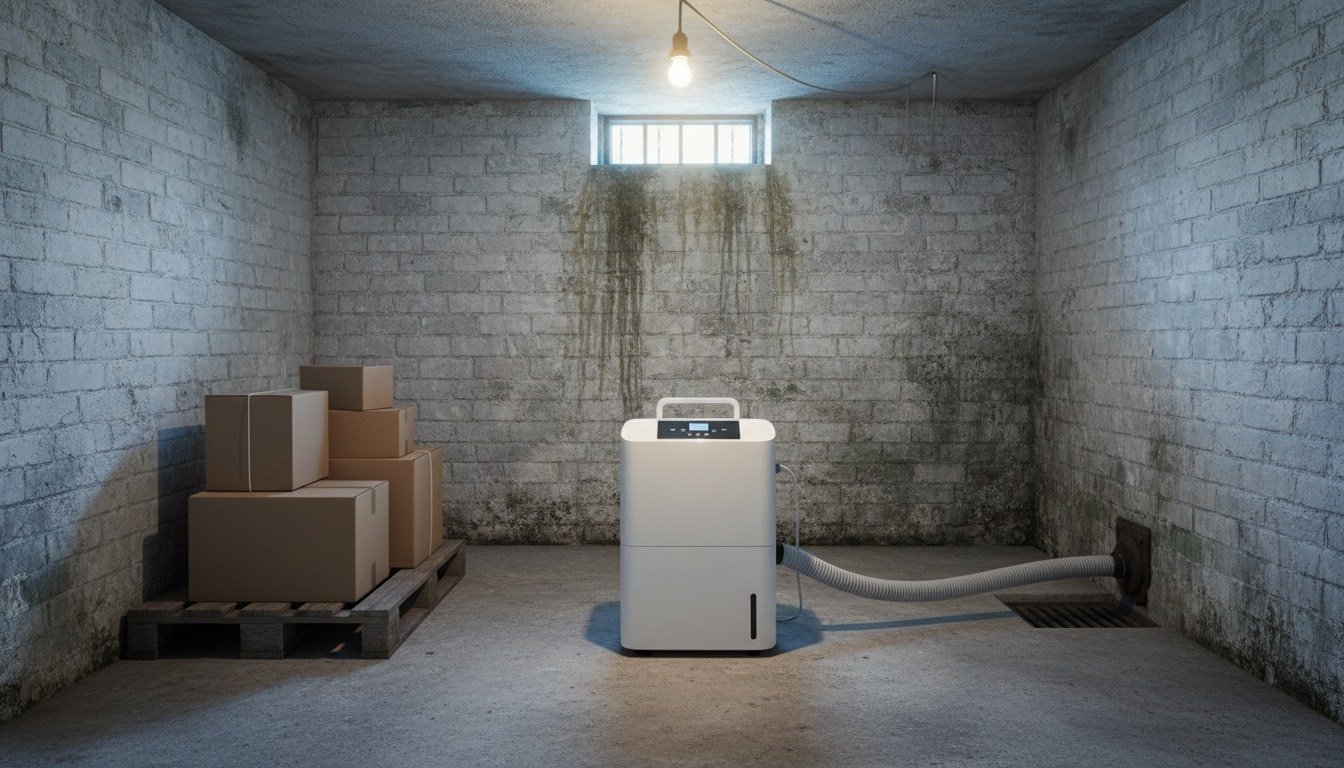
A cellar that smells of wet cardboard in August is telling you something specific: the air is sitting north of 65% relative humidity and the wall surfaces are colder than the air touching them. Moisture leaves that air onto the coldest thing it can find, usually the outside wall behind your boxes. A dehumidifier deals with the air, and deals with it very well. What it cannot deal with is water arriving through the masonry.
So this guide names four machines worth your money and is straight about the numbers: purchase price, electricity in pounds per year, and the point at which the sensible spend is a survey rather than an appliance. Prices are UK street prices including VAT, spring 2026.
Our top picks at a glance
Meaco Arete Two 20L Low Energy Dehumidifier
~£230-260The default sensible choice for a cellar that stays above about 15 degrees, drawing roughly 255W for a genuine 9 to 11 litres a day in real UK conditions. Quiet enough at 38 dB to leave running under a lounge floor, with a proper continuous drain outlet and a laundry mode that earns its keep in winter.
Pros
- ✓ Lowest running cost per litre extracted of anything at this price
- ✓ HEPA filter and sensible humidistat that holds a set point rather than cycling wildly
Cons
- ✗ Output drops noticeably below 15 degrees, so it is wrong for an unheated cellar
- ✗ The 6.4-litre tank fills fast in a wet space unless you plumb the drain hose
EcoAir DD1 Simple MK3 Desiccant Dehumidifier
~£180-220A desiccant unit that keeps its full 7 to 8 litres a day down to around 1 degree, which is exactly what an exposed British cellar needs from November onwards. It also raises the room temperature by two to three degrees, which helps the cold-surface condensation you were fighting in the first place.
Pros
- ✓ Genuinely unaffected by cold, unlike every compressor at this price
- ✓ Light at 6kg and easy to carry up cellar steps
Cons
- ✗ Around 500W means roughly £180 to £220 a year if you run it hard
- ✗ Warm exhaust air is unwelcome if the cellar adjoins a living space in summer
Ebac 3850e 21L Dehumidifier
~£300-340Built in County Durham and engineered around British conditions rather than adapted from a warm-climate design, with a smart control that learns the room and a compressor that starts reliably at lower temperatures than most rivals. Service agents see very few of these back, which is the metric that matters over ten years.
Pros
- ✓ Metal-heavy construction and readily available UK spare parts
- ✓ Handles 12 to 14 degrees better than typical compressor units
Cons
- ✗ Noticeably louder than the Meaco at full speed
- ✗ The premium over a mainstream 20-litre model only pays back over many years
Pro Breeze 12L Compressor Dehumidifier
~£130-160Fine for a small, relatively warm cellar or an under-stairs store of under about 12 square metres, and cheap enough to be worth trying before committing to a bigger machine. Treat the 12-litre rating as roughly 5 litres a day in realistic UK conditions.
Pros
- ✓ Low outlay and a simple humidistat that does what it says
- ✓ Compact enough for a tight cellar landing or utility corner
Cons
- ✗ Struggles badly below 15 degrees and will spend winter defrosting
- ✗ Two-litre tank needs emptying constantly unless drained continuously
Who this is for, and who should hold off
Buy a dehumidifier if your cellar is dry underfoot but the air is heavy, if storage boxes go soft, if you get black spotting in cold corners, or if you dry washing down there. Those are humidity problems and a machine solves them for the price of a weekly shop.
Hold off if any of the following is true, because you would be paying to remove water that is replaced faster than you extract it. Work out why the cellar is damp in the first place before spending anything.
- •Standing water, or a floor that darkens after heavy rain — that is groundwater, not humidity
- •A tide mark roughly 900mm up the wall with a chalky salt band above it
- •Water running down the wall in storms — usually a blocked gully or cracked downpipe
- •Mould over more than about a square metre, which needs cleaning down first — identify what you are dealing with
- •A cellar you plan to convert into a habitable room, where the answer is a designed waterproofing system, not an appliance
How we judge these, and what we have not done
We do not run an environmental chamber and will not pretend otherwise. These picks come from three disclosed sources: machines run in occupied UK homes and void properties by damp technicians we work with, logged with an energy monitor and a calibrated hygrometer over full winters; manufacturer extraction data, noting the headline litres-per-day figure is declared at 30 degrees and 80% RH, conditions no British cellar sees; and warranty records from UK service agents, where the gap between a three-year machine and a ten-year one shows up. We weight cold performance heavily: an unheated UK cellar sits at 8 to 14 degrees from November to March, and that is where cheap compressors quietly stop working.
Extraction rate, temperature and the figure nobody prints
Two technologies, and temperature decides between them, not budget. A compressor unit chills a coil and condenses water out of the air. It is cheap to run — a decent 20-litre model draws 250 to 300 watts — but output falls off a cliff below 15 degrees, and below 10 degrees many ice up and spend half their time defrosting. A desiccant uses a rotating drying wheel, works down to about 1 degree with no loss of output, but draws 330 to 650 watts continuously and dumps that energy back into the room as heat.
The field rule: if the cellar sits under the heated part of the house and stays above 15 degrees, buy compressor. If it is unheated, exposed on three sides, or you can see your breath in January, buy desiccant. Either way, aim for the right target humidity band of 50 to 55% RH, not the lowest setting the dial allows.
- •20L compressor at 20 degrees and 60% RH: expect 8 to 11 litres a day, not 20
- •8L desiccant at 10 degrees: close to full rating, which is why it wins in cellars
- •Continuous drainage beats tank size — a 6-litre tank fills twice a day in a working cellar
- •For cleaner air as well as drier air, note that these are different jobs and one machine rarely does both well
What it actually costs: purchase, electricity, and the alternative
Purchase price is the small number. Budget 10 to 12-litre compressors run £120 to £170; mainstream 20-litre low-energy models £200 to £280; 7 to 10-litre desiccants £160 to £230; UK-built heavy-duty machines £300 to £380. Building-drying units start at £500 and are rarely worth owning — hire at £30 to £45 a week after a flood.
Electricity is the number people miss. At 24.5p per kWh, a 280W compressor running an honest five hours a day costs about 34p daily, roughly £125 a year. A 500W desiccant on the same duty cycle is about 61p a day, near enough £220 a year. Two worked examples: an 18 square metre cellar in a 1930s semi at 78% RH took a 20-litre compressor eight weeks of near-continuous running to reach 55%, then settled to three hours a day — £245 for the machine, £96 in first-year electricity. A stone terrace cellar at 9 degrees needed a desiccant instead, £199 to buy and £180 a year to run, because the compressor it replaced achieved nothing all winter.
The honest comparison: if the cellar is genuinely wet, no machine is the fix. An independent damp survey costs £150 to £350. A cavity drain membrane system with sump and pump runs £3,000 to £8,000 for an average UK cellar — see what basement waterproofing costs — and labour is typically 55 to 65% of that, with membrane, battens, sump, pump and alarm making up the rest. A quote listing materials at over half the total deserves questions.
- •Reasonable quote: itemised, records actual moisture meter readings, names membrane and pump by model, includes a pump alarm and a service interval
- •Suspect quote: free survey by the firm doing the work, a rising damp diagnosis with no salt band recorded, a discount expiring today, or an injection damp-proof course sold for a below-ground wall
- •Check the guarantee is insurance-backed through a recognised scheme, not just company letterhead
Buying mistakes we see every winter
Nothing exotic here — the same errors, repeated, each costing somebody a few hundred pounds.
- •Buying a compressor for an unheated cellar — it will ice up, defrost, ice up again and extract almost nothing from December to March
- •Undersizing to save £60. A 10-litre unit in a 20 square metre cellar runs permanently and costs more in electricity than the bigger machine would
- •Emptying the tank by hand. Fit the drain hose to a gully on day one, or the machine sits switched off within a fortnight
- •Sealing the airbricks. Ventilation is doing real work down there; blocking it turns a chilly cellar into a mouldy one
- •Running flat out at 40% RH. Below 45% you gain nothing, timber shrinks and the bill climbs — the same logic applies when drying washing indoors
The verdict
For a cold but dry cellar, a 7 to 10-litre desiccant is the safer buy despite the running cost, because it works in January. Above 15 degrees, a 20-litre low-energy compressor costs half as much to run. If in any doubt, spend £150 on a survey first — the cheapest dehumidifier is the one you did not need to buy.
Found this useful?
There's plenty more — hundreds of guides and honestly-tested product reviews for every corner of your home.
Browse All Guides