Product Reviews · 7 min read · 13 May 2026
The Best Foundation Crack Filler (2026): What Actually Works on Old UK Brickwork
Most cracks we're called to in British houses don't need a stronger filler — they need someone to work out why the wall moved. Here is what genuinely works, and what quietly makes old brickwork worse.
By the Nims Casa editorial team — written from professional cleaning experience and checked against our editorial standards.
Affiliate disclosure: if you buy through links in this article we may earn a small commission at no extra cost to you. Our recommendations come from professional cleaning experience and are never influenced by retailers or brands.
Filling a crack is the last job in the sequence, not the first. On a Victorian terrace in Walthamstow last spring we opened up a 4mm stepped crack under a bay window that three previous owners had filled with cement mortar. Behind it was a fractured salt-glazed drain washing sand out from under a shallow brick footing. The filler had held perfectly. The wall had carried on dropping.
A crack filler is a finishing material. It restores weather resistance and appearance, and stitching systems can genuinely re-tie masonry across a fracture, but none of them stop ground movement. Diagnose first using how to tell if a foundation crack is serious, then choose the material that suits your wall's construction rather than the one with the highest advertised strength.
Our top picks at a glance
Twistfix Crack Stitching Kit (helical bar and cementitious grout)
~£70-130 per 10-bar kitA genuine structural repair rather than a filler: austenitic stainless helical bars bonded into raked-out bed joints re-tie masonry across a crack and redistribute load. On a stable Category 2-3 crack in solid brickwork it is the repair a structural engineer will usually specify.
Pros
- ✓ Actually restores tensile continuity across the crack instead of hiding it
- ✓ Stainless bars suit damp solid walls and are effectively permanent
- ✓ Repointed over afterwards, the repair is invisible from the pavement
Cons
- ✗ Needs a grinder, dust extraction and confidence with a resin gun
- ✗ Pointless and potentially dangerous on a crack that is still moving
- ✗ Bar spacing and length should be specified by an engineer, not guessed
Lime Green Ultra Pointing Mortar (NHL 3.5)
~£18-28 per 25kgA pre-blended natural hydraulic lime pointing mortar that behaves the way an old wall needs it to, staying weaker and more breathable than the brick around it. It is the right answer for the vast majority of period-property cracks that follow the mortar joints.
Pros
- ✓ Breathable and flexible, so seasonal movement stays in the joint
- ✓ Consistent blend removes the guesswork of batching lime and sand on site
- ✓ Acceptable on listed and conservation-area elevations
Cons
- ✗ Frost-sensitive: strictly an April-to-October material in most of Britain
- ✗ Needs damp hessian protection and slow curing, so it is not a rushed job
- ✗ Colour match to existing weathered pointing takes trial panels
Sikadur-31 CF Normal two-part epoxy repair mortar
~£50-75 per 1.2kgA thixotropic structural epoxy that bonds and fills in concrete, including damp substrates and overhead work. On a post-1970s trench-fill foundation, a garage slab or a cracked concrete lintel it far outperforms anything cement-based.
Pros
- ✓ Bonds to damp concrete, which matters in British ground conditions
- ✓ Very high strength and no shrinkage on cure
- ✓ Non-sag consistency works on vertical faces and soffits
Cons
- ✗ Far too strong and impermeable for old brick or stone
- ✗ Roughly 30-40 minutes of pot life at 20C, less on a warm day
- ✗ Expensive per litre and effectively irreversible once cured
Toupret Touprelith F exterior masonry filler
~£20-32 per 5kgA fine powder filler that mixes to a smooth, sandable paste and takes masonry paint cleanly, making it the sensible choice for cosmetic cracking in render and pebbledash above the damp-proof course. Sets in around two hours and can be feathered to nothing.
Pros
- ✓ Sands and paints beautifully, so repairs disappear under masonry paint
- ✓ Mix only what you need, with a workable 60-90 minute window
- ✓ Cheap enough to use across a whole elevation
Cons
- ✗ Cosmetic only, with no structural or tensile contribution
- ✗ Will re-crack over any joint that is still moving seasonally
- ✗ Not for use below the DPC or in permanently wet locations
Who this guide is for
This is for owners of houses with cracks that have been monitored and judged stable, or that fall into the cosmetic-to-moderate band. British practice uses the BRE Digest 251 damage categories, and they are worth knowing before you buy anything:
- •Category 0-1 (hairline to about 1mm): aesthetic only. Fill during normal redecoration or repointing.
- •Category 2 (up to 5mm): easily filled; repointing and localised repair. Worth monitoring for a full year first.
- •Category 3 (5-15mm, or several above 3mm): needs opening up, possible brick replacement and stitching. Get an engineer's opinion.
- •Category 4-5 (over 15mm): structural. Filler is irrelevant until the cause is fixed. This is engineer and insurer territory.
- •Any crack that is wider at the top than the bottom, runs diagonally through bricks rather than mortar, or has moved measurably in six months — stop and get advice.
How we judge these products, and what we have not done
We are not a laboratory and we do not claim compressive-strength testing. These assessments come from repair work on UK housing stock — mostly pre-1940 solid-wall properties in the South East and Midlands — plus manufacturer data sheets, BS EN 998-2 mortar classifications and the structural engineers we work alongside. We buy what we use; nothing here was supplied free.
Ratings weight four things: compatibility with the substrate (a filler stronger than the brick around it is a defect, not a feature), workability in British weather, whether the repair can be redone by the next person, and honest cost per square metre. Where a product is excellent but only in trade hands, we say so. For the money side, read how much foundation repair costs first.
Why old UK houses crack differently
A 1900s house is not a modern one with more character. Solid walls are typically 225mm of brick laid in lime mortar, no cavity and no wall ties, sitting on a footing that may be nothing more than three corbelled courses of brick 450-600mm below ground. No reinforced concrete strip, no DPC in the earliest examples, no designed movement joints anywhere.
That construction was meant to move. Lime mortar is deliberately weaker than the brick, so seasonal movement spreads as dozens of harmless hairline fractures along joints instead of one split through the masonry. Repoint in strong cement and you remove the release valve: the movement goes through the bricks instead, spalling their faces the first hard winter. Half the cracks we are asked to fill in period property were manufactured by a previous cement repair.
Three old-house factors rarely get mentioned. Victorian salt-glazed drainage with mortared joints leaks quietly for decades and washes fines from beneath shallow footings, which is why a CCTV drain survey at £150-350 often beats a £600 engineer's visit as a first step. Lath-and-plaster internal walls crack independently of the structure, so an internal crack alone proves very little — see how to fix cracks in plaster walls. And blocked cast-iron gutters saturate one corner of a solid wall until the ground softens, which makes gutter cleaning and maintenance a genuine foundation issue.
Our picks and what each one is actually for
There is no single best foundation crack filler because there is no single crack. Match the material to the wall.
Crack-stitching kits are the only products here that add tensile capacity, using helical stainless bars bedded in grout across raked-out bed joints at roughly 450mm vertical centres. Lime mortars are for solid brick and stone and nothing else. Epoxy mortars belong on concrete — a post-1970s trench-fill foundation, a garage slab, a lintel — where their 60-plus N/mm² strength matches the substrate. Exterior masonry fillers are for hairline movement in render above the DPC, where you want a paintable finish rather than a structural repair.
What to look for before you buy
Also check whether your property is listed or in a conservation area. Repointing a listed building in cement without consent is a criminal offence, not a technicality, and local authority conservation officers do take an interest in front elevations.
- •Substrate match first. On soft Victorian stock brick, use NHL 2 or NHL 3.5 hydraulic lime. On modern engineering brick or concrete, cement or epoxy is fine. Never the reverse.
- •Movement tolerance. A rigid filler in a live crack will simply re-crack, usually at the bond line. If the crack still moves seasonally, you need a flexible polyurethane sealant or a stitching repair, not a filler.
- •Depth of fill. Anything under 6mm wide should be raked out to 15-20mm depth first, or the repair will fall out within two winters.
- •Weather window. Lime will not carbonate below about 5C and must be protected from frost for 72 hours and from sun and wind with damp hessian. In practice that means April to early October in most of Britain.
- •Pot life. Two-part epoxies give you 30-40 minutes at 20C and considerably less on a warm day. Mix in small batches.
- •Colour and grading. Get a sand sample matched to the existing mortar before buying 25kg. Nothing shouts bad repair louder than pale, sharp-sand pointing on a soft red terrace.
The buying mistakes that cost the most
- •Buying strength. A repair mortar of 20 N/mm² in a wall of 8 N/mm² bricks transfers load into the brick faces and destroys them. Weaker than the surrounding fabric is the rule.
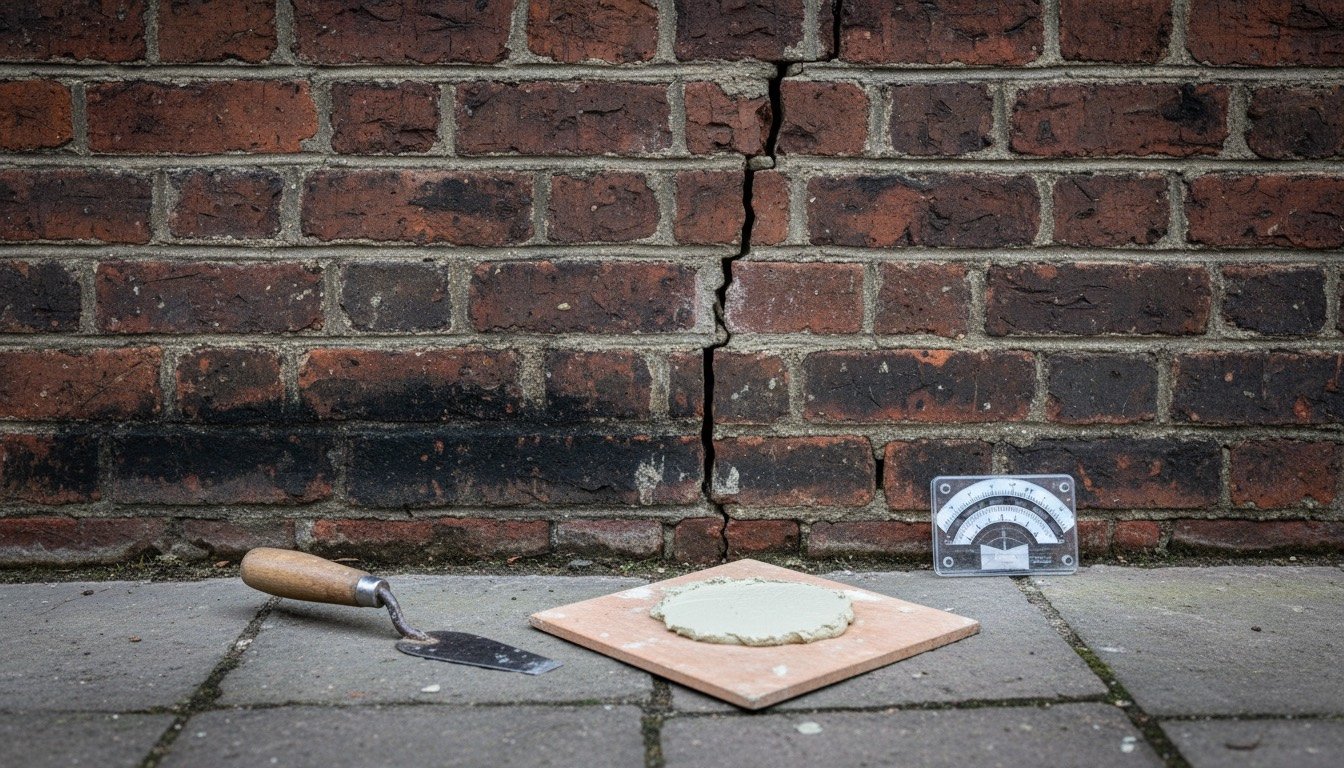
- •Filling before monitoring. Two Avongard-style tell-tale gauges cost around £12 each and, read monthly for 12 months, tell you more than any product. A crack that changes width between February and August is live and cannot be filled shut.
- •Grabbing the wrong ready-mix. Bagged general-purpose mortar from a shed is 1:4 cement and sand. It is the correct product for a modern cavity wall and the wrong one for anything built before the First World War.
- •Cosmetic filling before a sale or survey. Freshly filled cracks on an otherwise weathered elevation are the first thing a chartered surveyor photographs, and they invite the very Level 3 survey you were hoping to avoid.
- •Skipping the drains. Around a third of the localised settlement we see in Victorian terraces traces back to a fractured drain run within two metres of the wall. Fill the crack, keep the leak, repeat in three years.
Where DIY stops
Stop and call someone if a crack exceeds 5mm, has widened measurably over a monitoring period, runs diagonally through bricks rather than following the joints, appears on two elevations at the same corner, or is accompanied by doors and sash windows binding, floors sloping or a bay pulling away from the main wall. Those are movement symptoms, and understanding settling versus structural cracks is the difference between a £40 repair and a £25,000 one.
A structural engineer's inspection and report runs £400-800 in 2026 and is the cheapest money in this whole subject. Underpinning is notifiable work under Building Regulations and needs building control approval, so it is never a materials decision. If subsidence is confirmed, telephone your buildings insurer before instructing any contractor — the standard UK subsidence excess is around £1,000 and unauthorised works can prejudice the claim entirely. Our guide on when to call a structural engineer sets out what a proper instruction looks like.
Everything else — repointing a weathered joint, refilling a stable hairline in render, tidying a settled corner that has not moved in a decade — is well within a competent homeowner's reach, provided the material respects the wall it is going into.
Found this useful?
There's plenty more — hundreds of guides and honestly-tested product reviews for every corner of your home.
Browse All Guides