Product Reviews · 6 min read · 24 April 2026
The Best Garage Flooring UK (2026): Diagnose Your Slab Before You Buy
Most failed garage floors are not bad products — they are good products put on the wrong slab. Test the concrete first, then buy, and you will only pay for this once.
By the Nims Casa editorial team — written from professional cleaning experience and checked against our editorial standards.
Affiliate disclosure: if you buy through links in this article we may earn a small commission at no extra cost to you. Our recommendations come from professional cleaning experience and are never influenced by retailers or brands.
Nearly every peeling, blistering garage floor we get called out to was coated with something perfectly decent. The product was not the problem. The slab underneath was damp, dusty, oily or moving, and nobody checked before the tin was opened.
So this guide runs backwards. First you diagnose the concrete with three cheap tests, then pick the floor that suits what you found. Get that order right and an £80 tin will outlast a £900 installation.
Our top picks at a glance
Ecotile E500 7mm Interlocking Floor Tiles
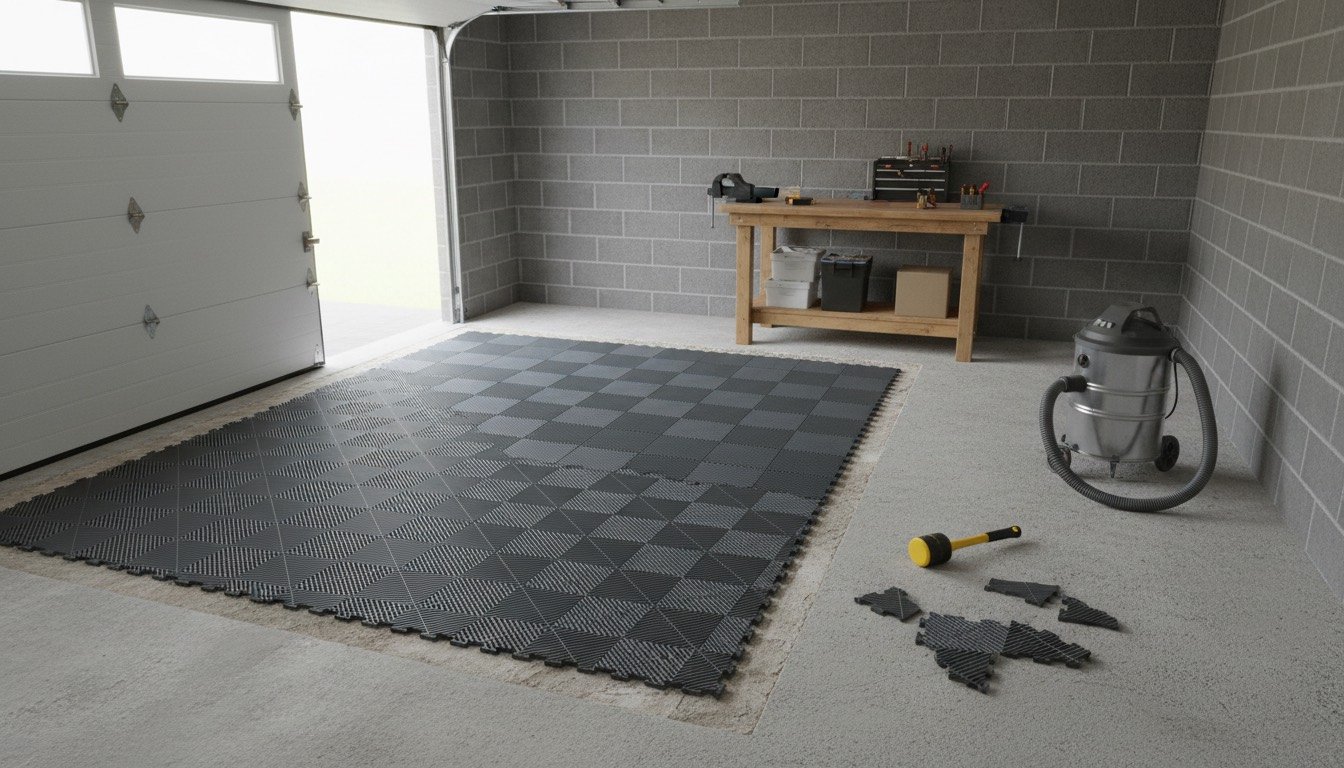
~£30-45/m²UK-manufactured 7mm PVC tiles that click together dry, with no adhesive and no curing time, so they can go straight over a damp, cracked or dusty slab that would destroy a coating. A 15m² garage takes about three hours with a rubber mallet and a jigsaw for the edge cuts.
Pros
- ✓ Works over damp slabs with no DPM
- ✓ Bridges cracks and lifts for repair
- ✓ No weather window — fit it in January
Cons
- ✗ Highest upfront cost of the four
- ✗ Grit collects in the joints and needs vacuuming
Watco Epoxy Floor Coating Kit
~£120-220A solvent-free two-pack epoxy from a long-standing UK industrial floor coatings supplier, supplied with hardener and full technical data. On a ground, dry, clean slab it gives a genuinely hard-wearing finish that shrugs off petrol, brake fluid and hot tyres.
Pros
- ✓ True workshop-grade durability
- ✓ Excellent chemical and hot tyre resistance
- ✓ Anti-slip aggregate available to match
Cons
- ✗ Unforgiving of poor prep — grinding is essential
- ✗ 30-45 minute pot life and a 10°C minimum
Ronseal Diamond Hard Garage Floor Paint
~£40-60A single-pack water-based floor paint sold in most UK sheds and trade counters, and the sensible choice for a tidy-up rather than a rebuild. Expect three to five years on a domestic garage rather than the decade a two-pack gives.
Pros
- ✓ Cheap, low odour and touch-dry in an hour
- ✓ Easy to patch and recoat later
Cons
- ✗ Softer film — can mark under hot tyres
- ✗ Needs two or three coats on bare concrete
Everbuild Black Jack 908 Damp Proof Membrane
~£40-55Not a finish in itself, but the product that makes a coating possible on the many UK garage slabs poured without a membrane. Two brushed coats at right angles, fully cured, then prime and coat over the top.
Pros
- ✓ Turns an un-coatable slab into a coatable one
- ✓ Widely stocked and simple to apply
Cons
- ✗ Adds a full day plus curing to the job
- ✗ Must be overlaid — it is not a wearing surface
Who this guide is for
This is aimed at ordinary UK garages: a 2.6m x 5.5m single or a square double, single-skin blockwork, an up-and-over door, and a power-floated or tamped slab poured somewhere between 1965 and last year. Unheated, unventilated, and cold enough for nine months of the year to matter.
If you are flooring the last stage of a full garage conversion, stop here — you need a membrane, insulation and a screed to Building Regs standards, not a coating. This guide is for garages staying as garages.
Diagnose the slab first: three tests, one evening
Do these before you buy anything. Between them they cost about £4 and eliminate roughly 90% of garage floor failures.
- •The polythene test (for damp): tape a 1m square of clear polythene to the slab on all four edges with duct tape, in the middle of the floor and again nearest the door. Leave it 72 hours. Condensation on the underside, or concrete that has gone visibly darker, means moisture is rising through the slab. Most UK garage slabs poured before the mid-1980s have no damp-proof membrane at all.
- •The scratch test (for a weak surface): drag a large flat screwdriver across the concrete with firm pressure. A sound power-floated slab scores a thin bright line. If it powders, dusts or leaves a groove, you have soft laitance on the surface and nothing will bond to it until it is ground off.
- •The straightedge test (for movement and level): lay a 2m level or a straight batten across the floor in three directions. Gaps over 5mm, cracks wider than 3mm, or cracks with a lip you can feel through a boot sole mean the slab has settled. Wide, level hairline cracks are normal shrinkage and fine.
- •The water bead test (for oil): flick a little water on the darkest patches. If it beads instead of soaking in, that is contaminated concrete. Resin will not stick to it, however good the resin is.
Match the diagnosis to the right floor
Once you know what you have, the choice narrows to one or two sensible options. This is the whole decision in five lines.
- •Damp under the polythene: interlocking PVC tiles, or a two-coat liquid DPM followed by a coating. Never epoxy straight onto a damp slab — hydrostatic pressure lifts it off in sheets within a winter.
- •Dusty or friable: diamond grind, then a penetrating primer and a solvent-free epoxy. Floor paint over unground laitance is money burnt.
- •Cracked or uneven: interlocking tiles bridge everything up to about 8mm and can be lifted later. A coating telegraphs every defect and then cracks along the same lines.
- •Sound, dry, level, clean: you have the widest choice. A two-pack epoxy kit gives the best value per year of service.
- •Cold and used year-round: check the product's minimum application temperature. Most two-pack resins need 10°C and a slab at least 3°C above dew point, which in an unheated UK garage means May to September.
How we judge garage flooring
We weight what determines whether a floor survives five British winters, not what photographs well. Hot tyre pickup is the big one: soft coatings and cheap self-adhesive tiles bond to warm tyres and lift off in crescents when you reverse out. Chemical resistance to petrol, brake fluid and antifreeze comes next, then abrasion from grit walked in off the drive.
- •Hot tyre pickup resistance, tested by parking a car on it within 48 hours of a summer run
- •Realistic coverage per litre on bare concrete versus the tin's optimistic figure
- •Tolerance of a slab that is not perfect — because almost none are
- •Slip resistance when wet, particularly the first metre inside the door
- •Whether it can be repaired in a patch, or only stripped and redone
- •Cost per square metre over ten years, including the grinder hire nobody budgets for
What to look for on the tin or the spec sheet
Ignore the front of the tin and read the technical data sheet, which every serious UK manufacturer publishes. Solvent-free two-pack epoxies are what commercial workshops use; single-pack "garage floor paint" is a modified acrylic and will do three to five years rather than ten. Check pot life too — many two-packs give you 30 to 45 minutes once mixed, which is not long alone on 18m².
For tiles, thickness and material are the numbers that matter. Anything under 5mm flexes over cracks; 7mm PVC in a good grade takes a trolley jack without denting. Loose-lay tiles are the only option that works over a damp slab, because the concrete still breathes at the joints. If your garage runs cold and clammy, pair the floor with better airflow or a dehumidifier.
Common buying mistakes
Almost all of these come from skipping the diagnosis. They are the same errors we see in domestic rooms too, and the pattern is covered in more depth in our guide to flooring installation mistakes.
- •Buying enough for one coat. Bare concrete drinks the first coat; budget 1.5 to 2 times the stated coverage.
- •Acid etching instead of grinding. Etching is a poor substitute on modern power-floated slabs and leaves residue that weakens the bond.
- •Coating in October. Below 10°C most epoxies never fully cure and stay soft enough to pick up on tyres all winter.
- •Sealing the floor and ignoring the walls. If condensation is running down single-skin blockwork, deal with damp and ventilation or insulate the garage first.
- •Choosing gloss black. It shows every speck of dust and turns lethal when you walk in from a wet drive; mid grey with a light broadcast of anti-slip aggregate is what workshops actually use.
- •Fitting the floor before the storage. Get wall systems and overhead racking fixed first, so you are not drilling and dropping brackets onto a fresh finish.
Realistic 2026 costs and when to call someone
For a 15m² single garage: floor paint £45 to £70 in materials, a two-pack epoxy kit £120 to £220, interlocking tiles £450 to £750, and a professionally installed resin screed £900 to £1,400. Add £60 to £90 for a day's diamond grinder and dust extractor hire from a plant shop, which is not optional on a dusty slab. Allow a full weekend for a coating — one day prep, one day laying — and about three hours for tiles.
Call a contractor in if the polythene test shows heavy damp and the garage is attached to the house, if cracks have a vertical step of more than 5mm, or if you want a seamless resin finish, which needs airless spray equipment and experience to lay flat. Comparing quotes is easier once you know what flooring installation costs per square metre elsewhere in the house.
Found this useful?
There's plenty more — hundreds of guides and honestly-tested product reviews for every corner of your home.
Browse All Guides