Product Reviews · 6 min read · 25 May 2026
The Best Gas Grill UK 2026: Gas Barbecues Rated by People Who Service Them
Most gas barbecues sold in Britain die of rust, not of use. Here are four that survive a wet winter, what they really cost to run, and the LPG rules nobody tells you about at the till.
By the Nims Casa editorial team — written from professional cleaning experience and checked against our editorial standards.
Affiliate disclosure: if you buy through links in this article we may earn a small commission at no extra cost to you. Our recommendations come from professional cleaning experience and are never influenced by retailers or brands.
Walk round any garden centre in April and you will see forty barbecues with near-identical spec sheets. What separates them shows up in year three, when the cook box has gone at the seams, the burner tubes have furred with rust and nobody stocks the spares. That is the British failure pattern: not heavy use, but 200 damp days a year and a cover trapping moisture against warm steel.
So the picks below weight build materials, spares availability and warranty terms over headline burner counts. We have also put real numbers on running costs, and covered the gas and planning rules that catch people out — particularly leaseholders and anyone thinking about plumbing a barbecue into the mains.
Our top picks at a glance
Weber Spirit II E-310 GBS
~£600-700Three burners, a cast-aluminium lid and cook box, and porcelain-enamelled cast iron grates that hold heat through a cold drop. It is the model we see still working properly at ten years old, which no budget barbecue manages.
Pros
- ✓ Genuinely even across the grate — under 20°C drift left to right at a steady setting
- ✓ Ten-year warranty covering burners, cook box and grates, not just the frame
- ✓ Spares and the GBS insert range are stocked everywhere in the UK
Cons
- ✗ Open cart design gives little wind protection on exposed plots
- ✗ Side shelf space is tight once you have two platters going
Weber Q 2200
~£280-330A single-burner cast aluminium unit that reaches 250°C in about ten minutes and cannot rust through the way a steel box does. Sits on a table or its own stand and stores in a shed between uses.
Pros
- ✓ Cast aluminium body is effectively rust-proof in UK conditions
- ✓ Fast to heat and easy to lift, so it actually gets used mid-week
- ✓ Works off a 5 kg patio gas bottle that a lot of people can carry
Cons
- ✗ One burner means no true two-zone cooking for indirect roasts
- ✗ Grate area suits four to six people, not a gathering
Char-Broil Professional Pro S 3
~£450-550Infrared emitter plates sit between burner and food, so dripping fat vaporises rather than landing on a naked flame. If burnt sausages are your recurring complaint, this is the design that fixes it.
Pros
- ✓ Markedly fewer flare-ups with fatty cuts and marinades
- ✓ Stainless lid and control panel wear well with basic upkeep
- ✓ Strong sear performance thanks to the radiant plates
Cons
- ✗ Emitter plates need scraping regularly or heat goes patchy
- ✗ Slower to respond when you turn the burners down
Outback Meteor 4 Burner Hooded
~£250-320Four burners plus a side ring, enough grate for ten to twelve, at roughly a third of the price of the Weber. Spares are cheap and widely stocked, which matters more than the finish at this price.
Pros
- ✓ Real capacity for entertaining without a four-figure spend
- ✓ Side burner is genuinely useful for sauces and onions
- ✓ Parts are inexpensive and easy to source
Cons
- ✗ Thinner enamelled steel lid sheds heat noticeably in wind
- ✗ Grate finish tends to wear within two or three seasons
Who a gas barbecue actually suits
Gas suits people who cook outdoors on weeknights. Lid up, ignite, ten minutes to 250°C — against the 25 to 35 minutes charcoal needs to ash over properly. If your realistic pattern is chicken thighs after work twice a week from May to September, gas gets used and charcoal does not.
It suits you less if flavour is the whole point: gas gives heat and control, not the smoke that comes off dripping fat hitting lumpwood. We set out the trade-offs in our gas versus charcoal comparison, worth reading before you spend £600. On space, a four-burner cart needs about 1.8 m of clear paving plus a metre of standing room, well away from fence panels.
How we judged these
Transparency first, because this category is full of invented test data. These picks come from hands-on use and years of servicing outdoor kit for clients across the South East and Midlands — burner tubes, regulator faults, cook boxes rotted after four winters. We ran no controlled laboratory comparison and will not pretend otherwise.
- •Cook box material — cast aluminium or porcelain-enamelled steel beats bare powder-coated steel, which rusts from the inside out
- •Heat evenness — drift left to right at a steady setting, probe-measured, not read off a lid gauge that runs 15-25°C optimistic
- •Recovery — how fast the grate climbs back after a lid-open session
- •Spares — whether burners, igniters and grates are stocked five years after launch
- •Warranty in writing — the term covering burners and cook box, not the headline figure covering the frame
Our four picks in brief
Full pros and cons are listed below: the Weber Spirit II E-310 GBS for most gardens, the Weber Q 2200 for courtyards, the Char-Broil Professional Pro S 3 if flare-ups plague you, the Outback Meteor 4 Burner on a budget.
What to look for (and what to ignore)
Ignore total kW output as a quality signal. A 14 kW four-burner with a thin lid loses more heat to a Yorkshire breeze than a 10 kW three-burner with a heavy cast lid holds in. Output relative to grate area, and heat retention, are what count.
On grates, porcelain-enamelled cast iron gives the best sear marks and holds heat through a cold sausage drop, but chips under a wire brush. Stainless rod grates are more forgiving but need thicker bar to resist warping. Either way, technique matters more than material — our guide to cleaning a barbecue properly covers the burn-off-then-scrape routine that keeps enamel intact.
- •A lid thermometer is a rough guide; a £15 instant-read probe improves your cooking more than any upgrade
- •Battery electronic ignition fails first in damp; piezo buttons are cruder but last outdoors
- •Pick a grease tray you can reach without kneeling — the ones behind a cabinet door get ignored and cause flare-ups
- •Cast aluminium castings outlive powder-coated tube frames by years in an exposed or coastal garden
- •Never fit the cover while the unit is warm, or cinch it airtight — trapped condensation is what rots cook boxes
The gas side: bottles, regulators and the UK rules that apply
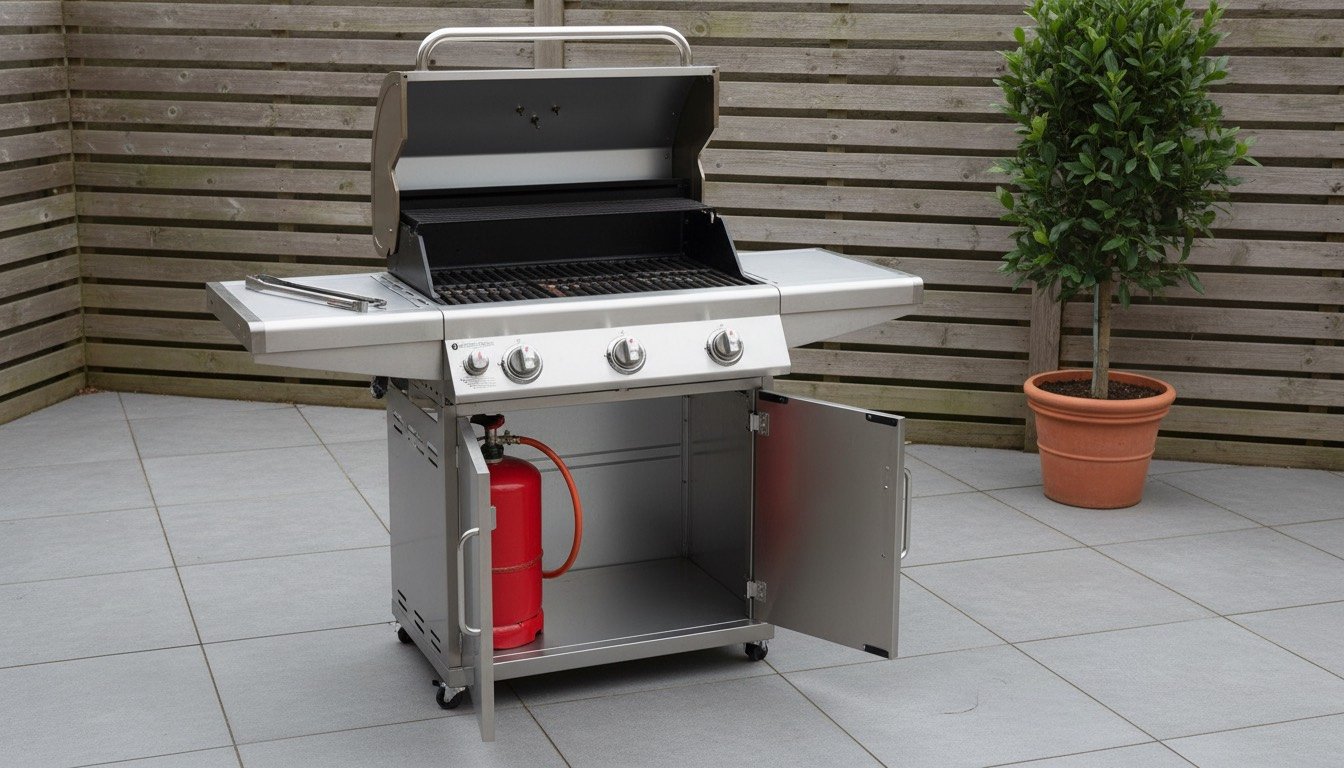
For a bottled barbecue you need no permissions and no registered engineer, but you do need the right kit. Propane runs at 37 mbar, butane at 28-30 mbar, and the regulator must match both gas and appliance. Choose propane if the barbecue lives outside all year — butane stops vaporising properly around 0-2°C, which is why the burner dies on a cold Easter afternoon. Hoses should be to BS 3212 or EN 16436 and carry a date stamp: replace at five years however they look, because the inner wall perishes before the outside cracks. Test joints with washing-up liquid, never a flame.
Storage is where people go genuinely wrong. LPG is heavier than air, so it pools rather than disperses. Cylinders — including 'empties', never truly empty — belong upright, outdoors, ventilated. Never a cellar, under-stairs cupboard or integral garage.
Going permanent changes everything. A barbecue plumbed into the mains gas supply is notifiable work under the Gas Safety (Installation and Use) Regulations 1998 and must be done by a Gas Safe registered engineer holding the relevant outdoor appliance qualification — DIY is a criminal offence, not a grey area. Landlords carry a further duty: any fixed gas or LPG appliance they supply needs an annual check and must appear on the Landlord Gas Safety Record. A bottled barbecue the tenant buys does not.
Leaseholders should read the lease first: many blocks, and most social landlords, ban barbecues and LPG storage on balconies outright, and enforcement has tightened in buildings above 11 m. A built-in run brings planning into it — a masonry outdoor kitchen counts as an outbuilding under permitted development, single storey, no higher than 2.5 m within 2 m of a boundary. Any new outdoor socket or lighting circuit is notifiable under Part P in England and Wales and needs a registered electrician or building control sign-off. Our guide to planning an outdoor kitchen covers the sequencing.
What it costs to run
A 13 kg propane refill runs about £32-£40 in 2026, plus a one-off cylinder deposit of £30-£50 the first time. A 10 kW three-burner at full output burns roughly 0.8 kg an hour, but nobody cooks flat out throughout — allow 25 to 30 hours of real cooking per bottle. That is a whole summer for most families, near £1.30 an hour, cheaper than equivalent oven time on most electricity tariffs.
Budget separately for consumables: hose and regulator every five years at £20-£30, a decent cover at £35-£60, burner tubes at £45-£90 around year six. Factor in the paving too — grease staining is the commonest complaint after a first season, and far easier to prevent than lift later, as our patio cleaning guide explains.
Common buying mistakes
- •Buying on burner count. Three well-spaced burners under a heavy lid beat five cramped ones and give a proper two-zone setup
- •Choosing butane because the bottle is lighter, then finding it will not run below about 2°C
- •Leaving the cover cinched tight all winter. Ventilate it, or shelter the unit and let it breathe — the same principle we apply to garden furniture through a British winter
- •Assuming you can plumb it into the mains yourself. That job is Gas Safe territory, full stop
- •Expecting it to replace a wood-fired oven. For 400°C pizza bases, an outdoor pizza oven is the right tool
Found this useful?
There's plenty more — hundreds of guides and honestly-tested product reviews for every corner of your home.
Browse All Guides