Product Reviews · 6 min read · 16 July 2026
The Best Window Air Conditioner for UK Homes (2026): What Actually Fits British Windows
The American box-in-the-window unit was designed for sash windows Britain mostly doesn't have. Here is what genuinely cools a UK room, what it costs, and where the regulations stop you.
By the Nims Casa editorial team — written from professional cleaning experience and checked against our editorial standards.
Affiliate disclosure: if you buy through links in this article we may earn a small commission at no extra cost to you. Our recommendations come from professional cleaning experience and are never influenced by retailers or brands.
Search for a window air conditioner and you will mostly be shown American units built for double-hung sash windows that slide vertically and leave a clean rectangular gap for a box to sit in. Very few British homes have them. Modern stock is almost entirely side-hung casement or tilt-and-turn, and period vertical sliders are usually painted shut or fitted with restrictors capping the opening at 100mm.
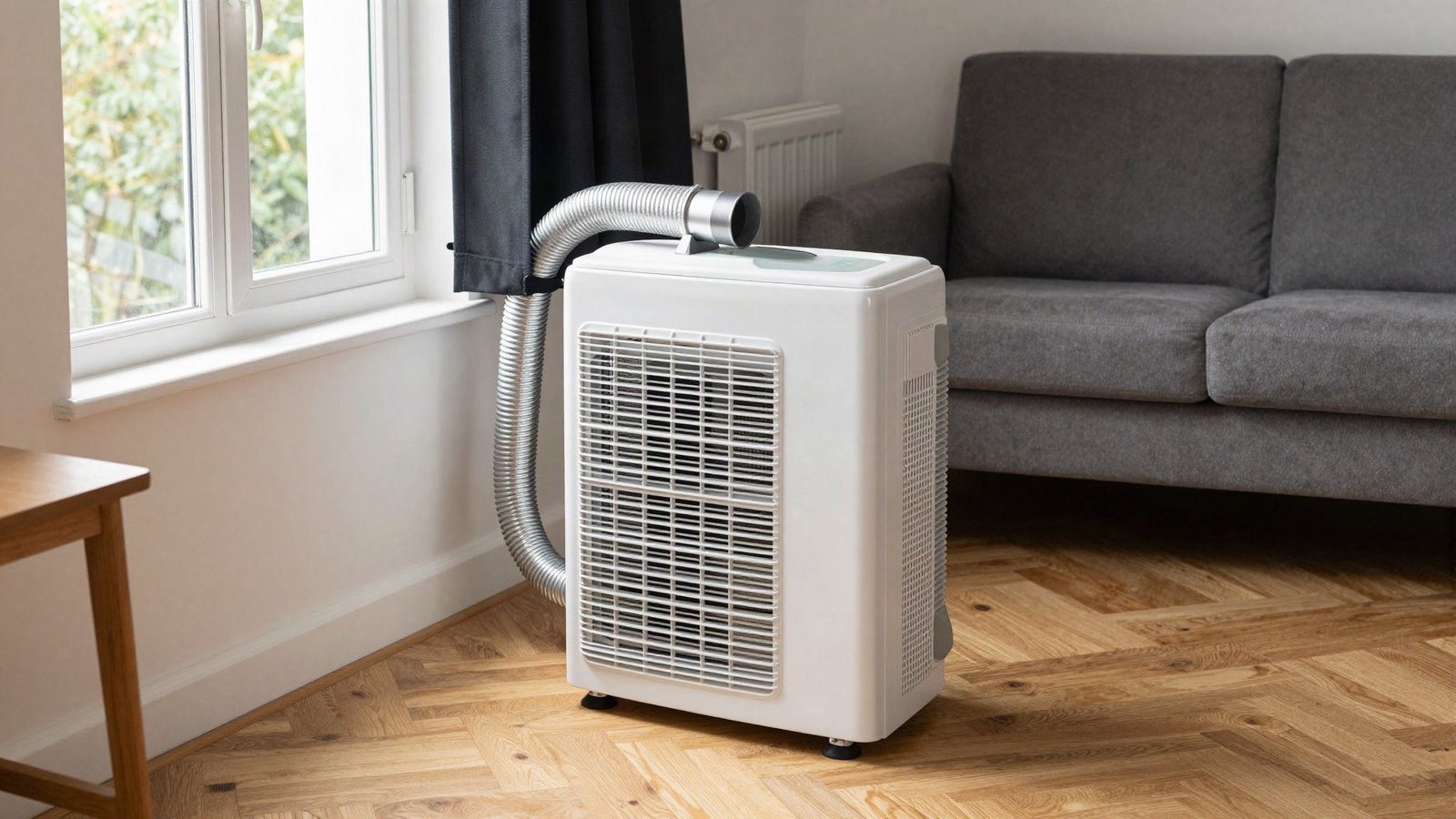
So in Britain the phrase almost always means one of two machines: a portable monobloc with a hose vented through a partly open window, or a fixed wall-mounted monobloc cored through the masonry. This guide covers both, with 2026 UK prices and the regulations that quietly rule out the third option for a lot of households.
Our top picks at a glance
MeacoCool MC Series Pro 10000
~£420-470Meaco has spent two decades building for British humidity rather than dry continental heat, and it shows in how this handles a muggy August night. Around 2.9kW of cooling, a genuinely usable 24-hour timer, and controls that work without an app or an account.
Pros
- ✓ Strong dehumidification, so it makes a sticky room feel cooler than the thermometer suggests
- ✓ Self-evaporative in normal use, so the tank rarely needs emptying
Cons
- ✗ Single-hose design, which pulls replacement air in from the rest of the house
- ✗ The supplied window kit is basic; budget £25-35 for a proper fabric seal
De'Longhi Pinguino PAC EL112 Silent
~£600-750The quietest portable we have lived with at this output, sitting near 50dB in its silent mode, which is the difference between using it overnight and switching it off at 1am. Real-Feel humidity control means it does not overcool and leave the room clammy.
Pros
- ✓ Genuinely bedroom-quiet in silent mode
- ✓ Self-evaporating condensate handling and a well-made window kit
Cons
- ✗ Expensive for a six-to-ten week British cooling season
- ✗ Heavy at around 33kg, and the castors struggle on deep pile carpet
Igenix IG9919 9,000 BTU Portable
~£230-280The cheapest unit we would still recommend for a small bedroom or a home office up to about 16 square metres. It cools properly, but it makes no attempt to be subtle about it.
Pros
- ✓ Around half the price of the premium options
- ✓ Light at roughly 23kg, so one person can move it between rooms
Cons
- ✗ Loud, around 65dB, and there is no quiet mode worth the name
- ✗ Thin filter and a flimsy window kit that needs replacing straight away
electriQ AirFlex 15W Wall Mounted
~£800-950A wall-mounted monobloc that vents through two cored holes in an external wall, with no outdoor condenser at all. Because the refrigerant circuit is sealed and factory-charged, no on-site F-Gas work is involved, which removes the biggest cost and consent hurdle of a split system.
Pros
- ✓ No hose, no lost window, and no external condenser to trigger a planning application
- ✓ Frees up floor space and runs quieter than any portable at the same output
Cons
- ✗ Permanent holes in an external wall, so freeholder or landlord consent is essential
- ✗ Installation adds roughly £250-450, plus a Part P electrician if it is hard-wired
Why British Windows Change the Answer
A US window unit needs a horizontal opening roughly 560-950mm wide, a sill deep enough to carry 25-45kg, and a sash that closes down onto the chassis to seal it. A side-hung casement gives you a vertical opening, no sill bearing and nothing to clamp against. A period vertical slider will physically take a unit, but the box frame and sash cords were never designed for that load, and on a first-floor bedroom you have also just blocked your Building Regulations Part B means of escape.
The two formats that do suit UK housing are the portable monobloc, where the whole refrigeration circuit sits in the room and a 130-150mm flexible hose dumps warm air outside, and the fixed wall monobloc, which needs two core holes and no outdoor unit at all. Split systems cool better than either, but they bring an F-Gas engineer and, usually, a planning application. If you are still weighing the formats up, our comparison of a heat pump versus a straight air conditioner is the better starting point.
Who This Guide Is For
These picks suit people cooling one or two rooms in a house built to keep heat in, not let it out. That is most of Britain.
- •Renters and leaseholders who cannot drill an external wall or hang a condenser without written consent
- •Owners of south-facing loft conversions and box rooms sitting at 28-31C from July into September
- •Anyone in a conservation area, a listed building, or a flat with a restrictive lease
- •Households wanting cooling for six to ten weeks a year, where a £6,000 whole-house split system never pays back
- •People who have already done the cheap fixes: blackout linings, external shading, and proper draught-proofing
How We Judge These Units, and What We Have Not Done
Be clear about the basis of this: it is expert research and installer experience, not a temperature-controlled laboratory. Our assessments come from fitting, servicing and stripping down portable and wall-mounted units in UK homes, from manufacturer test data measured to EN 14511, and from the published sound power figures. Where we have not personally run a model through a full season, we say so rather than dressing up a spec sheet as a test.
We weight four things: real cooling output in kW rather than headline BTU; sound pressure at one metre in the quietest usable mode, because a bedroom unit at 65dB will not get used twice; condensate handling, since a British August will fill a 2 litre tank overnight; and the window kit, which is where nearly every manufacturer economises.
What Actually Matters When You Buy
Sizing is where most money is wasted, in both directions. As a rough rule for UK rooms, allow 0.13kW of cooling per square metre for a north-facing room with modest glazing, and 0.16-0.18kW for a south or west-facing room with large windows or a converted loft. Add roughly 0.10kW for each occupant and around 0.30kW for a desktop PC. Our full kW and BTU sizing method for UK rooms sets the calculation out properly.
- •Single hose versus dual hose: a single-hose portable creates negative pressure and drags warm air in from the rest of the house. Dual-hose units are 20-30% more effective and cost roughly £100 more
- •The window seal is not optional. A bare hose through a gaping casement undoes half the machine's work; a fitted fabric seal costs £20-35
- •Noise: 48-53dB is liveable in a bedroom, 60dB+ is a living room machine only
- •Self-evaporative units send condensate out of the hose as vapour. Anything without it means emptying a tank, and on the muggiest nights that can be twice
- •Running cost: a portable rated A or better draws roughly 0.9-1.2kW to deliver 2.6-3.5kW of cooling, so at 27p per kWh an eight-hour night costs about £2 to £2.60
The Regulations That Genuinely Bite
This is where UK buyers get caught out, and it is not the same picture as North America. A plug-in portable on a standard 13A socket is unregulated and needs nothing from anybody, which is a large part of its appeal. Everything fixed is different.
Electrical work is the first hurdle. In England and Wales, adding a new circuit in a dwelling is notifiable under Part P of the Building Regulations, so a hard-wired wall unit on its own radial must be installed by a registered competent person through NICEIC or NAPIT, or notified to building control first. Scotland works through Building Standards and Northern Ireland has its own regulations. This is squarely in the category of electrical work that should never be a DIY job.
- •F-Gas: connecting, charging or decommissioning a split system's refrigerant circuit is restricted to F-Gas certified engineers. Pre-charged DIY kits do not exempt you, and an uncertified install voids the warranty
- •Planning: an external condenser is not covered by the air source heat pump permitted development rights, so most councils in England treat a wall-hung AC condenser as needing a planning application. Front elevations in conservation areas are usually refused
- •Listed buildings: any external unit, grille or core hole needs listed building consent, and going ahead without it is a criminal offence
- •Leasehold: a hole through an external wall is a structural alteration, so almost every lease requires the freeholder's written consent
- •Landlords and tenants: tenants need written permission before drilling, and a landlord fitting a fixed unit should ensure the five-yearly EICR reflects it
Common Buying Mistakes
Almost every disappointed buyer we meet made one of these five errors, and only one is about the machine itself.
- •Buying on BTU alone. A 12,000 BTU unit in a badly sealed room performs worse than a 9,000 BTU unit with a proper window seal
- •Ignoring the hose run. Every extra metre of uninsulated hose radiates heat back into the room; keep it short, straight and lagged if you can
- •Assuming a portable will cool a whole floor. It cools the room it is in, with the door shut. That is the design brief
- •Confusing an air conditioner with a dehumidifier. If your real problem is muggy air and damp rather than heat, the right dehumidifier for a UK home is cheaper to buy and to run
- •Skipping maintenance. A blocked filter costs 10-15% of output within one season. Fifteen minutes twice a summer following our air conditioner cleaning routine keeps the machine at its rated figures
Found this useful?
There's plenty more — hundreds of guides and honestly-tested product reviews for every corner of your home.
Browse All Guides