Heating & Cooling · 6 min read · 13 May 2026
Ceiling Fan Direction: Which Way in Summer vs Winter (UK Guide)
There is a slider on the side of your fan motor that almost nobody in Britain has ever moved. Here is which way it should point in each season, and what it is genuinely worth.
By the Nims Casa editorial team — written from professional cleaning experience and checked against our editorial standards.
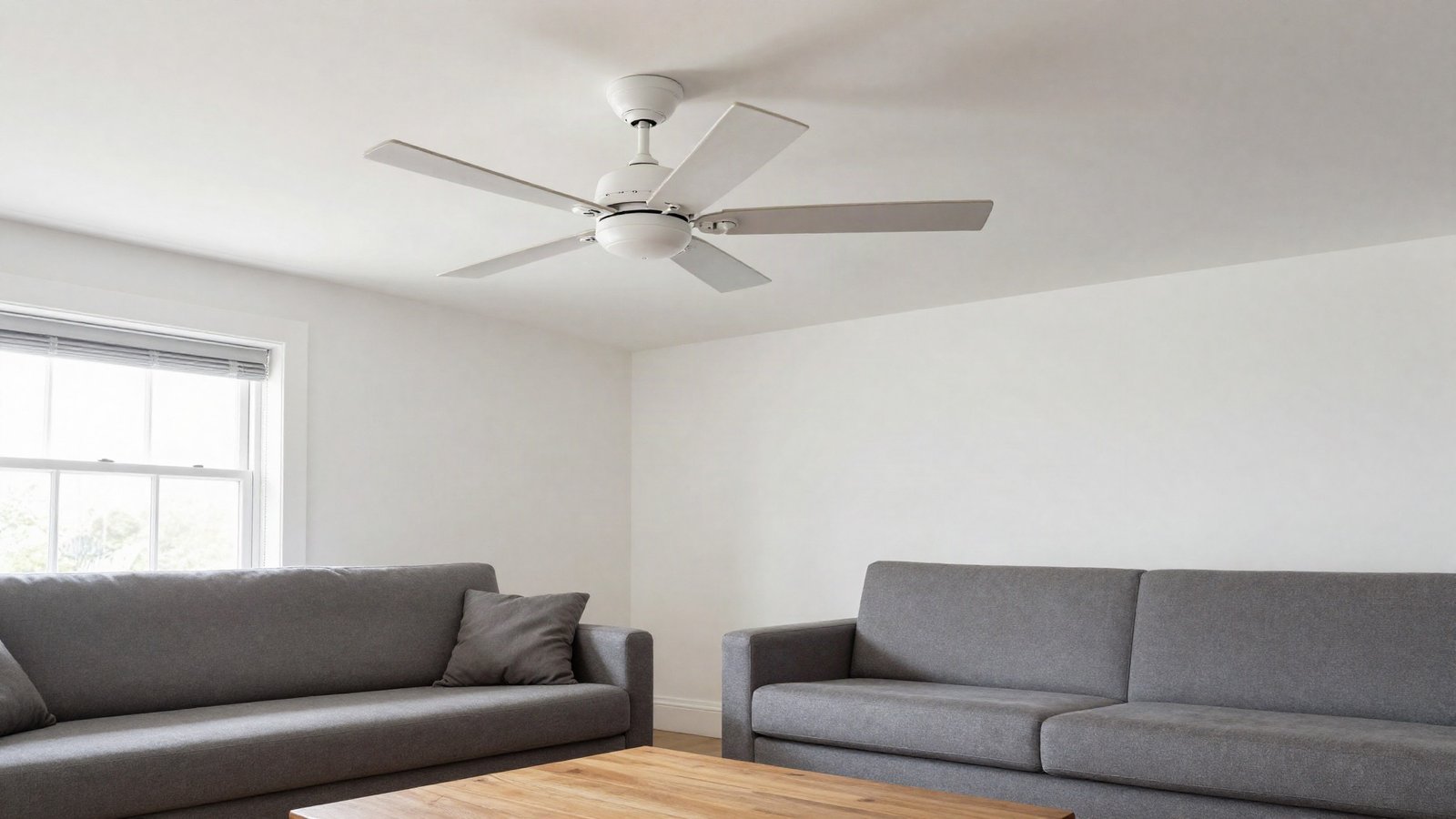
There is a small slider on the side of most fan motor housings, or a curved-arrow button on the remote, and in most UK homes it has not been touched since the fitter left. It reverses the blade rotation, and it does change what the fan does to a room.
The short version: in summer the blades should turn anticlockwise as you look up at them, pushing air straight down onto you. In winter they turn clockwise on the slowest speed, easing the warm layer at the ceiling down the walls. Whether that second setting is worth anything in your house depends almost entirely on ceiling height.
What Each Direction Actually Does
The summer setting works on wind chill, not cooling. Air moving across skin at about a metre per second makes a room feel 2-3°C cooler than the thermometer says. It cools people, not air, and the motor adds roughly 50W of heat, so switch it off when you leave. When a fan stops being enough, our air conditioner sizing guide covers the step up.
The winter setting works on stratification. In a modern UK room with a 2.4m ceiling, floor-to-ceiling temperature differs by only 1-2°C, so there is little up there to reclaim. In a Victorian room with 3m ceilings, a loft conversion or anything vaulted, the gap runs 4-6°C and the reversal earns its keep.
- •Summer: anticlockwise viewed from below, medium to high speed, direct downdraught, only when the room is occupied.
- •Winter: clockwise viewed from below, lowest speed only, no breeze at head height.
- •Ceilings under 2.5m: leave it in summer mode all year and switch it off in the cold months.
Safety First: Isolate Before You Touch Anything
People still hurt themselves on this two-minute job, almost always by reaching up to a fan that is still coasting. Blades take 15-30 seconds to stop, and a slowing blade at head height carries enough momentum to split a lip.
- •Switch off at the wall or pull cord, then switch off the lighting MCB at the consumer unit and label it.
- •Opening the motor housing or ceiling rose? Prove dead with a two-pole voltage indicator. A neon screwdriver is not a test instrument.
- •Use a Class EN 131 stepladder or hop-up, not a dining chair on a rug, and have someone foot it.
- •Browning at the rose, a hot-varnish smell, or rubber-insulated cable: stop, and read the electrical repairs you should never DIY.
Tools, Materials and Realistic Time
A direction change needs nothing but a ladder. The kit below only matters if the reverse mechanism has failed.
- •Class EN 131 stepladder or hop-up: £30-£70
- •Two-pole voltage indicator: £15-£30
- •Replacement DPDT reverse slide switch: £6-£12
- •Replacement remote receiver module: £18-£40
- •Fan start capacitor, usually a CBB61 at 4.5µF or 5µF: £5-£9
- •Time: 30 seconds with a remote, 5 minutes with a slider, 45-90 minutes to replace a switch or receiver.
How to Change the Direction, Step by Step
Do it at the change of season — late May, then late October. Many fans deliberately ignore the reverse switch while the motor is still turning, which is why people wrongly conclude it has failed.
- •1. Turn the fan off at its own control and wait for the blades to stop completely.
- •2. With a remote, press the two-curved-arrows button, or hold the speed button for three seconds — the fan pauses and restarts the other way. Skip to step 5.
- •3. On a manual fan, set the ladder so the motor housing is at chest height, not overhead. Reaching sideways from a low step is how people fall.
- •4. Push the slider on the housing, usually a 10mm tab above the light collar, fully to the opposite end — partial travel leaves the fan dead or humming. Restore power and restart on low.
- •5. Stand underneath: air on your face is summer mode; no downdraught but curtains stirring at the edges is winter mode.
- •6. In winter, drop to the lowest speed. Anything faster defeats the point and you will feel a chill.
What It Really Costs to Run
An older AC induction motor draws 50-75W flat out and 8-15W on the lowest winter speed; a modern DC motor draws 3-35W across its range. At a 2026 unit rate of 26-28p per kWh, a 60W AC fan running eight hours a day costs about 13p, or £3.90 a month. The same use on a DC fan is nearer 1p a day — worth knowing if you are buying, alongside our ceiling fan size guide.
The reversal itself saves less than the marketing suggests. In a 2.4m room it is 1-2% of that room's heating, inside the margin of error and invisible on a bill. In a 3m Victorian room or a vaulted loft it is a fair 4-8%, roughly £15-£40 a heating season. Real money, but not a reason to buy a fan: draught-proofing beats it several times over.
Troubleshooting: When the Direction Will Not Change
Nearly every reversal fault falls into one of these, and only the last needs a trade.
- •Slider moved, nothing changed: the motor was still spinning. Stop it fully, move the slider, restart.
- •Fan hums but will not turn: the slider is mid-travel between contacts. Push it firmly to one end.
- •Slider now does nothing either way: worn DPDT contacts. A £6-£12 part and about 45 minutes.
- •Remote reverse dead after a battery change: the handset lost pairing. Cut power for 30 seconds, restore, then press pair within 30 seconds.
- •Reverses but moves far less air: normal. Blade pitch favours the downdraught direction.
- •Buzzing at the wall switch, or the fan cutting out and restarting: stop using it — wiring or control fault.
When to Call an Electrician, and What a Fair Quote Looks Like
Call someone for any burning smell, browning at the rose, a fan that trips the MCB, or wiring older than the 1970s. Also call if the fan must come down and there is no accessible joist above it — a fan is a moving load and needs bracing, not a plasterboard fixing.
Expect £45-£70 an hour outside London and £70-£110 inside it, with a first-hour or minimum charge of £60-£120. Replacing a reverse switch or receiver is 45-60 minutes plus £10-£40 of parts: £70-£150 all in, roughly 80% labour to 20% materials, which is normal for small electrical work. Swapping a fan onto an existing ceiling point is £90-£180 labour, the fan itself £60-£400. Where no ceiling point exists, chasing, bracing and a possible new spur put it at £250-£450. Our electrician cost guide breaks the rates down, and fitting a fan where no light point exists covers the bracing.
A quote is reasonable when it itemises labour and materials separately, prices parts near trade plus 20-30%, and arrives in writing. Treat it as suspect if a stuck slider is diagnosed as a whole-fan replacement, if a 45-minute switch job comes in at £300 or more, if you get one round number with no breakdown, or if nobody can give you an NICEIC, NAPIT or ELECSA number for work touching fixed wiring.
Found this useful?
There's plenty more — hundreds of guides and honestly-tested product reviews for every corner of your home.
Browse All Guides