DIY & Maintenance · 6 min read · 7 May 2026
Plasterboard and Drywall Repair Mistakes to Avoid in Older UK Homes
Most failed wall repairs were competently done. They failed because the wall wasn't what the person thought it was — and in a pre-war British house, it usually isn't.
By the Nims Casa editorial team — written from professional cleaning experience and checked against our editorial standards.
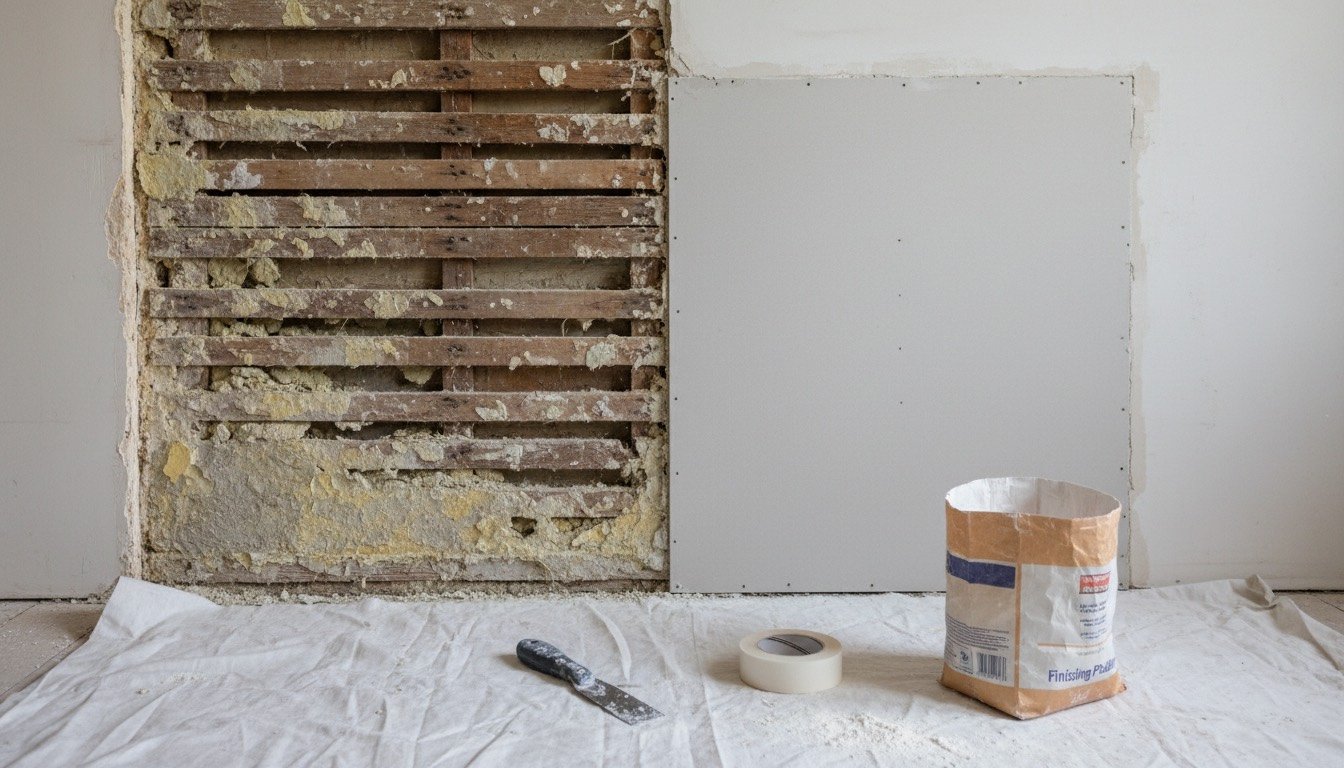
Most of the failed wall repairs we get called back to were technically competent. The filler was mixed properly, it was sanded flat, the paint went on evenly — and six weeks later the crack had reopened along the same line, or a fist-sized lump of ceiling was on the sofa. The technique wasn't the problem. The diagnosis was.
Roughly a fifth of British homes predate 1919 and about half predate 1965, so a great many so-called plasterboard repairs are nothing of the kind. Behind that emulsion there may be timber lath, lime and horsehair, a bricked-up flue, a solid nine-inch wall, or a 1958 rubber-insulated cable running diagonally where no modern electrician would put it.
The mistakes, ranked by what they cost you
Attention usually goes to the wrong end of this list. People agonise over feathering a patch and give no thought to what the multi-tool blade will meet 40mm inside the wall.
- •1. Cutting or drilling blind into a pre-1970s wall — live cable, gas pipe, lead water pipe.
- •2. Dry-sanding pre-1992 paint, or disturbing textured coating that may contain chrysotile asbestos.
- •3. Filling a crack in a sagging lath ceiling: 20-40kg of plaster comes down at once.
- •4. Filling a live structural crack, which hides the evidence a surveyor needed.
- •5. Skimming over damp or salt-contaminated plaster; it blows within a season, £250-£500 wasted.
- •6. Using gypsum on lime in a solid-walled house: the patch shrinks and traps moisture.
- •7. Hanging weight on fixings that grip only the finish coat.
- •8. Rushing the finish — deep fill in one pass, no mist coat, painting green plaster. Cosmetic only, and top of most people's worry list.
The genuinely dangerous ones
Modern cable is meant to run in safe zones — within 150mm of a wall top or internal corner, or straight up and down from an accessory. Pre-1980s wiring ignores all of that; we have found cable stapled diagonally across the face of the lath. A detector alone is not enough: use one, isolate the circuits at the consumer unit before cutting, and never assume a pre-1966 lighting circuit has an earth.
The other hazard is dust. Lead was legal in UK decorative paint until 1992, so wet-sand old edges or use a shrouded sander with an M or H class vacuum; see lead paint safety in older properties. Treat any textured ceiling of unknown age as suspect — a UKAS lab sample costs £30-£60 and settles it in a week, worth doing before you touch an Artex ceiling. Wear FFP3, not a paper mask.
Mistake: treating lath and lime like plasterboard
Lath and plaster works because wet lime squeezed between the laths forms nibs, or keys, on the back. When the keys snap, the plaster is attached to nothing. Knuckle-tap it: sound areas ring dull, detached areas sound hollow and flex. Filling a crack there is pointless — either re-fix the panel with plaster washers and 40-50mm screws into the laths and joists (about £15 per 100 washers), or cut back to sound plaster and patch.
Then there is the material. Gypsum multi-finish is harder and less breathable than the lime around it, so on a solid wall it shrinks at the perimeter and pushes moisture sideways. On a small patch in a dry room, bonding plus multi-finish is accepted practice; on external solid walls, cellars and listed properties, use lime or a breathable filler. Our walkthrough on repairing old plaster walls covers the mixes.
Mistake: filling the crack without finding the movement
Filler does not stop movement, it records it. Hairline cracks that reappear each winter above a sash window are seasonal — timber boxes and lintels shrinking once the heating goes on — and want flexible decorator's caulk, not rigid filler. Cracks along a wall-to-ceiling junction want scrim tape bedded in.
Low-level cracks that keep returning on a ground-floor wall are different. In terraces with original salt-glazed clay drainage, a cracked gully beside a solid wall soaks the brickwork; hygroscopic salts migrate into the plaster and it blows again however well you fill it. Same on a bricked-up chimney breast, where soot salts stain through emulsion. Fix the drain, ventilate the flue, then replaster with a salt-retardant render — and if a patch has failed twice, read why wall cracks keep coming back and tracing damp and mould.
- •Diagonal cracks over 5mm, wider at one end, stepping through mortar joints: get a structural engineer's report (£400-£800).
- •Fresh cracks after a loft conversion or removed chimney breast: check the gallows brackets or beam first.
- •Cracks along every wall-ceiling junction: ordinary seasonal movement. Caulk, don't fill.
Mistake: fixings that grip only the finish
Drywall anchors do most of their damage here, because half the walls they get pushed into are not plasterboard. On lath and plaster no anchor is reliable — it is 15-20mm of brittle lime over timber strips, so find the stud or joist and use a 60-80mm woodscrew. On dot-and-dab, standard on masonry since the 1990s, there is a 10-25mm void behind the board, so a 50mm plug bites nothing but adhesive. That is the classic television-on-the-floor failure: use a frame fixing that reaches 50mm into the blockwork.
In genuine hollow partitions, learn the numbers rather than guessing. In 12.5mm board, a plastic self-drive anchor holds roughly 5-10kg, a metal one 10-15kg, a spring toggle 20-30kg in shear. Heavier loads belong on the studs or a plywood pattress. If the hole is now too big to fix, our guide to patching holes in plasterboard covers the offcut-and-batten method.
Mistake: rushing the last ten per cent
Deep-filling a 20mm hole in one pass guarantees a shrinkage dimple. Build it in 5mm layers, or use bonding undercoat for anything over 10mm and finish with 2-3mm of multi-finish. Feather at least 150mm past the repair with a wide taping knife; a patch visible in raking light was almost always floated too tight to its own edge.
Then leave it. Allow a week per 5mm of thickness before painting, four to six weeks for a full re-plaster. Paint early and you get flashing, or emulsion lifting in sheets. Seal with a mist coat of roughly 70 per cent contract matt to 30 per cent water before the topcoat.
When to stop and call someone
Call a plasterer when more than about a square metre sounds hollow, when a ceiling is bowing, when a repair has failed twice, or when the surface is Artex, lime in a listed building, or visibly damp. Call an electrician before opening a wall in a house with rewireable fuses or cloth-and-rubber cable — Part P notifiable work in England and Wales, and a full rewire is £3,500-£6,000 for three bedrooms.
For scale: a plasterer's minimum is £120-£200 for a half day, a small ceiling repair £250-£400, a re-skim of a 3m x 4m room £350-£600 with materials, and taking down a failed lath ceiling £700-£1,200. Against those figures, £40 on a cable detector, FFP3 masks and a 250mm taping knife is the cheapest decision in the job.
- •Stop at once if you expose rubber-sheathed cable, a live gas pipe, or anything resembling asbestos insulating board.
- •Stop if plaster comes away in your hand over an area bigger than a dinner plate — that is a re-plaster, not a patch.
- •Stop if the wall is wet to the touch or the filler will not go off. Find the water first.
Found this useful?
There's plenty more — hundreds of guides and honestly-tested product reviews for every corner of your home.
Browse All Guides