Roofing & Exterior · 6 min read · 17 April 2026
How Far Should Downspouts Extend From a House? A UK Downpipe Guide
Most damp patches we get called to start outside, at knee height, where a downpipe dumps its water a hand's width from the brickwork. Here are the distances that matter, and what fixing it costs.
By the Nims Casa editorial team — written from professional cleaning experience and checked against our editorial standards.
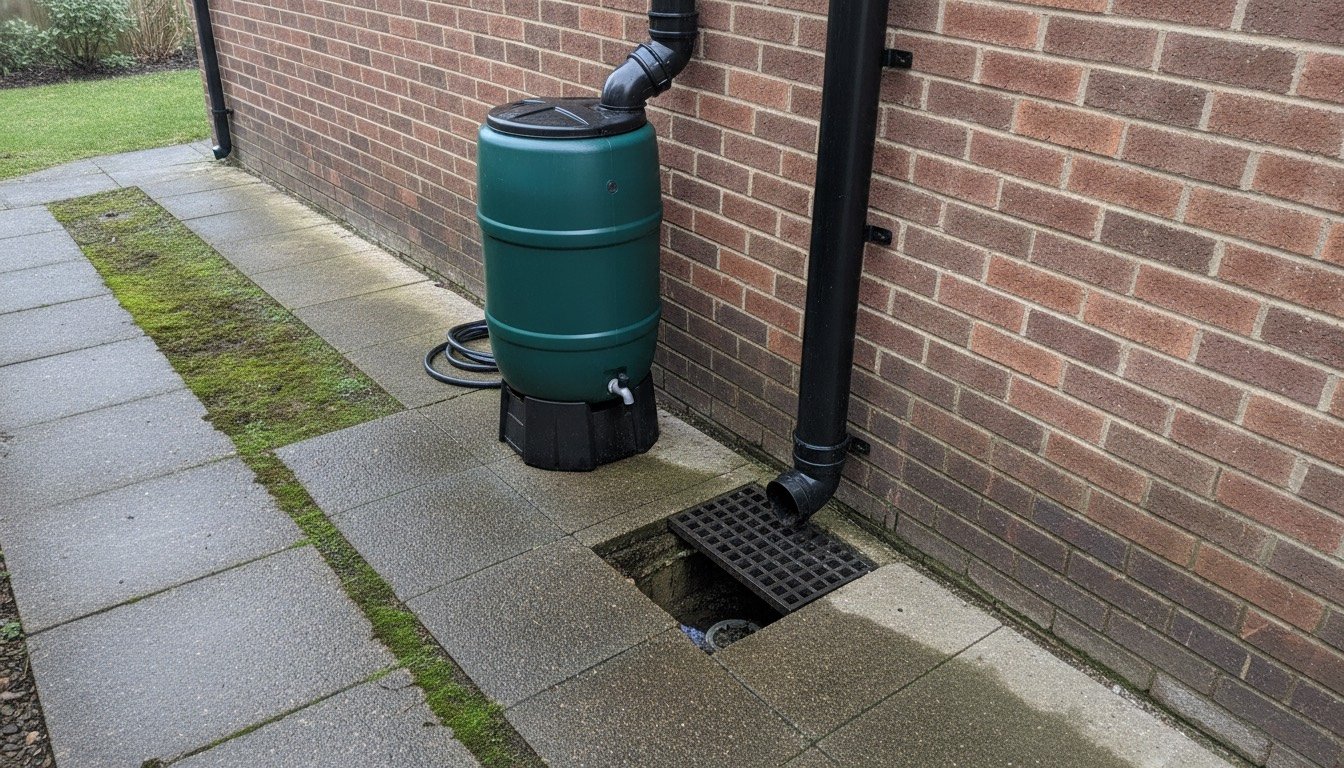
Every autumn brings the same call-out: a dark tidemark inside an external wall, always the same corner, always worse after a wet week. Nine times out of ten the cause is standing outside at knee height. A downpipe ends 300mm above a paving slab set hard against the brickwork, and every drop it carries lands within a hand's width of the wall.
People want one number in reply. There isn't one, because British houses rarely discharge rainwater across open ground the way American guides describe; ours run into a gully, a soakaway or a surface water sewer. But there are firm minimum distances, set by Building Regulations rather than opinion, and ignoring them is one of the cheapest expensive mistakes in home maintenance.
The Short Answer: Distances That Actually Matter
Treat these as floors rather than targets. Where the plot allows, more is better, and the fall of the ground matters as much as the distance.
- •Onto open ground or a border: 1.5m from the wall as an absolute minimum, 2-3m if you have room, with the ground falling away at 1:40 or steeper.
- •Onto paving or a drive: never leave it there. Water on an impermeable surface finds its way back to the wall within a metre. Route it into a channel drain or gully.
- •Into a soakaway: at least 5m from any foundation and around 2.5m from a boundary, sized after a percolation test (Approved Document H3 in England and Wales, Section 3.6 of the Technical Handbook in Scotland).
- •Into an existing trapped gully: the shoe sits inside the grating, not hovering over it, and the gully should be at least 150mm below the damp-proof course.
- •Away from ventilation: keep the discharge a clear metre from any air brick, or you flood the void under your floorboards.
- •Never onto a neighbour's land or the public pavement. On a highway that is an offence, not just bad manners.
Why the Distance Matters
Do the arithmetic and the caution makes sense. A rear roof slope of 45 square metres in a 25mm/hour downpour, routine in a British October, sheds about 1,125 litres in an hour: roughly 19 litres a minute out of one 68mm pipe, and a summer thunderstorm at 50mm/hour doubles it. You are emptying a bucket every fifteen seconds onto one square metre of ground.
Two things then go wrong. Brickwork below the damp-proof course wicks water sideways, mortar spalls in frost, and by January you have the tidemark and the smell; clearing damp and mould indoors is only half that job. Worse, on the shrinkable clays of the South East, repeated soaking softens bearing soil beside a shallow Victorian footing at 450-600mm depth. If movement has appeared, check whether a foundation crack is serious before spending on drainage.
The Five Options, and When Each Applies
First confirm the gutter above is working. Half the overflowing downpipes we see are simply blocked, and routine gutter and downpipe maintenance solves the problem for nothing.
- •Shoe and free fall onto ground. Cheapest, adequate on a large garden with genuine fall, useless on a narrow terrace side-return.
- •Shoe into a channel drain or trapped gully. The standard UK answer for paved areas. Restoring a broken connection beats inventing a new route.
- •Below-ground connection to a surface water sewer. Fine where a public surface water drain exists, but it needs water company consent.
- •Soakaway. The right answer where no sewer exists. Crates go into a 1.2-1.5m pit wrapped in geotextile, minimum 5m from the house.
- •Land drain or French drain to a suitable outfall. Best where the garden is already waterlogged; treat it as part of wider work to improve garden drainage.
What It Costs in 2026: Materials, Labour and Worked Examples
Materials for this work are cheap; labour and plant are not, and that split is the most useful thing to grasp before reading a quote.
- •68mm uPVC shoe £4-8; bends £3-6; clips £1.50-3; a 2.5m length of downpipe £9-15.
- •Channel drain with grating £18-35 per metre, plus £8-15 for end caps and outlet.
- •110mm underground pipe £15-22 per 3m length; bends £5-10; trapped or back-inlet gully £20-45.
- •Soakaway crates £45-75 each for a 190-litre unit; geotextile membrane £25-45; pea shingle surround £60-90.
- •Labour: a roofer or handyman charges £35-55 an hour on an £80-150 minimum call-out. A two-person groundworks team is £350-500 a day, £500-700 in London.
- •Plant and disposal: mini-digger £90-160 a day plus £60-120 delivery; a 6-yard skip £250-380.
- •Worked example one — shoe plus 1.5m of channel drain on an existing fall: £45-70 materials, 90 minutes labour, £120-200 total. Labour is about 60 per cent, normal where the call-out dominates.
- •Worked example two — extending a downpipe to a gully 2.5m away, dug by hand: £70-120 materials against £180-260 for half a day, so £250-380, a 70:30 labour split.
- •Worked example three — a 1,000-litre crate soakaway 6m out, spoil removed: £400-650 materials, £600-1,000 labour and plant, £1,000-1,650 total. Under £700 means someone is skipping the percolation test or the skip.
Reading a Quote: Reasonable Against Suspect
A fair drainage quote reads like a specification, not a slogan. If new rainwater goods are bundled in, cross-check against typical gutter installation costs so the two elements are priced separately.
- •Reasonable: states pipe diameter, the fall worked to (1:60 to 1:100 for 110mm surface water), and exactly where the water ends up.
- •Reasonable: prices a percolation test before quoting a soakaway, and lists spoil removal and reinstatement separately.
- •Suspect: a four-figure 'drainage system' quoted from photographs, with nobody having lifted a manhole cover or run a hose test.
- •Suspect: any proposal to tee rainwater into the foul drain. It is generally not permitted, and the water company can make you undo it at your cost.
- •Suspect: tanking sold as the cure while the downpipe still discharges against the wall. That is treating the symptom at ten times the price.
DIY or Call Someone In
Everything above ground is genuinely DIY. Fitting a shoe, adding an offset bend, running a metre of channel drain or clearing a silted gully needs a hacksaw, a spirit level and an afternoon. Work from a properly footed ladder and never lean sideways from one.
Stop where you would be digging deeper than 600mm, cutting into an existing below-ground drain, or connecting to anything public. Underground runs need specific gradients, proper couplings and a rest bend at the base; a badly bedded joint silts up and back-floods within two winters. A soakaway in heavy clay behaves like a bathtub, which is what the percolation test exists to catch. One day of a groundworker's labour is cheaper than digging it twice.
Common Questions
Do I need approval to move a downpipe? Like-for-like repositioning above ground needs nothing. A new connection to a public sewer requires water company consent, and a soakaway serving an extension falls under Part H.
Are roll-out flexible extensions worth it? They last one season, split at the concertina folds, freeze solid in January and trip people up across a path.
Does a water butt solve it? Only partly. A 210-litre butt swallows the first ten minutes of a downpour, then overflows, and the overflow still needs somewhere sensible to go. That is the bit everyone forgets to plumb.
Found this useful?
There's plenty more — hundreds of guides and honestly-tested product reviews for every corner of your home.
Browse All Guides