Roofing & Exterior · 6 min read · 5 May 2026
How to Install a French Drain: A UK Step-by-Step (Including Old Houses)
Most boggy British gardens are not a groundwater problem at all. Here is how to tell, how to build the trench properly, and what changes when the house predates damp-proof courses.
By the Nims Casa editorial team — written from professional cleaning experience and checked against our editorial standards.
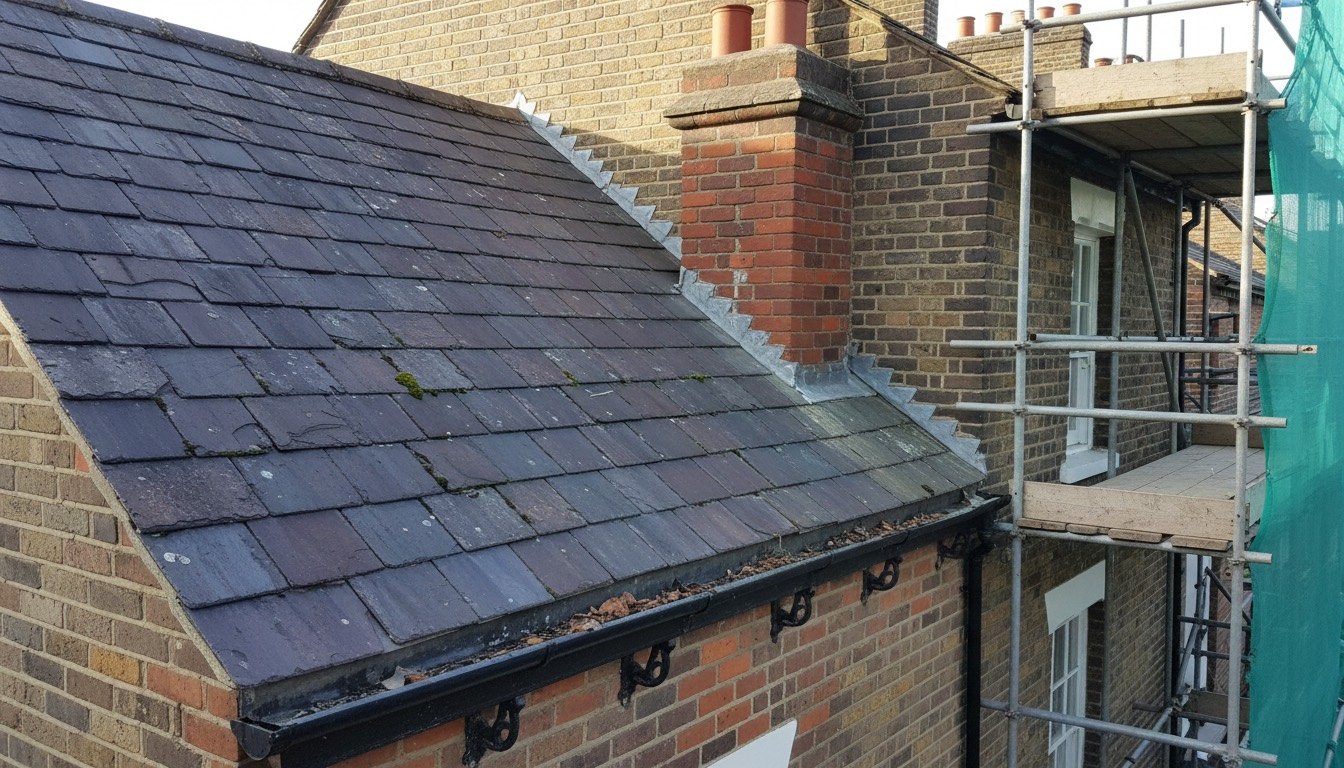
Most of the water standing on a lawn in February is not groundwater. It is rain that landed on 60 square metres of roof, overshot a sagging gutter and soaked the soil nearest the wall. Spend one wet afternoon watching where it arrives from: nine times in ten a £40 downpipe repair and a proper gutter clean does more than £900 of trench.
When you do have real ground water — a lawn still spongy a week after rain, a garage slab that sweats, a retaining wall weeping halfway up — a gravel-and-pipe drain will shift it. Here is how one goes in, what it costs, and what changes when the house predates damp-proof courses.
Safety and permissions before the first spade goes in
Digging a 600mm trench along the back of a British house is the most reliable way to find services nobody knew about — older houses worst of all, with no drawings and everything buried by whoever was cheapest. Run a free LSBUD search, hire a CAT and Genny at around £45 a day, and hand-dig trial holes every three metres before a machine arrives. On a terrace the Party Wall etc. Act 1996 bites too: excavate within 3m of a neighbour's wall and deeper than their foundations and you owe two months' notice.
- •Victorian salt-glazed clay drains often sit only 300-450mm down, in places no modern plumber would choose. A CCTV survey at £120-250 beats finding one with a bucket.
- •Pre-1970s garden circuits — rubber-sheathed cable out to an outhouse — are often 150mm deep with no warning tape and no RCD. Isolate at the consumer unit first, and expect a lead supply pipe at 600-750mm.
- •Building Regs Part H: never connect surface water to a foul drain, and keep a new soakaway 5m from any building.
- •Discharging to a ditch needs land drainage consent from the lead local flood authority. Never work in an unsupported trench deeper than 1.2m.
Tools and materials for a 10-metre run
The digging is unskilled; the setting-out is not. Consistent fall is what separates a working drain from a gravel-filled ditch.
- •100mm perforated land drain coil, 25m: £55-85. Rigid slotted 110mm costs more but can be rodded later.
- •20mm washed angular gravel, roughly 2.5 tonnes for a 10m trench — three bulk bags at £75-110 each, plus sharp sand for the bed.
- •Non-woven needle-punched geotextile, 4.5m x 11m: £30-50. Weed fabric blinds within two winters.
- •Rodding point or 320mm inspection chamber, £45-75 each.
- •Spade, mattock, barrow, pegs, line and a 2m straightedge or hired laser level (£15-25 a day), plus goggles and steel toecaps.
- •A 0.8-tonne micro digger, £90-130 a day plus delivery, pays for itself past about 8m of clay.
Realistic time and cost
Two fit people hand-digging 10m of London clay should plan two full days plus half a day to build the drain; a micro digger cuts that to a day and a half. Spoil is the hidden cost — 10m makes about 1.5 cubic metres of clay.
- •DIY materials only, 10m run: £250-450.
- •DIY with digger hire and a 6-yard skip (£220-330, more in London): £600-850.
- •Contractor supply and fit: £70-150 per linear metre, so a typical 12m job is £1,100-1,800.
- •A new soakaway with a BRE Digest 365 percolation test: add £400-900.
Installing the drain, step by step
Work backwards from the outfall: deciding where the water goes is the design, and the trench is only joinery.
- •1. Confirm the outfall first — a surface water drain, a soakaway 5m clear of the house, or a consented ditch. Without one you are only building a soakaway under the lawn.
- •2. Set the line out across the slope, so it intercepts water rather than following it downhill.
- •3. Peg the fall at 1:80 to 1:100 — 100-125mm of drop over 10m — and mark the invert on every peg.
- •4. Excavate 300mm wide and 450-900mm deep, checking the base against a straightedge every 2m.
- •5. Line the trench with geotextile, 400mm draped each side, then bed 50mm of sharp sand and re-check the fall.
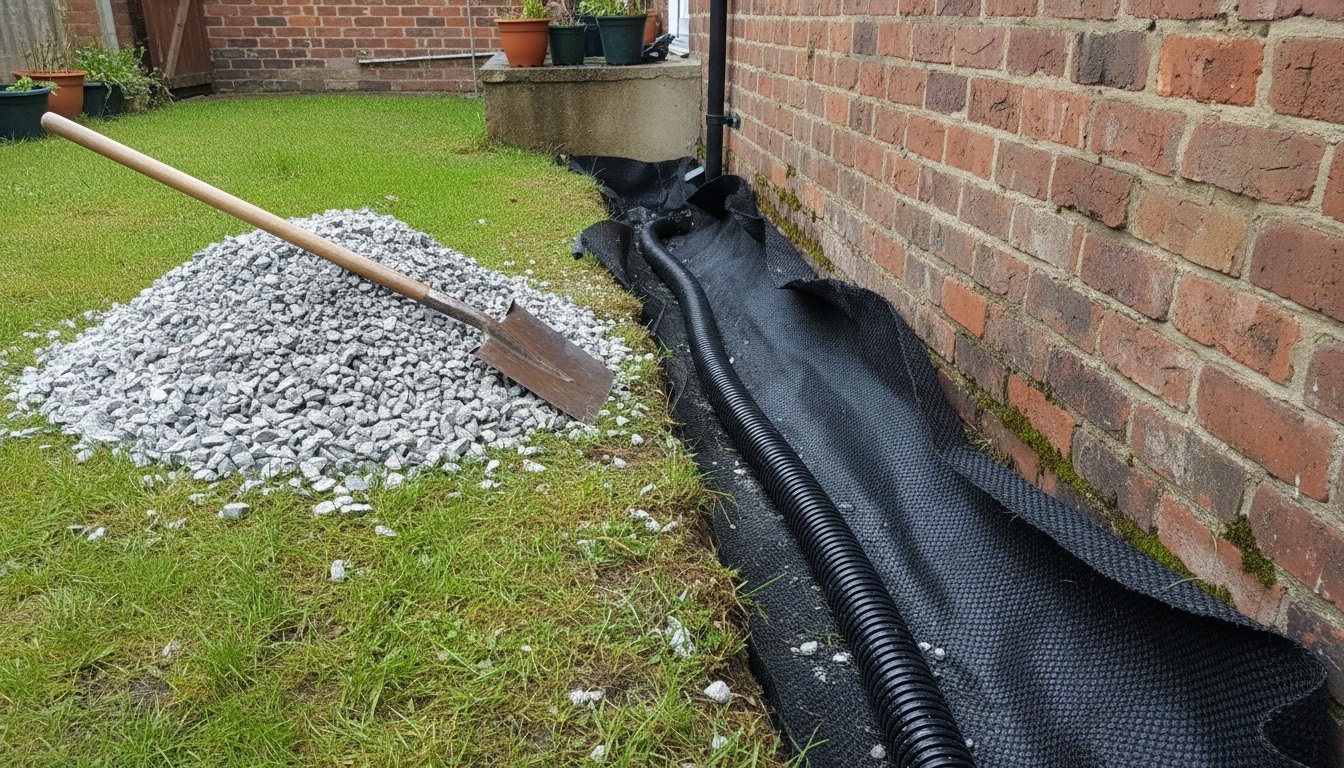
- •6. Add 100-150mm of gravel and lay the pipe perforations-down, or at four and eight o'clock. Water rises in from the trench; holes facing up only delays entry.
- •7. Fit a rodding point at the head and at every change of direction.
- •8. Backfill to 100-150mm below the surface, compacting by hand in layers, then fold the membrane over with a 300mm overlap.
- •9. Finish with turf on 100mm of topsoil, or leave the gravel exposed as a splash margin. Test with a hose for ten minutes; water should reach the outfall within two.
What changes on a Victorian or Edwardian house
Solid-wall houses do not behave like modern cavity construction. Victorian footings are often two or three corbelled courses at 400-600mm on bare clay, so a trench running parallel and deeper than the footing removes lateral support and can open cracks within weeks. Keep the trench base above the footing, stay 1m clear, or dig in 1m bays, backfilling each before opening the next. If cracks appear, establish whether the crack is structural before carrying on.
Solid brick bedded in lime relies on evaporation, and the base of the wall is where it happens. That is why the conservation version against an old house is a shallow open gravel channel — a dry area — not a deep buried pipe. If you are repointing too, the lime versus cement choice matters more than the drain.
- •Keep finished levels at least 150mm below the slate DPC, or below internal floor level where there is no DPC at all.
- •Never let gravel bridge a DPC or bank against render; that turns an outdoor problem into internal damp and mould.
- •External drainage alone rarely dries a cellar — persistent cellar damp is usually tanking or ventilation.
- •Expect unrecorded lightwells and coal chute voids within 2m of a rear elevation.
Troubleshooting a drain that is not working
Nearly every failure is one of four things: no fall, no outfall, silted gravel, or water that was never groundwater.
- •Pooling at the head that never moves: the fall is wrong or reversed, and there is no fix but re-laying.
- •Outfall runs briefly then stops while the ground stays wet: too little gravel volume, or a silted pipe. Rod it.
- •Performance falls off after two or three winters: fines have blinded the membrane, usually from weed fabric or unwashed gravel.
- •Wet only during and after heavy rain: that is surface water. Fix the gutters and look at wider garden drainage instead.
- •One patch that never dries even in August: suspect a leaking supply pipe or cracked drain.
When to stop and call a professional
The digging is simple enough, but several situations carry consequences that dwarf the £700 you saved doing it yourself.
- •The trench needs to exceed 1.2m, or the sides will not stand up unsupported.
- •A percolation test shows the clay will not soak away, so the job needs attenuation, a pump, or a sewer connection the water company must approve.
- •The property is listed or in a conservation area, or you uncover asbestos cement pipe, unidentified cable or a live clayware drain.
Found this useful?
There's plenty more — hundreds of guides and honestly-tested product reviews for every corner of your home.
Browse All Guides