Costs & Hiring · 6 min read · 4 June 2026
How Much Does a Home Inspection Cost in the UK? 2026 Survey Prices
Nobody enjoys paying £900 to be told a house they don't own yet has problems. Here is what UK surveys really cost in 2026, what drives the number, and which checks you can safely do yourself.
By the Nims Casa editorial team — written from professional cleaning experience and checked against our editorial standards.
The surveys buyers skip to save a few hundred pounds are, with tedious reliability, the ones that cost five figures later. A collapsed clay drain under a rear addition is a £7,000 job — the seller's problem before exchange, entirely yours after it.
Britain has no regulated product called a home inspection. You are buying a survey from a chartered surveyor, and the price tracks floor area and age more than purchase price — which is why an older property versus a new build changes the budget entirely.
What You Are Actually Buying
The most expensive misunderstanding in UK conveyancing is treating the lender's valuation as a survey. It is a short visit to confirm the bank is not lending £400,000 against a £300,000 asset. It will not mention that the wall plate is rotten.
- •Mortgage valuation — for the lender, often free. Inspects nothing on your behalf.
- •RICS Level 1 (Condition Report) — traffic-light ratings, no repair costs. Modern flats in sound order only.
- •RICS Level 2 (HomeBuyer Report) — the default for a conventional post-war house. Visible and readily accessible only; carpets stay down.
- •RICS Level 3 (Building Survey) — for anything pre-war, extended, timber-framed or already showing problems. Ladder access to gutter level, priced repair priorities.
- •Specialist follow-ups — damp and timber, structural engineer, CCTV drainage, electrical, asbestos — commissioned because the main survey flagged something.
Typical 2026 Prices, Survey by Survey
Middle-of-market figures for a three-bed property outside inner London, VAT included. In Scotland the seller supplies a Home Report containing a Single Survey — roughly a Level 2 — at their own cost of £450 to £1,000, so buyers often start at nil. On a Victorian tenement, commission your own Level 3 regardless.
- •Mortgage valuation: £0–£350
- •RICS Level 1 Condition Report: £330–£550
- •RICS Level 2 HomeBuyer Report: £450–£950, plus £100–£200 with a valuation
- •RICS Level 3 Building Survey: £750–£1,600; £2,000–£3,000 listed, thatched or very large
- •New-build snagging survey: £350–£650 by bedroom count
- •EICR by a registered electrician: £150–£300 house, £120–£180 flat
- •CCTV drainage survey: £150–£350; gas safety check on appliances: £60–£120
- •Structural engineer's visit and report: £400–£900
- •Independent damp and timber survey: £250–£450
- •Asbestos management survey: £200–£450; drone roof inspection: £150–£300
Where the Money Goes, and What Moves It
There are no materials in a survey, which is why pricing feels opaque next to a trade quote. You are buying time and professional indemnity insurance. On a £900 Level 3 the split is roughly 30 per cent site time, 40 per cent report writing and desk research, 20 per cent insurance, travel and kit, 10 per cent profit — an effective day rate of £400 to £700.
- •Floor area is the main lever — most independents band by square metre or bedroom count, not purchase price.
- •Value banding survives at corporate firms, which punishes expensive postcodes: a £900,000 house takes no longer to inspect than a £350,000 one.
- •Pre-1919 solid wall, timber frame or non-standard construction adds £100–£400; listed or conservation status another £150–£400.
- •Access problems — boarded loft, no hatch, tenant in situ — raise either the fee or the caveat count.
- •A 48-hour turnaround costs 15–25 per cent more; rural call-outs beyond 30 miles add £50–£100. Regional spread nationally is about 25–35 per cent.
Three Worked Examples
The pattern is consistent: the survey is predictable, the specialist reports are where the money goes. Budget £700 baseline and hold £1,000 in reserve for anything pre-1945, where the usual age-related faults surface.
- •1930s three-bed semi, Wakefield, £245,000. Level 3 £780 plus an EICR at £170 because the consumer unit looked original. Total £950. Found perished rubber lighting circuits and asbestos cement garage sheeting; £3,800 off.
- •New-build four-bed, Warrington, £395,000. Snagging survey before completion £480, lender's valuation free. It listed 143 defects, all corrected under the two-year warranty — skipping it is the commonest false economy in British house buying.
- •Victorian mid-terrace, Bristol, £420,000, cracking above the bay. Level 3 £1,150, structural engineer £625, CCTV drain survey £220, damp and timber £340. Total £2,335. The bay movement was historic and stable; the drain had collapsed. £6,900 off.
The DIY-or-Professional Line
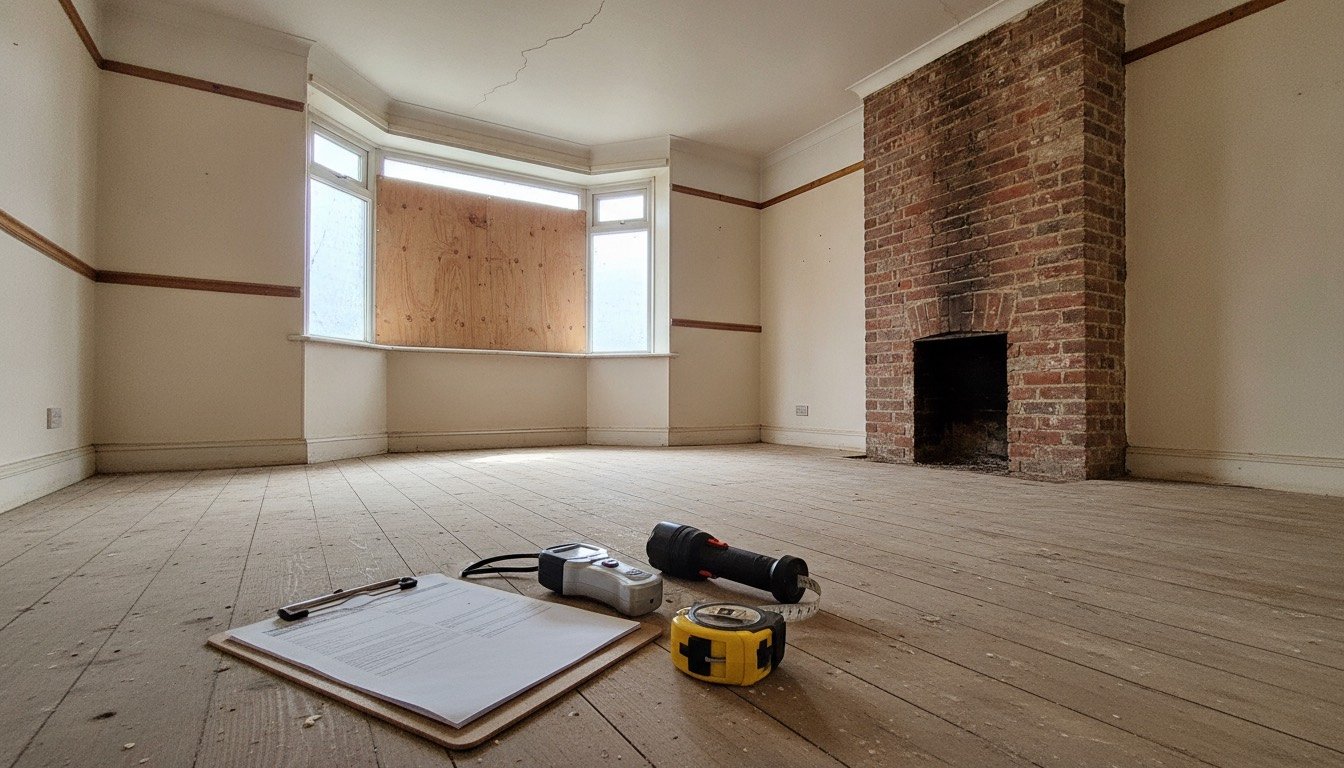
Do your own second viewing with a torch and a tape measure — it tells you which paid reports are worth commissioning, and knowing which cracks are serious alone can save a £625 engineer's fee. With the vendor's permission: run every tap for two minutes, listening for the boiler short-cycling; look through the loft hatch with a torch, without crawling over someone else's ceiling joists; photograph cracks with a coin in shot for scale; and check ground level sits about 150mm below the damp-proof course, since bridged DPCs cause most damp and mould complaints. The EPC register, flood map and council planning portal are free.
The list below is different: each item needs a registered competent person under UK law, or carries consequences that make amateur assessment indefensible.
- •Anything behind the consumer unit cover. Circuit testing and the EICR must come from a registered electrician working to Part P.
- •Anything gas. Only a Gas Safe registered engineer may inspect or dismantle appliances — a DIY check is illegal, not merely unwise.
- •Roof-level access above single-storey height: use a tower, a roofer or a drone. Ladder falls remain the leading cause of serious injury in home maintenance.
- •Structural movement. Separating historic settlement from active subsidence needs a chartered structural engineer; the mortgage and insurance consequences of guessing are enormous.
- •Asbestos — never sample, drill or break Artex, cement sheet or pipe lagging. Nor should you enter unventilated cellars or lift floorboards in a house you do not own.
How to Sanity-Check a Quote
Quotes of £590 and £940 on the same house are usually quoting different jobs — apply the same scrutiny you would when comparing contractor estimates.
- •Ask for the RICS registration number and check it on the Find a Surveyor register. "Surveyor" alone is not a protected title, and some firms sell an unregulated "home buyer's report" that is not the RICS product.
- •Request a redacted sample. A good Level 3 runs 40–60 pages with photographs; a poor one is 12 pages of disclaimers.
- •Ask three access questions: will you enter the loft, ladder to gutter level, and lift loose floor coverings? That explains most of the £350 gap.
- •Check the fee includes VAT and that indemnity cover is at least £250,000 — your only recourse if something is missed.
- •Decline free damp surveys from damp-proofing contractors — the report is a sales document that ends in an injection quote almost every time.
Methodology and Timing
Figures come from 2026 quotes across all four UK nations, spanning independent RICS practices, national firms and specialist contractors. Ranges show the middle 80 per cent; the cheapest and dearest tenth were discarded as loss-leaders or unusual properties. Review annually — fees track wage inflation.
Book the day your offer is accepted, not the week before exchange. Lead times run one to three weeks in spring and summer, and rushing costs a quarter more for no extra insight. Keep the defect list: it becomes year one of your annual running costs.
Found this useful?
There's plenty more — hundreds of guides and honestly-tested product reviews for every corner of your home.
Browse All Guides