Energy & Insulation · 5 min read · 6 July 2026
How Much Does a Standby Generator Cost in the UK? 2026 Price Guide
Most UK standby generator quotes land between £7,000 and £16,000 fitted, and the badge on the canopy is rarely what moves the number. Here is where the money actually goes.
By the Nims Casa editorial team — written from professional cleaning experience and checked against our editorial standards.
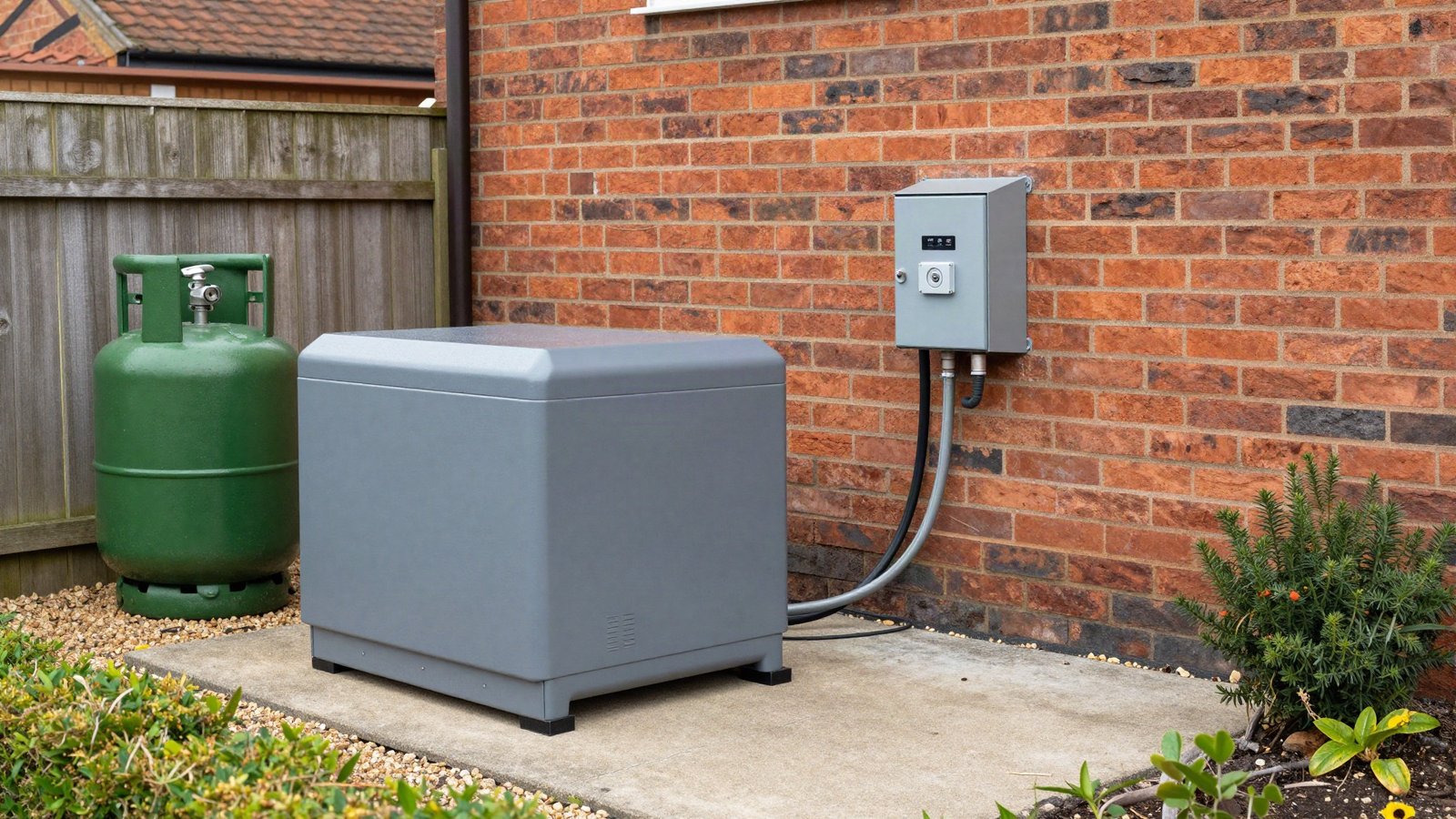
Most standby generator quotes in Britain land between £7,000 and £16,000 fitted, and the spread has almost nothing to do with the badge on the canopy. Sizing, groundworks, the transfer switch and the state of your consumer unit move the number. A three-bed semi keeping a fridge, a boiler and a few sockets alive is a different job from a farmhouse running a borehole pump through a storm.
Below: the price broken down the way an installer builds a quote, three worked examples with real line items, and a plain statement of which parts a competent DIYer can take on and which are certified trade work by law.
Typical UK price range in 2026
When people ask how much does a standby generator cost, they want one number. The honest one is £700 to £1,100 per kVA installed for a domestic set of 8-16 kVA. Below £500 per kVA means a manual changeover and no groundworks; above £1,500 means a very small set or a very awkward site. All figures include VAT.
- •6-8 kVA LPG or petrol, essential circuits only: £6,000-£9,500 installed
- •10-13 kVA LPG or diesel, whole house on a modest property: £9,000-£15,000
- •16-22 kVA canopied diesel, large detached or rural: £13,000-£22,000
- •27-40 kVA for a smallholding or farmhouse: £20,000-£38,000
- •Manual changeover only, existing hardstanding: £2,800-£5,500
Unit costs, line by line
The two items homeowners underestimate are the transfer switch and the trench; together they add £2,000-£3,500 to a job people assumed was just a generator. Work out what you need to keep running first — oversizing is the costliest mistake here, and our guide to sizing a home generator covers the starting-current maths.
- •Canopied generating set, 8-22 kVA: £3,200-£15,000
- •Automatic transfer switch (ATS), 63A-100A with controller: £850-£2,400
- •Manual changeover switch instead: £180-£450
- •Concrete plinth 1.5m x 1.0m x 150mm on Type 1: £280-£650
- •Trenching: £45-£70 per metre in soft ground, £90-£140 through a drive
- •4-core SWA cable: £14-£22/m at 16mm², £22-£32/m at 25mm²
- •TT earth rod array and testing where the supply is PME: £250-£600
- •Bulk LPG tank base and connection (tank usually loaned on contract): £400-£950
- •Commissioning, load test and certification: £250-£550
- •Annual service contract: £180-£350
Labour versus materials, and what moves the price
The split on a typical domestic installation is roughly 60-65 per cent hardware and materials, 35-40 per cent labour and groundworks. Two people need two to three days for an 8-13 kVA job, and electrician day rates of £320-£480 outside London rise to £480-£650 inside the M25.
The second item below catches people out. If your board is a 1980s rewireable with no RCD protection, it gets replaced before anything connects to it, and that consumer unit upgrade at £600-£1,100 is not optional.
- •kVA rating — every extra 5 kVA adds roughly £2,000-£3,500
- •Condition of the consumer unit and the main earthing arrangement
- •Automatic transfer switch versus manual changeover: a £1,500-£2,000 swing
- •Whole-house backup versus an essential-circuits sub-board (the sub-board usually wins)
- •Super-silenced canopy to 55-60 dB(A) at 7m: £800-£2,000, and often the only way past a neighbour dispute
- •Access: no side gate means a hand-dug trench and crane hire at £60-£90 a day
- •Region — a 20-35 per cent premium in London and the South East
Three worked examples
Composites of jobs quoted in the past eighteen months, rounded and inclusive of VAT.
- •Three-bed semi, Norfolk, essential circuits only. 8 kVA LPG set £4,200; 63A ATS and sub-board £980; slab base £320; 12m SWA and trench £560; two days' labour £780; Gas Safe LPG connection £520; commissioning £300. Total £7,660.
- •Four-bed detached, rural Powys, whole house with oil boiler and borehole pump. 13 kVA canopied diesel £8,900; 100A ATS £1,650; plinth £520; 25m trench and 25mm² SWA £1,780; TT earth rods £380; three days for two £1,440; commissioning £450. Total £15,120.
- •Victorian terrace, south London, four short power cuts a year. 10 kVA LPG, hand-dug trench through the side return, London rates, acoustic screen: £13,400. We advised against it — a £2,200 unit from our home battery backup round-up covered router, fridge, freezer and lighting.
The DIY limit: what you can do, and what you cannot
A competent DIYer can do the civils and the ongoing ownership, worth 15-25 per cent of the bill. Everything electrical or fuel-related is off limits: notifiable under Part P in England and Wales, covered by a building warrant in Scotland, or Gas Safe work with the correct LPG category.
One rule is absolute. Never feed a generator into the house through a socket on a double-ended lead. It energises the street side of your cut-out, it can kill a network engineer, and it is illegal — the reasoning behind our list of electrical repairs you should never DIY. Agree the split in writing before your installer quotes; most take £600-£1,400 off for prepared groundworks.
- •DIY: digging the trench to the electrician's spec — 600mm deep, sand bed, warning tape 150mm above the cable
- •DIY: casting the plinth, clearing access, removing fence panels, building the acoustic screen
- •DIY: owner servicing — oil, filters, battery, coolant, and the weekly 12-minute exercise run
- •DIY: fuel housekeeping — water traps and dosing diesel against fuel bug
- •PROFESSIONAL ONLY: the ATS, the tails, everything upstream of the main switch, and the DNO seal on the cut-out
- •PROFESSIONAL ONLY: the earthing decision — exporting a PME earth to a generator frame wrongly can make metalwork live during a fault
- •PROFESSIONAL ONLY: all LPG or gas pipework, regulators, connection and bulk tank siting
- •PROFESSIONAL ONLY: the commissioning load test, the Electrical Installation Certificate and Part P notification
How to sanity-check a quote
A quote failing three or more of these is not cheap, it is incomplete, and the shortfall arrives later as a variation. Check running costs too: a 13 kVA diesel at half load burns 1.8-2.4 litres an hour, roughly £3-£4 on white diesel, against £2.20-£3.50 for an equivalent LPG set. Four eight-hour outages a year is about £100 of fuel — weigh that against how often your area actually loses power, and read the portable versus standby comparison first.
- •Does it state prime and standby kVA separately? A '13 kVA' standby set is about 11.8 kVA prime.
- •Is the ATS named by make, model and amp rating, not just 'auto changeover'?
- •Does it specify cable size, length and trench method?
- •Does it say who notifies your Distribution Network Operator?
- •Does it include an Electrical Installation Certificate and the installer's NICEIC, NAPIT or ELECSA number?
- •Is the earthing arrangement stated — PME export, or a TT rod array with test results?
- •Is VAT shown, and does a 'from £x' set price quietly exclude the transfer switch?
Methodology
Figures come from itemised quotes and completed installations across England, Wales and Scotland between early 2025 and mid-2026, cross-checked against UK trade pricing. Prices include VAT at 20 per cent and assume a single-phase 100A domestic supply; three-phase properties, listed buildings and sites needing acoustic assessment sit outside these bands. Fuel costs assume white diesel at £1.45-£1.60 a litre and bulk LPG at 55-70p. Labour was sampled from the South East, Midlands, North West and mid-Wales; Cornwall and the Highlands run higher on transport alone.
Found this useful?
There's plenty more — hundreds of guides and honestly-tested product reviews for every corner of your home.
Browse All Guides