Energy & Insulation · 6 min read · 15 April 2026
How to Collect Rainwater: A UK Water Butt and Harvesting Guide
A single downpipe on an average UK roof throws away tens of thousands of litres a year. Here is how to capture it properly, what it really costs, and where the water regulations draw the line.
By the Nims Casa editorial team — written from professional cleaning experience and checked against our editorial standards.
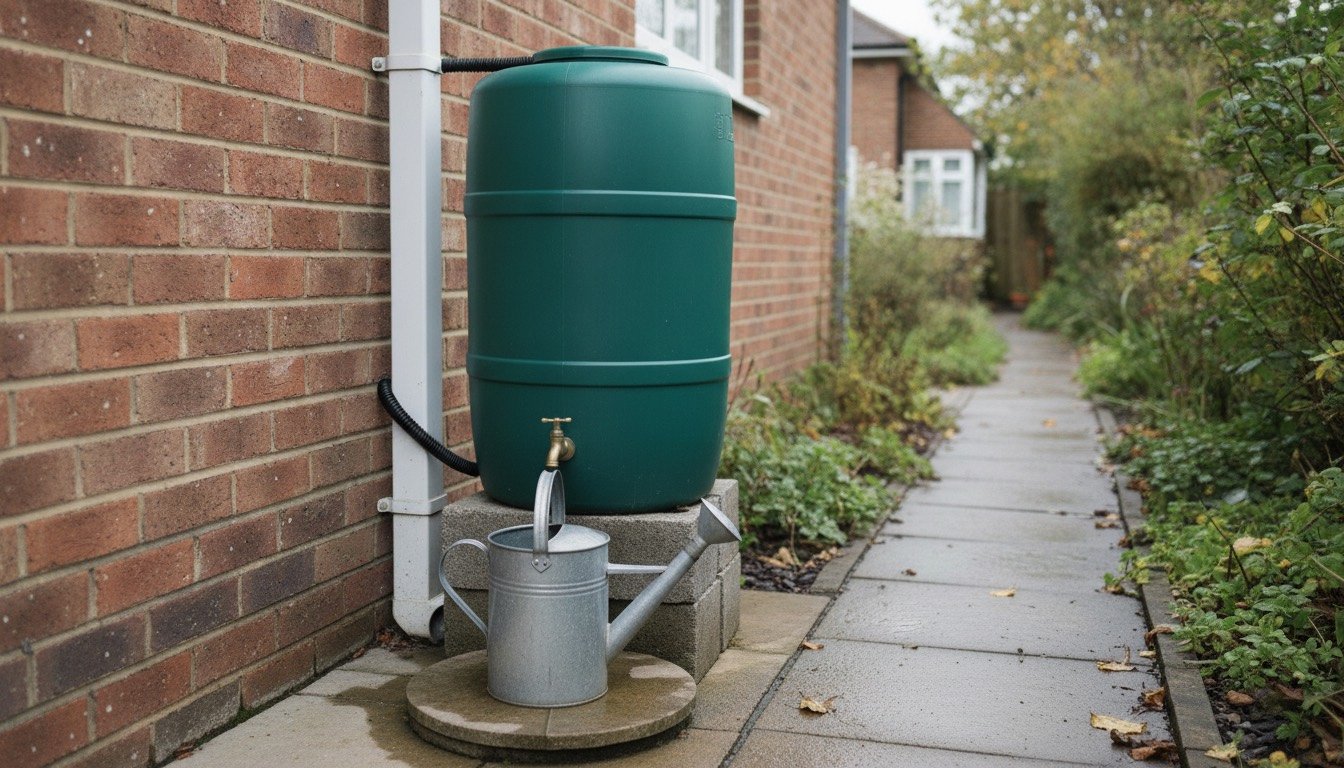
Most of the rain leaving a British roof is perfectly good garden water heading into a combined sewer. A 60 m² roof plane in the South East catches roughly 30,000 litres a year, and about 4 mm of rain fills a 210-litre butt from it. Capturing some of that is a Saturday-morning job with a hacksaw and a hole saw.
What trips people up is the bit either side: siting a container that weighs a fifth of a tonne when full, and the point where harvested rainwater stops being a garden nicety and becomes a plumbing installation your water company needs to know about.
Safety and the rules to check before you cut anything
Rainwater is non-potable. Never drink it, and keep it out of anything producing a fine aerosol — pressure washers, oscillating sprinklers — because stagnant tank water can carry legionella. Watering cans, soaker hoses and drip lines are fine.
A full 210-litre butt weighs about 215 kg. That needs a level, solid base: a 450 mm paving slab bedded on compacted sharp sand or MOT type 1, not lawn and not decking of unknown span. Lids must clip or lock shut — an open butt is a drowning hazard for a toddler and a mosquito nursery by July.
A butt fed by gravity from a gutter is unregulated. Top a tank up from the mains, though, and you are into the Water Supply (Water Fittings) Regulations 1999 (Water Byelaws 2014 in Scotland). Rainwater is Fluid Category 5, the highest risk band, so the mains feed needs a Type AA or AB air gap and the work is notifiable to your supplier beforehand. Any pump on a fixed outdoor supply falls under Part P in England and Wales, so the circuit must be installed by a registered competent person or notified to building control. On a listed building, cutting a cast-iron downpipe needs consent — our guide to when you need a building permit covers those lines.
Tools and materials
Skill level: beginner. No ladder needed if you fit the diverter at chest height, which is where it belongs.
- •Water butt, 100–250 litres, opaque (translucent butts grow algae)
- •Rainwater diverter kit to suit your downpipe — 68 mm round or 65 mm square is standard UK uPVC
- •Butt stand, or blocks and a paving slab, giving 300–450 mm clearance under the tap
- •Junior hacksaw or fine-tooth pad saw, plus a file to deburr the cut
- •Cordless drill and 32 mm or 34 mm hole saw, if the butt is undrilled
- •Spirit level, tape measure, marker, PTFE tape, spare 3/4 in BSP washer
- •Leaf guard or gutter brush for the gutter mouth
Realistic time, cost and yield
Allow 45–90 minutes for a first butt, less for each one after. Budget £35–£90: diverter kits are £12–£20, a plain 210-litre butt with tap and lid £30–£55, and most UK water companies still sell subsidised butts through their own websites at £25–£40 delivered, usually the cheapest route.
For yield, multiply roof plan area in m² by annual rainfall in mm, then knock off 20% for splash and first-flush losses. A 40 m² rear roof plane in Kent (about 700 mm) yields roughly 22,000 litres a year; the same roof in Manchester (about 900 mm) yields 28,000. One butt stores only a fraction of that, which is why linked butts beat one big tank. For a full system, the rainwater harvesting cost guide has installed figures.
Step by step: butt to downpipe
- •1. Clear the gutter first — a butt fed by a blocked gutter fills with silt, so clean the gutters safely before you start.
- •2. Pick the downpipe serving the largest roof area, ideally on a shaded north or east wall.
- •3. Build the base. Bed the slab, check it level both ways, stack the stand or blocks, then check again. Ten minutes here prevents a toppled butt in year two.
- •4. Dry-position the butt and mark the downpipe at its inlet height minus about 25 mm, so the connecting hose falls towards the butt.
- •5. Cut the downpipe. Wrap tape round it as a saw guide, remove the section the diverter needs (usually 60–80 mm), then file both cut ends.
- •6. Push the diverter in, easing the upper pipe up and dropping it back over the spigot. Friction fit only — no sealant, no screws through the pipe.
- •7. Drill the butt if undrilled, using the hole saw at the marked inlet, and fit the connecting hose with the supplied grommets.
- •8. Fit the tap low on the butt, PTFE on the thread and a washer either side. Hand-tight plus a quarter turn; over-tightening cracks the moulding.
- •9. Test it: run a hose into the gutter for two minutes and watch the diverter, hose joint and tap. Fit the lid and child lock.
Scaling up: linked butts, IBCs and whole-house systems
Two or three butts linked at the base with a 32 mm connector kit behave as one vessel and cost far less than a bespoke tank. A food-grade 1,000-litre IBC is £80–£150 second-hand, but needs a proper slab, a shade cover and honest thought about a tonne of water near a fence.
Underground systems feeding WCs and washing machines are a different job: designed to BS 8515 and BS EN 16941-1, pipework permanently marked non-potable, no cross-connection to mains. Expect £2,500–£5,000 installed. Before going that far, the cheap wins are indoors — see how to reduce water use at home — and outdoors, feeding a butt into a drip irrigation system.
Troubleshooting
- •Barely fills after heavy rain: the diverter sits too high, the flap is in backwards, or the gutter is blocked. Check the gutter first — four times out of five that is it.
- •Water pooling at the base or soaking the wall: the connecting hose dips or kinks, so overflow cannot return down the pipe. Give it a continuous fall, or run a 25 mm overflow to a border or gulley — never against brickwork.
- •Green water or a pond smell: light is getting in and leaf litter with it. Use an opaque butt, keep the lid on, fit a leaf guard and rinse out each autumn.
- •Weak flow at the tap: gravity gives about 0.1 bar per metre, so raise the butt or fill cans rather than run a hose.
- •Winter splits: drain to a third full from December and leave the tap a quarter turn open.
When to stop and call a professional
Call a WRAS-approved plumber for any mains top-up, internal supply or connection near existing pipework — the backflow protection and the supplier notification are not optional, and a failed inspection can condemn the installation. Call a registered electrician for pump wiring or any fixed outdoor supply: notifiable under Part P, and it needs RCD protection and a certificate.
Get a roofer in if the downpipe or gutter is the real problem, because a leaking gutter undermines the whole exercise. And if you rent, ask your landlord in writing before cutting anything: a diverter is a permanent alteration, whereas a freestanding butt fed by a gutter-mouth rain saver keeps your deposit intact.
Found this useful?
There's plenty more — hundreds of guides and honestly-tested product reviews for every corner of your home.
Browse All Guides